Evangelical Christians are told that we need to place the highest value on a literal interpretation of the Bible. By that we are most often told to "take it at face value". If someone dares to question the face value of the passage in question, they are viewed as "denying the Word of God", a curse worse than death.
Many passages, however, cry out for a closer examination. There are two basic reasons for this. In some cases, the passage is hard to understand. The language used is odd, or the idea isn't clear. In other cases, the text is clearly understood, but there is as problem with taking a passage at face value. Sometimes it's just hard to accept. Sometimes it will plainly contradict another passage taken at face value. Since the Bible is the Word of God, and God cannot contradict Himself, we are at an impasse. How are we to understand apparently nonsensical statements?
When the Reformers cried, "Sola Scriptura!", they intended a literal reading of the Bible. However, by "literal" they didn't mean "at face value". They meant "as written". Sometimes these two terms are the same; sometimes they are not. When we read, for instance, that Cain slew Abel, we take it "at face value". Why? Because the text is written in historical narrative style, suggesting that if we are going to take it "as written", we are going to take it "at face value". Sometimes, these two terms are not synonymous. When Jesus said, "I am the door", we understand that He was speaking in metaphorical language. We don't take it "at face value". He's not a door with hinges and door knob. He is using one thing, a door, to illustrate something else, that He is the access point. So we take it "as written", not "at face value."
I am going to examine a few of these "hard sayings", statements in Scripture that bear a second glance. Since I believe what I believe, I'll also offer my own take on the passage in question. Feel free to discard my view. But please, don't simply ignore the situation. These passages need to be examined.
I'll do one quickly so you get the idea. It is commonly held that we are to "Abstain from all appearance of evil" (1 Thess. 5:22). We all nod and agree with that because, after all, that's what our Bibles say. But does it mean to avoid all appearance of evil, or does it mean something else? I ask because if you think it through, it makes no sense. We live in a diverse world. It is unlikely that anything that you can imagine would be viewed universally as "good" or "evil". We are commanded, as an example, to share the gospel. Many people consider that evil. You shouldn't be foisting your beliefs off on others; that's wrong. So we are in a dilemma. If we are to obey this command in Thessalonians, then we must ignore the command to share the gospel. What are we to do?
I would suggest a second look. The popular rendition that I quoted above comes from the King James. It probably worked just fine in the 1600's. But what does the original text say? The word for "appearance" is eidous. It literally means "form". Can "form" mean "appearance"? Absolutely. But, may I suggest that it doesn't fit well in this verse? The idea in this verse is not to avoid appearing evil, but to avoid evil in all its forms. That's why the same verse in the New American Standard Bible reads, "Abstain from every form of evil." Now that makes sense, doesn't violate logic, and doesn't require the dilemma of which command to obey.
As I said, feel free to discard my view, but please don't simply ignore the situation. These passages need to be examined. If we are to be diligent students as we are commanded, it will take, at times, a longer look at some hard sayings.
Tuesday, October 10, 2006


Monday, October 09, 2006
Religious Right
(You know, it seems as if an inordinate number of my posts are about what I don't understand instead of what I do understand. I wonder if that's its own commentary on me.)
I don't understand this term: "Religious Right". You'll hear it all the time from all sides. It is typically a pejorative term, intended as an insult, as a means of sounding an alarm. Despite its overwhelming mention in print and on TV, it seems that I don't really know what it is. Here's what I've gleaned.
The "religious right" are everywhere. They run the country. They are a dangerous crowd, trying to force religion on everyone. They appear to be almost exclusively Christian in religious persuasion, but may also include a small number of Jewish and Moslem "right wingers". They are extremely small-minded, apparently focusing on only two things: ending abortion and prohibiting "gay marriage". That can't be true, however, because neither of these were of primary importance in the last major election where they took over the world (or, at least, the U.S. government). They are extremely active politically, very hateful to anyone not of their kind, and promote vast conspiracies against those they don't like.
So I try to find out exactly what this "religious right" is. Apparently I'm one of them, or so I've been told, but I don't know why. I found a "Religious Right Test" online and took it. They said, "Not a member of the Religious Right. Our advanced scoring methods suggest you are Roman Catholic (probably lapsed) with progressive tendencies." Of course, it's rather odd because I am not Roman Catholic in the first place, let alone "lapsed", and I wouldn't say I have "progressive tendencies". That can't be right.
Google offers a few helpful definitions. "United States political faction that advocates social and political conservativism, school prayer, and federal aid for religious groups and schools" says Princeton's wordnet. Religioustolerance.org defines it as
Wikipedia has a nice little article on the topic, but opens with a warning that it might not be quite accurate. Here they tell me what I suspected -- the term, "religious right" almost exclusively references evangelical Christians, even though sometimes they have reached out to other religious groups that are sympathetic to their cause. Wikipedia provides more help when you link to the term "Christian right" (which they say is essentially the same thing). The "Christian right" exists in a variety of places, although they are limited to what is called "the anglosphere" - places related to Great Britian. Thus, the "Christian right" appears to only occur in five geographic locations: Australia, Canada, New Zealand, the UK, and the U.S. (I'm not entirely clear why.) They started in the 70's with the Moral Majority and are thus closely associated with Pat Robertson and Jerry Fallwell. The primary issues of the Christian right are:
*Issues about life, sexuality, and reproduction (abortion, gay marriage, family issues, divorce, euthanasia, death penalty issues, sex education, pornography, abstinence, etc.)
*Issues about the separation of Church and State (religion in schools, using the Bible for moral values, allowing funding of faith-based services by the government, homeschooling, introduction of Intelligent Design or Creationism to education with an accompanying depreciation of scientific method and critical thinking, opposition to pagan influences in schools, etc.)
*Opposition to judicial activism as it affects these issues.
*Strong support for President Bush as a man chosen by God to lead America (or whomever is in charge of the country they're in if he's conservative).
*Support for Middle East policy (support for the war in Iraq and for Israel).
I'm sorry, but I'm still not getting it. I suppose that some of these things are issues with me and some are not. I suppose that some of these things I agree on and some I don't. But what is most disturbing is the pejorative nature of the term. It's like "Arminian". No one claims to be "Arminian". I know of no one who claims to be a "right wing Christian". (That doesn't mean they're not out there; I just don't know any of them.) It's almost exclusively a term from their opponents meant to denigrate them. It is typically spit out, like "What kind of loon is on the 'religious right'?" They have no thought, no ideas, no "critical thinking", no rationale. They are intolerant and unkind. Since I know no one of that nature, I suppose I still don't know what the "religious right" is or if I'm part of it. But it sure seems a lot like what is being complained about of them is equally a problem to their opponents, so I'm just unclear all the way around.
I don't understand this term: "Religious Right". You'll hear it all the time from all sides. It is typically a pejorative term, intended as an insult, as a means of sounding an alarm. Despite its overwhelming mention in print and on TV, it seems that I don't really know what it is. Here's what I've gleaned.
The "religious right" are everywhere. They run the country. They are a dangerous crowd, trying to force religion on everyone. They appear to be almost exclusively Christian in religious persuasion, but may also include a small number of Jewish and Moslem "right wingers". They are extremely small-minded, apparently focusing on only two things: ending abortion and prohibiting "gay marriage". That can't be true, however, because neither of these were of primary importance in the last major election where they took over the world (or, at least, the U.S. government). They are extremely active politically, very hateful to anyone not of their kind, and promote vast conspiracies against those they don't like.
So I try to find out exactly what this "religious right" is. Apparently I'm one of them, or so I've been told, but I don't know why. I found a "Religious Right Test" online and took it. They said, "Not a member of the Religious Right. Our advanced scoring methods suggest you are Roman Catholic (probably lapsed) with progressive tendencies." Of course, it's rather odd because I am not Roman Catholic in the first place, let alone "lapsed", and I wouldn't say I have "progressive tendencies". That can't be right.
Google offers a few helpful definitions. "United States political faction that advocates social and political conservativism, school prayer, and federal aid for religious groups and schools" says Princeton's wordnet. Religioustolerance.org defines it as
A group of very conservative, politically active organizations within Fundamentalist Christianity which is attempting to implement conservative changes to society and its laws. The American Family Association, Christian Coalition, Concerned Women for America, Family Research Council, Focus on the Family form part of the religious right. Their main areas of activity are in reducing choice in abortion access, homosexual rights, same-sex marriage, physician assisted suicide, and prayer in the public school.That's a little more helpful, except now we have to find out what "Funtamentalist Christianity" is and then ask, "Why do these two definitions differ so much?" And, of course, how am I to figure it if I'm not part of any of the organizations listed? (Note, by the way: Isn't it interesting how this definition views the "pro-life" stance as "reducing choice" rather than "defending life"?) So I'm still stumped.
Wikipedia has a nice little article on the topic, but opens with a warning that it might not be quite accurate. Here they tell me what I suspected -- the term, "religious right" almost exclusively references evangelical Christians, even though sometimes they have reached out to other religious groups that are sympathetic to their cause. Wikipedia provides more help when you link to the term "Christian right" (which they say is essentially the same thing). The "Christian right" exists in a variety of places, although they are limited to what is called "the anglosphere" - places related to Great Britian. Thus, the "Christian right" appears to only occur in five geographic locations: Australia, Canada, New Zealand, the UK, and the U.S. (I'm not entirely clear why.) They started in the 70's with the Moral Majority and are thus closely associated with Pat Robertson and Jerry Fallwell. The primary issues of the Christian right are:
*Issues about life, sexuality, and reproduction (abortion, gay marriage, family issues, divorce, euthanasia, death penalty issues, sex education, pornography, abstinence, etc.)
*Issues about the separation of Church and State (religion in schools, using the Bible for moral values, allowing funding of faith-based services by the government, homeschooling, introduction of Intelligent Design or Creationism to education with an accompanying depreciation of scientific method and critical thinking, opposition to pagan influences in schools, etc.)
*Opposition to judicial activism as it affects these issues.
*Strong support for President Bush as a man chosen by God to lead America (or whomever is in charge of the country they're in if he's conservative).
*Support for Middle East policy (support for the war in Iraq and for Israel).
I'm sorry, but I'm still not getting it. I suppose that some of these things are issues with me and some are not. I suppose that some of these things I agree on and some I don't. But what is most disturbing is the pejorative nature of the term. It's like "Arminian". No one claims to be "Arminian". I know of no one who claims to be a "right wing Christian". (That doesn't mean they're not out there; I just don't know any of them.) It's almost exclusively a term from their opponents meant to denigrate them. It is typically spit out, like "What kind of loon is on the 'religious right'?" They have no thought, no ideas, no "critical thinking", no rationale. They are intolerant and unkind. Since I know no one of that nature, I suppose I still don't know what the "religious right" is or if I'm part of it. But it sure seems a lot like what is being complained about of them is equally a problem to their opponents, so I'm just unclear all the way around.
Sunday, October 08, 2006
Being Right
Paul of Paul's Ponderings suggests we are asking the wrong questions. He suggests that we are being too concerned with being right and not concerned with the people with whom we are speaking. He asks, "Do you want to be right or do you want to plant and water the seed of the gospel in the hearts of people?" Von, of Von's Takes argues that Christians need to be right because they are commanded to be.
This question of "being right" isn't new. It's often hotly debated among Christians. (Isn't that ironic? The question of whether or not Christians need to be right is hotly debated ... odd. Odd because it shouldn't be a question. Odd because those who would argue "no" are ... arguing. Odd.) But, as Von has pointed out, in our world the idea that someone would claim to be right is offensive because no one should believe that there is revealed truth. Indeed, among Americans, 75% say they believe there is no absolute truth. This statistic lies starkly against the very same number that say they are Christians. Now, isn't that contradictory? "I believe in Jesus ... although there is no real truth."
There needs to be something else here. There needs to be a right position that is concerned about its listeners. Many complain about the infighting among Christians about doctrine, for instance. "Doctrine divides," they say. Well, sure it does. That's the point. Doctrine says, "This is right and if you are outside of this, you are wrong." Even those who say, "We shouldn't argue about doctrine" are making a doctrinal statement: "We shouldn't argue about doctrine, and those who do are wrong." Every single truth claim we make divides. You either agree ... or disagree. It is the nature of truth claims. It is not a problem with truth or a problem of defending the truth. We are commanded to be "ready to make a defense to anyone who asks" (1 Peter 3:15). The problem is in ignoring the rest of the story. We are to speak the truth ... "in love" (Eph. 4:15). We are to be ready to make a defense to anyone who asks ... "with gentleness and reverence" (1 Peter 3:15). We are to select words that "give grace to those who hear" (Eph. 4:29).
We cannot -- we must not abandon the defense of the truth. Indeed, part of the defense of the truth is the very quest for it. None of us has arrived. I've found many times that in discussing my views with those who disagree, I am forced to change my views. That's a good thing. We cannot abandon the defense of the truth, especially among ourselves. The necessity is not in abandoning the dialogue. The necessity is love, gentleness, edification. If we would take into account the audience with whom we are communicating and put their well-being first and foremost in our intentions, would we withhold the truth from them, or would we simply be careful to put it in ways that they might be best able to get it?
Being right isn't a bad thing. Abdicating truth for peace is. The two are not mutually exclusive. It is possible to present the truth in love. It is not always possible to be at peace with all men, but it is possible to monitor myself to be as concerned for those around me as I am for the truth. Indeed, it isn't merely possible; it is required.
This question of "being right" isn't new. It's often hotly debated among Christians. (Isn't that ironic? The question of whether or not Christians need to be right is hotly debated ... odd. Odd because it shouldn't be a question. Odd because those who would argue "no" are ... arguing. Odd.) But, as Von has pointed out, in our world the idea that someone would claim to be right is offensive because no one should believe that there is revealed truth. Indeed, among Americans, 75% say they believe there is no absolute truth. This statistic lies starkly against the very same number that say they are Christians. Now, isn't that contradictory? "I believe in Jesus ... although there is no real truth."
There needs to be something else here. There needs to be a right position that is concerned about its listeners. Many complain about the infighting among Christians about doctrine, for instance. "Doctrine divides," they say. Well, sure it does. That's the point. Doctrine says, "This is right and if you are outside of this, you are wrong." Even those who say, "We shouldn't argue about doctrine" are making a doctrinal statement: "We shouldn't argue about doctrine, and those who do are wrong." Every single truth claim we make divides. You either agree ... or disagree. It is the nature of truth claims. It is not a problem with truth or a problem of defending the truth. We are commanded to be "ready to make a defense to anyone who asks" (1 Peter 3:15). The problem is in ignoring the rest of the story. We are to speak the truth ... "in love" (Eph. 4:15). We are to be ready to make a defense to anyone who asks ... "with gentleness and reverence" (1 Peter 3:15). We are to select words that "give grace to those who hear" (Eph. 4:29).
We cannot -- we must not abandon the defense of the truth. Indeed, part of the defense of the truth is the very quest for it. None of us has arrived. I've found many times that in discussing my views with those who disagree, I am forced to change my views. That's a good thing. We cannot abandon the defense of the truth, especially among ourselves. The necessity is not in abandoning the dialogue. The necessity is love, gentleness, edification. If we would take into account the audience with whom we are communicating and put their well-being first and foremost in our intentions, would we withhold the truth from them, or would we simply be careful to put it in ways that they might be best able to get it?
Being right isn't a bad thing. Abdicating truth for peace is. The two are not mutually exclusive. It is possible to present the truth in love. It is not always possible to be at peace with all men, but it is possible to monitor myself to be as concerned for those around me as I am for the truth. Indeed, it isn't merely possible; it is required.
Saturday, October 07, 2006
A Higher Standard?
Unless you've been under a rock for the past month or so, you already know that Congressman Mark Foley has resigned from office after it was made public that he had had inappropriate communication with congressional pages. Irrefutable evidence showed that he had propositioned them for sex, it seems, and the hits keep coming. Speaker of the House Dennis Hastert has said, "The buck stops here" but hasn't resigned, although there is a call from Democrats and Republicans alike for him to do so because he failed to do anything about Foley earlier.
Have you noticed, however, that it seems as if the Republicans are being held to a different standard than the Democrats? Former President Clinton committed adultery in the White House, but the problem wasn't the president -- it was the vast right-wing conspiracy that pointed it out. Should the president resign? No, of course not! It's only sex. The Speaker of the House, on the other hand, ought to step down for ignorance. In the Chappaquiddick incident, Senator Ted Kennedy drove drunk with a woman not his wife and ended up killing her. He received criticism for drunk driving, failing to save MaryJo Kopechne, and for contacting his lawyer before getting help. Did Senator Kennedy resign? Of course not. But the Democrats are outraged because the Republicans knew that Foley was "gay and indiscreet". (I couldn't believe it when I heard that accusation on the news.)
Should Foley have resigned? I think so. I think prison is likely and rightly in his future. Should Hastert resign? It is purely my opinion here, but I think it would likely be a good idea. I'm not offering any defense here of the current events and players. My question is regarding this apparent higher standard to which Republicans are held.
It seems as if a hint of impropriety will result in a Republican scandal, while Democrats actually get the sex and no one cares. And maybe it's not unexpected. After all, many Republicans run and win on a moral ticket. Democrats don't. Remember, it was they who argued "Character doesn't count." Apparently it doesn't count for Democrats, but it's essential for Republicans.
Since I believe that character does count, I'm repeating this. I'm not defending the Republicans. I'm not suggesting that we should give Republicans a pass on immoral behavior because Democrats do it all the time. I'm simply pointing out that those of us who call for higher morality will be held to a higher moral standard. Be prepared. Avoid evil in all its forms. It's a good approach to take.
Have you noticed, however, that it seems as if the Republicans are being held to a different standard than the Democrats? Former President Clinton committed adultery in the White House, but the problem wasn't the president -- it was the vast right-wing conspiracy that pointed it out. Should the president resign? No, of course not! It's only sex. The Speaker of the House, on the other hand, ought to step down for ignorance. In the Chappaquiddick incident, Senator Ted Kennedy drove drunk with a woman not his wife and ended up killing her. He received criticism for drunk driving, failing to save MaryJo Kopechne, and for contacting his lawyer before getting help. Did Senator Kennedy resign? Of course not. But the Democrats are outraged because the Republicans knew that Foley was "gay and indiscreet". (I couldn't believe it when I heard that accusation on the news.)
Should Foley have resigned? I think so. I think prison is likely and rightly in his future. Should Hastert resign? It is purely my opinion here, but I think it would likely be a good idea. I'm not offering any defense here of the current events and players. My question is regarding this apparent higher standard to which Republicans are held.
It seems as if a hint of impropriety will result in a Republican scandal, while Democrats actually get the sex and no one cares. And maybe it's not unexpected. After all, many Republicans run and win on a moral ticket. Democrats don't. Remember, it was they who argued "Character doesn't count." Apparently it doesn't count for Democrats, but it's essential for Republicans.
Since I believe that character does count, I'm repeating this. I'm not defending the Republicans. I'm not suggesting that we should give Republicans a pass on immoral behavior because Democrats do it all the time. I'm simply pointing out that those of us who call for higher morality will be held to a higher moral standard. Be prepared. Avoid evil in all its forms. It's a good approach to take.
Friday, October 06, 2006
What Does That Look Like?
One of Jesus's great concerns was unity among believers. In His great High Priestly prayer of John 17, He prayed, "I do not ask in behalf of these alone, but for those also who believe in Me through their word; that they may all be one; even as Thou, Father, art in Me, and I in Thee, that they also may be in Us; that the world may believe that Thou didst send Me" (John 17:20-21). Paul expresses a similar concern. Indeed, it seems that one of the primary reasons for his letter to the church at Philippi was a call for unity. In Phil. 1:27, he says, "Conduct yourselves in a manner worthy of the gospel of Christ; so that whether I come and see you or remain absent, I may hear of you that you are standing firm in one spirit, with one mind striving together for the faith of the gospel." Soon after he says, "If therefore there is any encouragement in Christ, if there is any consolation of love, if there is any fellowship of the Spirit, if any affection and compassion, make my joy complete by being of the same mind, maintaining the same love, united in spirit, intent on one purpose" (Phil. 2:1-2).
There is much more in Scripture on the topic of unity, but I'm wondering ... what does that look like? What was the intent here? Paul writes in 1 Cor. 12 that the Body of Christ operates as a body. That is, not everyone is the same, and not everyone has the same function. Thus, I would conclude that "unity" doesn't mean "sameness". But the concept of "of the same mind" is repeated. So maybe the idea is "sameness", at least in thought. I'm not sure.
The reason I'm not sure is because when I look at Christianity as a whole, I don't see "of the same mind". We are bombarded on all sides by differing views. Wikipedia, for instance, has a partial list of some 300 Christian denominations. While most share a basic set of doctrine upon which they agree, there are thousands of differences as well. Seventy-five percent of Americans call themselves "Christians", but their beliefs are as divergent as their numbers. And, of course, these divisions didn't start in America. They didn't even start at the Reformation. They date all the way back to the first days of Christianity, when Paul complained about the Corinthian church. "Each one of you is saying, 'I am of Paul,' and 'I of Apollos,' and 'I of Cephas,' and 'I of Christ.' Has Christ been divided?" (1 Cor 1:12-13). So it would seem that division has existed from the beginning.
So ... again I wonder, what does unity look like? Stroll through the blogs, and you'll find a wide division of viewpoints on a large number of topics. What would it look like if we were "of the same mind"? Look at the infighting that we all experience. What would it look like if we were one? I honestly don't know. I wonder if anyone does.
There is much more in Scripture on the topic of unity, but I'm wondering ... what does that look like? What was the intent here? Paul writes in 1 Cor. 12 that the Body of Christ operates as a body. That is, not everyone is the same, and not everyone has the same function. Thus, I would conclude that "unity" doesn't mean "sameness". But the concept of "of the same mind" is repeated. So maybe the idea is "sameness", at least in thought. I'm not sure.
The reason I'm not sure is because when I look at Christianity as a whole, I don't see "of the same mind". We are bombarded on all sides by differing views. Wikipedia, for instance, has a partial list of some 300 Christian denominations. While most share a basic set of doctrine upon which they agree, there are thousands of differences as well. Seventy-five percent of Americans call themselves "Christians", but their beliefs are as divergent as their numbers. And, of course, these divisions didn't start in America. They didn't even start at the Reformation. They date all the way back to the first days of Christianity, when Paul complained about the Corinthian church. "Each one of you is saying, 'I am of Paul,' and 'I of Apollos,' and 'I of Cephas,' and 'I of Christ.' Has Christ been divided?" (1 Cor 1:12-13). So it would seem that division has existed from the beginning.
So ... again I wonder, what does unity look like? Stroll through the blogs, and you'll find a wide division of viewpoints on a large number of topics. What would it look like if we were "of the same mind"? Look at the infighting that we all experience. What would it look like if we were one? I honestly don't know. I wonder if anyone does.
Thursday, October 05, 2006
Facing the Giants
Okay, this never, ever, ever happens. I got an email from my mother recommending a movie. You have to understand. My parents don't watch movies. Perhaps they take in one or two a year ... maximum ... including rentals. So when I got an email from my mother recommending this movie (to an all-inclusive list of folks in the header), I had to take a look.
 The movie title is Facing the Giants. This is the plot summary:
Oh, and here's the kicker. This movie is rated PG ... for religious content! I kid you not. Violence, language, sexual situations, sure, they can threaten young children's fragile minds, but certainly not any more than talking about God.
The movie title is Facing the Giants. This is the plot summary:From the award winning producers of Flywheel, comes an action-packed drama about a Christian high school football coach who uses his undying faith to battle the giants of fear and failure. In six years of coaching, Grant Taylor has never led his Shiloh Eagles to a winning season. After learning that he and his wife Brooke face infertility, Grant discovers that a group of fathers are secretly organizing to have him dismissed as head coach. Devastated by his circumstances, he cries out to God in desperation. When Grant receives a message from an unexpected visitor, he searches for a stronger purpose for his football team. He dares to challenge his players to believe God for the impossible on and off the field. When faced with unbelievable odds, the Eagles must step up to their greatest test of strength and courage. What transpires is a dynamic story of the fight between faith and fear. Facing the Giants is a powerful experience for the whole family inspiring viewers to live with faith, hope, and love!This is clearly not your every day Hollywood fare. I understand it isn't in the theaters for long, so if you want to get something that actually might be beneficial to watch, I suggest you get there fast.
Oh, and here's the kicker. This movie is rated PG ... for religious content! I kid you not. Violence, language, sexual situations, sure, they can threaten young children's fragile minds, but certainly not any more than talking about God.
"Free Speech"
CBS Evening News airs a segment they call "Free Speech" in which someone makes comments on a current event or issue. A few nights ago the segment was given by Brian Rohrbough, a father of one of the young victims of the Columbine massacre. Mr. Rohrbough made some startling statements. He attributed the killings in schools over the last week or so to the godlessness of America. He said, "This country is in a moral free-fall. For over two generations, the public school system has taught in a moral vacuum, expelling God from the school and from the government, replacing Him with evolution, where the strong kill the weak, without moral consequences and life has no inherent value."
There is a furor, as one might anticipate, over Mr. Rohrbough's statements. Blaming the murders of school children on America's removal of God in school has people up in arms. More to the point, people aren't merely disagreeing -- they're angry at CBS. "The news organization should never have allowed such a thing to be broadcast. I'm never watching CBS again!!"
Christians are too often long on rhetoric and short on reason, but they're not alone. It appears that a large number of outspoken Americans believe that it's acceptable for people to make public comments with which they agree, but not acceptable to release those with which they disagree. The Christian public is known for this odd approach, but the non-Christian public is equally guilty. Woefully few responses say, "I disagree with him, but he has the right to speak." Instead we see primarily either, "I agree with him, so good for you for putting him on" or "I disagree with him, so shame on you for putting him on."
We Christians should learn from this duplicity. While non-Christians clamor for "free speech" yet complain when they don't like the speech they hear, we are equally upset by people who say things in public against what we believe. We need to make up our minds. Do we want the freedom to say what we believe? Then we need to allow the freedom of others to do the same and deal with it rather than trying to suppress it. They want it both ways. We can't have it both ways. Make up your mind.
There is a furor, as one might anticipate, over Mr. Rohrbough's statements. Blaming the murders of school children on America's removal of God in school has people up in arms. More to the point, people aren't merely disagreeing -- they're angry at CBS. "The news organization should never have allowed such a thing to be broadcast. I'm never watching CBS again!!"
Christians are too often long on rhetoric and short on reason, but they're not alone. It appears that a large number of outspoken Americans believe that it's acceptable for people to make public comments with which they agree, but not acceptable to release those with which they disagree. The Christian public is known for this odd approach, but the non-Christian public is equally guilty. Woefully few responses say, "I disagree with him, but he has the right to speak." Instead we see primarily either, "I agree with him, so good for you for putting him on" or "I disagree with him, so shame on you for putting him on."
We Christians should learn from this duplicity. While non-Christians clamor for "free speech" yet complain when they don't like the speech they hear, we are equally upset by people who say things in public against what we believe. We need to make up our minds. Do we want the freedom to say what we believe? Then we need to allow the freedom of others to do the same and deal with it rather than trying to suppress it. They want it both ways. We can't have it both ways. Make up your mind.
Wednesday, October 04, 2006
Choice and Foreknowledge
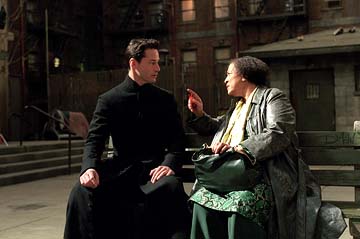 In The Matrix Reloaded, the Oracle offers Neo a candy. He asks if she already knows what he will choose and she says she does. Neo asks the Oracle, "But if you already know, how can I make a choice?"
 Welcome to my world. This is perhaps the biggest single objection I hear from Christians and non-Christians alike. If God is omniscient, if God has perfect foreknowledge, if He already knows what choices we will make and we cannot make any other choices (or He'd be wrong), then in what possible sense do we have free will?
Apparently there is a debate that has gone on for over two millenia about the definition of "free will" and whether or not we have it. They can't even agree on what it means. So I'm going to have to lay down my own definition for this discussion. The simplest definition I can find of "free will" is "The ability to make choices that are unconstrained by external circumstances or agencies." Some people will argue that for "free will" to be free, it has to be unconstrained by internal circumstances or agencies as well. This is nonsensical. People always choose according to their strongest desire at the moment. Without internal influence, no choice can be made, or at best it is purely random. And the reason this is important is that one of the fundamental ideas behind "free will" is moral responsibility. If we do not have the capacity to make choices unconstrained by externals, then we cannot be held responsible for our moral choices ... since they don't exist.
Now, Christians seem to believe almost as a whole in the idea that Man has "free will", primarily for the reason I just gave. However, the biblical support for the existence of "free will" is less obvious. I suppose the best proof we can find is in the several places that the Bible says, "Choose." This implies "free will", even if it isn't explicit. But for some reason most of Christendom also believes that God cannot or will not ever under any circumstances violate the freedom of the human will. I don't know the basis of this belief, and I don't believe it myself.
My question here is about the concept that perfect foreknowledge eliminates free will. Why must that be true? Let's take a human example. Mom takes a plate of cookies and a plate of cauliflower to Johnny's room and says, "Which one do you want?" What will Johnny choose? Of course Johnny will choose the cookies. And since you all know that, Johnny has no choice, right? Well, of course not. Johnny made an uncoerced choice, even if it was fully predictable. From Mom's perspective, there was no chance that Johnny would choose anything but the cookies, but from Johnny's perspective he had the choice between two options and chose the cookies. Johnny's choice was free from external constraints; he made it from his own preferences. It was, therefore, "free will" even if it was "foreknown".
So why is it that so many think that if God knows all things perfectly, there is some sort of loss of free will in our choices? Just because He knows what the choice will be (His perspective) doesn't require that there was any coercion or external constraints. The person made the choice without being forced, and that's "free will". God knew what that choice would be and that's "foreknowledge". And the two don't conflict. I don't understand why people think they must.
Tuesday, October 03, 2006
The Trouble with Calvinism
When I was growing up, I thought myself a "Calvinist" because I believed that, once saved, you couldn't lose your salvation. I knew those "Arminians" believed you could, so I was obviously a Calvinist. Imagine my surprise when I learned that I was a "1-pointer", in terms of Calvinist beliefs, and a "4-point Arminian".
Since then, Scripture and reason that I couldn't escape has edged me into a corner. I'm forced now, based on what I see in the Bible, to be identified by my beliefs as "a Calvinist". I don't like the term because it seems to say I'm a follower of Calvin, while the truth is I'm a follower of Scripture, but there it is. If a "Calvinist" is defined as believing what I believe, then I'm one.
So what's the big objection? I've read quite about in the debate between Calvinists and ... not. (Very few who are aligned with the Arminian perspective will call themselves or be called "Arminians".) They generally rehash the same thing over and over. And I think I've boiled it down to a very fine point. So this is what I see is the general perception of what's wrong with Calvinism.
Calvinists place an undue emphasis on the Sovereignty of God. Most Christians will write the "sovereignty of God", but Calvinists prefer to capitalize it -- the "Sovereignty of God" -- because it's so important. In this extremist position, they hold that God is absolutely sovereign. Humans are never sovereign. They only appear to be at times. A human "sovereign" never really exercises "supreme authority". But to the Calvinist, God is truly Sovereign -- the Supreme Authority.
The rational next step of this belief is that humans don't decide who gets saved -- the Supreme Authority does. Calvinists view this as a magnification of the character of God and a magnification of the nature of grace. So much is grace magnified in their view, that they refer to their doctrines as "the doctrines of grace". You see, if "grace" is defined as "unmerited favor", and God alone decides who will be saved outside of human choice, then it is an extreme view of "unmerited favor" -- grace.
So Calvinism has its impact on God's character (Sovereignty), grace, and on Man's character. Calvinism claims that natural Man is dead in sin. Not only is he "sin sick"; he's actually dead, spiritually ("Total Depravity"). This renders him incapable of responding to God ... since he's dead. Being incapable of responding to God, there is nothing in him that would endear him to God, so the basis of God's choice is not Man, but ... God ("Unconditional Election"). So God, for His own purposes and of His own free choice, has done what was necessary to save those whom He has chosen to save ("Limited Atonement") and then, when He so chooses, irrevocably brings the chosen to spiritual life (Irresistible Calling). This new life produces a change in the chosen that causes them to work toward personal holiness because God is at work in them (Perseverance of the Saints). In other words, God is magnified to the utmost Sovereignty, and Man is diminished to the smallest.
Look at the arguments. I think this is what you'll generally see. Those who disagree with Calvinist doctrines do so primarily on two points. 1) It makes God out to be the utmost. 2) It diminishes Man to be the least. They complain that it makes God "unfair" (As my dear mother taught me time and time again, "Who ever told you life was fair?"). They complain that it diminishes Man's abilities. Surely the Bible doesn't teach that God is absolutely Sovereign and Man is not ... does it?
Since then, Scripture and reason that I couldn't escape has edged me into a corner. I'm forced now, based on what I see in the Bible, to be identified by my beliefs as "a Calvinist". I don't like the term because it seems to say I'm a follower of Calvin, while the truth is I'm a follower of Scripture, but there it is. If a "Calvinist" is defined as believing what I believe, then I'm one.
So what's the big objection? I've read quite about in the debate between Calvinists and ... not. (Very few who are aligned with the Arminian perspective will call themselves or be called "Arminians".) They generally rehash the same thing over and over. And I think I've boiled it down to a very fine point. So this is what I see is the general perception of what's wrong with Calvinism.
Calvinists place an undue emphasis on the Sovereignty of God. Most Christians will write the "sovereignty of God", but Calvinists prefer to capitalize it -- the "Sovereignty of God" -- because it's so important. In this extremist position, they hold that God is absolutely sovereign. Humans are never sovereign. They only appear to be at times. A human "sovereign" never really exercises "supreme authority". But to the Calvinist, God is truly Sovereign -- the Supreme Authority.
The rational next step of this belief is that humans don't decide who gets saved -- the Supreme Authority does. Calvinists view this as a magnification of the character of God and a magnification of the nature of grace. So much is grace magnified in their view, that they refer to their doctrines as "the doctrines of grace". You see, if "grace" is defined as "unmerited favor", and God alone decides who will be saved outside of human choice, then it is an extreme view of "unmerited favor" -- grace.
So Calvinism has its impact on God's character (Sovereignty), grace, and on Man's character. Calvinism claims that natural Man is dead in sin. Not only is he "sin sick"; he's actually dead, spiritually ("Total Depravity"). This renders him incapable of responding to God ... since he's dead. Being incapable of responding to God, there is nothing in him that would endear him to God, so the basis of God's choice is not Man, but ... God ("Unconditional Election"). So God, for His own purposes and of His own free choice, has done what was necessary to save those whom He has chosen to save ("Limited Atonement") and then, when He so chooses, irrevocably brings the chosen to spiritual life (Irresistible Calling). This new life produces a change in the chosen that causes them to work toward personal holiness because God is at work in them (Perseverance of the Saints). In other words, God is magnified to the utmost Sovereignty, and Man is diminished to the smallest.
Look at the arguments. I think this is what you'll generally see. Those who disagree with Calvinist doctrines do so primarily on two points. 1) It makes God out to be the utmost. 2) It diminishes Man to be the least. They complain that it makes God "unfair" (As my dear mother taught me time and time again, "Who ever told you life was fair?"). They complain that it diminishes Man's abilities. Surely the Bible doesn't teach that God is absolutely Sovereign and Man is not ... does it?
Monday, October 02, 2006
Poor Communication
It would seem that more than one person has misunderstood what I wrote regarding the biblical requirements of Christians toward the poor. While I would like to think that I'm an able communicator and that this is possibly because I'm perceived as a "right wing Republican", I have to be honest and admit that it could simply be that I didn't express myself well. This one accused me of copping out. A pastor responded to tell me how wrong I was. It's a good idea, then, that I clear up some misunderstandings.
A couple things I said made people think that I was against working against poverty. I said, "Some well-meaning Christians believe that it is our duty to work at stamping out poverty in the world. I think it's a nice idea ... but impractical. And if the task is impractical and impossible, is it really our job to pursue it?" By that I did not mean "Don't work against poverty." I meant, "Understand that the poor you will always have with you. Understand that working against poverty is done by meeting the needs of people, because poverty itself will never end." Yeah, I think it's pretty clear that what I meant wasn't well expressed by what I said.
I said, "Notice that nothing is said about 'food banks', taking care of people we don't know, fighting poverty, or any such thing. All of the commands in Scripture for Christians to take care of the poor are for Christians to take care of the poor with whom they come in contact, not the poor 'in general'." That was perceived as me saying that I'm against these things. It's an obvious conclusion from what I said, but it's not what I meant. And since it was so broadly misunderstood, I think it's important that I state it more clearly.
Here's what I was trying to get across in that post. Some Christians are led to work against poverty in general. Those who are ... must. It's a command from God to them, an individual calling, a requirement. And they should be passionate about it and work hard at it. And it's a good thing. The problem I was addressing was not fighting poverty, but the command of Scripture to all believers that they meet the needs of the poor with whom they come in contact. I wasn't looking for a "way out", an escape, an "I don't have to deal with the poor". I was trying to say that Christians are not doing what we are specifically commanded.
We are not, each and every one, specifically commanded to fight world poverty. It's a fine and noble calling for those who have it. But we don't all have that calling. We do, however, all have the command to care for those with whom we have contact. And, listen folks, we all have contact with needy people. I wasn't calling for a step-down; I was asking Christians to stand up. Maybe you are called to work in large ways against poverty. Maybe. But you are certainly commanded to work in your little corner of the world against poverty. We have (as I said in the post) failed at this, at least in the American Church.
Maybe you're not called to work in an organization that will meet the needs of the hungry people you will never know or see. Fine. You are commanded to reach out to those in your community, your circle of influence. We dare not neglect that command.
I hope that clears up some of the misunderstanding. Ah, well, hope springs eternal.
A couple things I said made people think that I was against working against poverty. I said, "Some well-meaning Christians believe that it is our duty to work at stamping out poverty in the world. I think it's a nice idea ... but impractical. And if the task is impractical and impossible, is it really our job to pursue it?" By that I did not mean "Don't work against poverty." I meant, "Understand that the poor you will always have with you. Understand that working against poverty is done by meeting the needs of people, because poverty itself will never end." Yeah, I think it's pretty clear that what I meant wasn't well expressed by what I said.
I said, "Notice that nothing is said about 'food banks', taking care of people we don't know, fighting poverty, or any such thing. All of the commands in Scripture for Christians to take care of the poor are for Christians to take care of the poor with whom they come in contact, not the poor 'in general'." That was perceived as me saying that I'm against these things. It's an obvious conclusion from what I said, but it's not what I meant. And since it was so broadly misunderstood, I think it's important that I state it more clearly.
Here's what I was trying to get across in that post. Some Christians are led to work against poverty in general. Those who are ... must. It's a command from God to them, an individual calling, a requirement. And they should be passionate about it and work hard at it. And it's a good thing. The problem I was addressing was not fighting poverty, but the command of Scripture to all believers that they meet the needs of the poor with whom they come in contact. I wasn't looking for a "way out", an escape, an "I don't have to deal with the poor". I was trying to say that Christians are not doing what we are specifically commanded.
We are not, each and every one, specifically commanded to fight world poverty. It's a fine and noble calling for those who have it. But we don't all have that calling. We do, however, all have the command to care for those with whom we have contact. And, listen folks, we all have contact with needy people. I wasn't calling for a step-down; I was asking Christians to stand up. Maybe you are called to work in large ways against poverty. Maybe. But you are certainly commanded to work in your little corner of the world against poverty. We have (as I said in the post) failed at this, at least in the American Church.
Maybe you're not called to work in an organization that will meet the needs of the hungry people you will never know or see. Fine. You are commanded to reach out to those in your community, your circle of influence. We dare not neglect that command.
I hope that clears up some of the misunderstanding. Ah, well, hope springs eternal.
Sunday, October 01, 2006
From All Sides
I don't suppose it was too surprising to hear from Venezuela's President Chavez that his theory was that the 9/11 tragedy was a conspiracy brought about by President Bush. I mean, we all know that the president of Venezuela isn't ... generous in his view of our president. Too bad it's not limited to the obvious.
You may not have heard of David Ray Griffin. Dr. Griffin is a retired professor of theology and philosophy of religion. Dr. Griffin is gathering a name for himself. According to the Washington Post, Dr. Griffin is a "conspiracy theorist". What is the conspiracy du jour? The same one from President Chavez.
Dr. Griffin wrote a book, The New Pearl Harbor: Disturbing Questions About the Bush Administration and 9-11, in 2004. In it he claims that, just as at Pearl Harbor, the president was complicit in the events. Most standard readers will find his leaps of logic to be too easily refuted, but Griffin hangs on tenaciously.
How tenaciously? In his latest book, Christian Faith and the Truth Behind 9/11, Dr. Griffin goes further. He assures the reader that the terrorists were not Muslims. Better yet, they weren't even in the aircraft. They're alive today. And their leader, Osama Bin Laden? He's either an innocent man framed for the crimes or, perhaps, a CIA operative. Now, we were watching live as the aircraft hit the World Trade Center, but Dr. Griffin assures us that it wasn't the aircraft that brought it down; it was dynamite. And remember the heroic passengers of Flight 93? Well, they didn't bring that plane down; the government shot it down. (Why? No one is quite sure.) No plane hit the Pentagon at all, Dr. Griffin asserts.
And what motivation does he offer? Well, clearly it is President Bush's imperialism, his grand scheme to take over the world. He took Afghanistan because an oil company wanted to put a pipeline across it. He took Iraq for the oil.
Never mind that we're not getting rich off oil in Iraq. Don't look at the fact that no pipeline has been built in Afghanistan. And you can't believe all those Islamic Jihadists who are laying claim to and rejoicing over the events of 9/11. Then there's the fact that Bush's plan to take over the world is failing so miserably. One would think that someone so brilliant as to pull off this kind of conspiracy would be able to pull off that feat, too.
There's more to Dr. Griffin's claims. He claims that Jesus was actually against the concept of empires. He holds that the conspirators that wrote the Bible covered that up. And the real problem ... the ultimate reason for all this? Dr. Griffin believes that it is mostly due to the doctrine of the omnipotence of God. On the other hand, he is quite sure that America is evil and is the primary location of demonic power today.
All of this is disturbing, coming from a purported Christian, a professor, a theologian, but to me there's more. Dr. Griffin's book has been published. Who published it? The publisher was Westminster John Knox Press, the publishing arm of the PCUSA. Known for publishing many good works, one has to wonder why a publisher often associated with intellectualism would produce such a flight of fantasy. Now, it is said that the best proof of a conspiracy is the total lack of evidence, but one would think that a wise, Christian publisher would avoid joining in such nonsense.
So, we get it from all sides.
You may not have heard of David Ray Griffin. Dr. Griffin is a retired professor of theology and philosophy of religion. Dr. Griffin is gathering a name for himself. According to the Washington Post, Dr. Griffin is a "conspiracy theorist". What is the conspiracy du jour? The same one from President Chavez.
Dr. Griffin wrote a book, The New Pearl Harbor: Disturbing Questions About the Bush Administration and 9-11, in 2004. In it he claims that, just as at Pearl Harbor, the president was complicit in the events. Most standard readers will find his leaps of logic to be too easily refuted, but Griffin hangs on tenaciously.
How tenaciously? In his latest book, Christian Faith and the Truth Behind 9/11, Dr. Griffin goes further. He assures the reader that the terrorists were not Muslims. Better yet, they weren't even in the aircraft. They're alive today. And their leader, Osama Bin Laden? He's either an innocent man framed for the crimes or, perhaps, a CIA operative. Now, we were watching live as the aircraft hit the World Trade Center, but Dr. Griffin assures us that it wasn't the aircraft that brought it down; it was dynamite. And remember the heroic passengers of Flight 93? Well, they didn't bring that plane down; the government shot it down. (Why? No one is quite sure.) No plane hit the Pentagon at all, Dr. Griffin asserts.
And what motivation does he offer? Well, clearly it is President Bush's imperialism, his grand scheme to take over the world. He took Afghanistan because an oil company wanted to put a pipeline across it. He took Iraq for the oil.
Never mind that we're not getting rich off oil in Iraq. Don't look at the fact that no pipeline has been built in Afghanistan. And you can't believe all those Islamic Jihadists who are laying claim to and rejoicing over the events of 9/11. Then there's the fact that Bush's plan to take over the world is failing so miserably. One would think that someone so brilliant as to pull off this kind of conspiracy would be able to pull off that feat, too.
There's more to Dr. Griffin's claims. He claims that Jesus was actually against the concept of empires. He holds that the conspirators that wrote the Bible covered that up. And the real problem ... the ultimate reason for all this? Dr. Griffin believes that it is mostly due to the doctrine of the omnipotence of God. On the other hand, he is quite sure that America is evil and is the primary location of demonic power today.
All of this is disturbing, coming from a purported Christian, a professor, a theologian, but to me there's more. Dr. Griffin's book has been published. Who published it? The publisher was Westminster John Knox Press, the publishing arm of the PCUSA. Known for publishing many good works, one has to wonder why a publisher often associated with intellectualism would produce such a flight of fantasy. Now, it is said that the best proof of a conspiracy is the total lack of evidence, but one would think that a wise, Christian publisher would avoid joining in such nonsense.
So, we get it from all sides.
Saturday, September 30, 2006
The Poor You Always Have With You
When the woman poured costly perfume on Jesus (Matt. 26:6-13), the disciples were offended. They thought she should have sold the perfume and aided the poor. Jesus said, "Why do you bother the woman? For she has done a good deed to Me. For you always have the poor with you; but you do not always have Me. For when she poured this perfume on My body, she did it to prepare Me for burial" (Matt. 26:10-12).
I find this a little perplexing in light of the claim of "moderate Christians" that our primary concern ought to be the poor. Jesus's disciples made the very same objection that some of today's Christians are making. "Our #1 priority ought to be to the poor!" Jesus thought otherwise. In fact, Jesus said, "You always have the poor with you."
Some well-meaning Christians believe that it is our duty to work at stamping out poverty in the world. I think it's a nice idea ... but impractical. And if the task is impractical and impossible, is it really our job to pursue it?
So, if the Bible did not command us to elminate world poverty, what are we instructed to do? It seems to me that the commands in Scripture regarding the poor are not on a global or, especially, impersonal scale, but in the realm of the personal. Look at some of these commands:
I'm not against working against poverty. I'm not against supporting organizations that feed the poor. I'm not suggesting in the least that this isn't a "Christian thing to do". What I'm suggesting is that the commands of Scripture are to individual Christians to tend to individual people in need -- the ones with whom the individual Christian has contact. When some try to force on Christianity a command to stamp out poverty or tend to the poor in general, I think they're pressing on Christians a command that God hasn't given. They may be led to do so, and they must, then, act on that, but to suggest that the Bible requires all Christians to work on eliminating worldwide poverty isn't supported in the pages of Scripture.
I find this a little perplexing in light of the claim of "moderate Christians" that our primary concern ought to be the poor. Jesus's disciples made the very same objection that some of today's Christians are making. "Our #1 priority ought to be to the poor!" Jesus thought otherwise. In fact, Jesus said, "You always have the poor with you."
Some well-meaning Christians believe that it is our duty to work at stamping out poverty in the world. I think it's a nice idea ... but impractical. And if the task is impractical and impossible, is it really our job to pursue it?
So, if the Bible did not command us to elminate world poverty, what are we instructed to do? It seems to me that the commands in Scripture regarding the poor are not on a global or, especially, impersonal scale, but in the realm of the personal. Look at some of these commands:
"Give to him who asks of you, and do not turn away from him who wants to borrow from you" (Matt. 5:42).Two important points: 1) We are commanded to be concerned about and to take care of the poor. There is no doubt about that. And there is no doubt that we aren't doing this. 2) The poor that we are commanded to be concerned about and to take care of are those with whom we have contact. Notice that nothing is said about "food banks", taking care of people we don't know, fighting poverty, or any such thing. All of the commands in Scripture for Christians to take care of the poor are for Christians to take care of the poor with whom they come in contact, not the poor "in general".
"For I was hungry, and you gave Me something to eat; I was thirsty, and you gave Me something to drink; I was a stranger, and you invited Me in; naked, and you clothed Me; I was sick, and you visited Me; I was in prison, and you came to Me" (Matt. 25:35-36).
Pure and undefiled religion in the sight of our God and Father is this: to visit orphans and widows in their distress, and to keep oneself unstained by the world (James 1:27).
If a brother or sister is without clothing and in need of daily food, and one of you says to them, "Go in peace, be warmed and be filled," and yet you do not give them what is necessary for their body, what use is that (James 2:15-16)?
Whoever has the world's goods, and sees his brother in need and closes his heart against him, how does the love of God abide in him (1 John 3:17)?
I'm not against working against poverty. I'm not against supporting organizations that feed the poor. I'm not suggesting in the least that this isn't a "Christian thing to do". What I'm suggesting is that the commands of Scripture are to individual Christians to tend to individual people in need -- the ones with whom the individual Christian has contact. When some try to force on Christianity a command to stamp out poverty or tend to the poor in general, I think they're pressing on Christians a command that God hasn't given. They may be led to do so, and they must, then, act on that, but to suggest that the Bible requires all Christians to work on eliminating worldwide poverty isn't supported in the pages of Scripture.
Friday, September 29, 2006
"Moderate" Christians
Recently I asked if it was possible to deny the Trinity and be a Christian. I still don't know the answer to that one. Now I have a new question. Is it possible to be a moderate or liberal Christian? Okay, so that's not a sincere question. Of course, it is. Real Christians can be wrong about all sorts of things and still be Christians. (If you didn't chuckle at that, you probably missed the fact that it was intended for humor.)
But I still wonder about the difference and what causes it. According to John C. Danforth, a former Republican senator from Missouri, the primary difference between the conservative Christian and the moderate or liberal Christian is this: "The only absolute standard of behavior is the commandment to love our neighbors as ourselves."
This standard leads to some other conclusions. It's okay to allow the death of a person in a persistently vegetative state. It's loving to save people's lives through embryonic stem cell research. It's divisive to bring God into the public square. It's wrong to do anything that would make a homosexual feel humiliated. It's wrong to bring faith into affairs of a diverse State because the government never shares the same concerns as our faith. Senator Danforth says, "For us, religion should be inclusive, and it should seek to bridge the differences that separate people."
So, the primary difference between the conservative Christian and the rest is that the rest are concerned with love, and the conservative Christian is not. Insisting that life is important and should be protected rather than ended is not loving. Believing that human life, regardless of its stage, is precious and shouldn't be routinely destroyed, even for the purpose of saving others is not loving. Those who believe that biblical marriage is important, that "gay marriage" is an oxymoron, and that the best they can do for the acting homosexual is diminish their capacity to act that way are not loving. We who believe that what we believe is for the benefit of all and should, therefore, make it public are not loving. And if you are one who believes that God made laws in the best interest of His creation, and we are acting in the best interest of other people if we encourage the passage of such laws in our society are not loving.
"Experience unites; doctrine divides." This is true. But wasn't it Jesus who said, "If the world hates you, you know that it has hated Me before it hated you. If you were of the world, the world would love its own; but because you are not of the world, but I chose you out of the world, therefore the world hates you" (John 15:18-19). Ironically, Jesus says this immediately following His command to love one another (John 15:17). Jesus also said, "Do not think that I came to bring peace on the earth; I did not come to bring peace, but a sword. For I came to set a man against his father, and a daughter against her mother, and a daughter-in-law against her mother-in-law; and a man's enemies will be the members of his household" (Matt 10:34-36). Yes, we are to be people known for our love, especially for one another. Love, however, doesn't mean what many people seem to think. And the truth is that truth in general and Christianity in particular will not be inclusive; it excludes by its very nature those who are outside the truth. We need to be careful about our aims, intentions, and definitions.
But I still wonder about the difference and what causes it. According to John C. Danforth, a former Republican senator from Missouri, the primary difference between the conservative Christian and the moderate or liberal Christian is this: "The only absolute standard of behavior is the commandment to love our neighbors as ourselves."
This standard leads to some other conclusions. It's okay to allow the death of a person in a persistently vegetative state. It's loving to save people's lives through embryonic stem cell research. It's divisive to bring God into the public square. It's wrong to do anything that would make a homosexual feel humiliated. It's wrong to bring faith into affairs of a diverse State because the government never shares the same concerns as our faith. Senator Danforth says, "For us, religion should be inclusive, and it should seek to bridge the differences that separate people."
So, the primary difference between the conservative Christian and the rest is that the rest are concerned with love, and the conservative Christian is not. Insisting that life is important and should be protected rather than ended is not loving. Believing that human life, regardless of its stage, is precious and shouldn't be routinely destroyed, even for the purpose of saving others is not loving. Those who believe that biblical marriage is important, that "gay marriage" is an oxymoron, and that the best they can do for the acting homosexual is diminish their capacity to act that way are not loving. We who believe that what we believe is for the benefit of all and should, therefore, make it public are not loving. And if you are one who believes that God made laws in the best interest of His creation, and we are acting in the best interest of other people if we encourage the passage of such laws in our society are not loving.
"Experience unites; doctrine divides." This is true. But wasn't it Jesus who said, "If the world hates you, you know that it has hated Me before it hated you. If you were of the world, the world would love its own; but because you are not of the world, but I chose you out of the world, therefore the world hates you" (John 15:18-19). Ironically, Jesus says this immediately following His command to love one another (John 15:17). Jesus also said, "Do not think that I came to bring peace on the earth; I did not come to bring peace, but a sword. For I came to set a man against his father, and a daughter against her mother, and a daughter-in-law against her mother-in-law; and a man's enemies will be the members of his household" (Matt 10:34-36). Yes, we are to be people known for our love, especially for one another. Love, however, doesn't mean what many people seem to think. And the truth is that truth in general and Christianity in particular will not be inclusive; it excludes by its very nature those who are outside the truth. We need to be careful about our aims, intentions, and definitions.
Thursday, September 28, 2006
It's Taxing, Isn't It?
Okay, this is just wrong. I don't know how many times I've heard in the last 6 years that the Republicans in general and President Bush in particular prefer to tax the poor and give the rich all the breaks. That isn't news to anyone, is it? I remember during the last campaign when President Clinton got some laughs when he said that President Bush's tax cut plan gave him a nice tax break, but he didn't need it. It is the rally cry so often of the Democrats: "Tax the rich!"
So here I am doing a little research and what do I find? According to the IRS, the numbers are not quite what we thought they were. According to them, the average tax rate of the top 1% of taxpayers was 23.5%. (The top 1% made over $328,000.) Overall, for the top 50% of taxpayers, the average tax rate was 13.5%. (The top 50% made over $30,000.) On the other hand, for the bottom 50%, the average tax rate was 3%. What? That's not what we've heard. That looks a lot like the rich are paying a higher rate than the poor. Of the top 50%, the top half of them (the top 25%) pays an average rate of 15.5%, while the bottom half of them pays an average rate of 7%. (To be in the top 25%, you have to make over $60,000.) So the top 25% of taxpayers are paying 15% of their Adjusted Gross Income (AGI), the next 25% are paying 7%, and the last 50% are paying 3%. Somehow that doesn't look like a "tax break to the rich" scheme.
Well, perhaps it's in the term "adjusted". After all their tax breaks the rich get, are they actually paying more? Yes ... yes they are. In terms of share of total income taxes received by the IRS, the top 1% paid 37%, while the bottom 50% paid 3%. In a similar breakdown as the above, the top 25% paid 85% of the total income taxes paid, while the next 25% paid 12% of the total. I don't know. It sounds an awful lot like the rich are the most heavily taxed in our country.
Well, perhaps it's in terms of money? How much was actually paid? The IRS received a total of about $832 trillion in income taxes. The top 1% paid $306 trillion. The top 25% paid $706 trillion. The next 25% paid $99 trillion. The combined total of the bottom 50% was $27 trillion.
Since the president's 2003 tax cuts, the 25% of taxpayers who earn the most accounted for nearly 66% of the nation’s income, but they paid more than $17 out of every $20 collected by the IRS. The top 1% accounted for about 19% of the nation’s income, yet paid almost 37% of all federal income taxes.
I don't know about you, dear readers, but somehow none of this cries, "Too many tax breaks for the rich!" None of this seems to say, "The tax code favors the wealthy!" Maybe I'm just "numbers challenged", but it looks like the tax rates are heavily slanted in favor of the poor, and the rich in this country, as evil as some want to make them out to be, are shouldering the vast majority of the tax burden ... just like the Democrats think they should. So ... why isn't the president getting credit for this?
So here I am doing a little research and what do I find? According to the IRS, the numbers are not quite what we thought they were. According to them, the average tax rate of the top 1% of taxpayers was 23.5%. (The top 1% made over $328,000.) Overall, for the top 50% of taxpayers, the average tax rate was 13.5%. (The top 50% made over $30,000.) On the other hand, for the bottom 50%, the average tax rate was 3%. What? That's not what we've heard. That looks a lot like the rich are paying a higher rate than the poor. Of the top 50%, the top half of them (the top 25%) pays an average rate of 15.5%, while the bottom half of them pays an average rate of 7%. (To be in the top 25%, you have to make over $60,000.) So the top 25% of taxpayers are paying 15% of their Adjusted Gross Income (AGI), the next 25% are paying 7%, and the last 50% are paying 3%. Somehow that doesn't look like a "tax break to the rich" scheme.
Well, perhaps it's in the term "adjusted". After all their tax breaks the rich get, are they actually paying more? Yes ... yes they are. In terms of share of total income taxes received by the IRS, the top 1% paid 37%, while the bottom 50% paid 3%. In a similar breakdown as the above, the top 25% paid 85% of the total income taxes paid, while the next 25% paid 12% of the total. I don't know. It sounds an awful lot like the rich are the most heavily taxed in our country.
Well, perhaps it's in terms of money? How much was actually paid? The IRS received a total of about $832 trillion in income taxes. The top 1% paid $306 trillion. The top 25% paid $706 trillion. The next 25% paid $99 trillion. The combined total of the bottom 50% was $27 trillion.
Since the president's 2003 tax cuts, the 25% of taxpayers who earn the most accounted for nearly 66% of the nation’s income, but they paid more than $17 out of every $20 collected by the IRS. The top 1% accounted for about 19% of the nation’s income, yet paid almost 37% of all federal income taxes.
I don't know about you, dear readers, but somehow none of this cries, "Too many tax breaks for the rich!" None of this seems to say, "The tax code favors the wealthy!" Maybe I'm just "numbers challenged", but it looks like the tax rates are heavily slanted in favor of the poor, and the rich in this country, as evil as some want to make them out to be, are shouldering the vast majority of the tax burden ... just like the Democrats think they should. So ... why isn't the president getting credit for this?
Wednesday, September 27, 2006
Natan Sharansky on CBS
I'm not a big fan of CBS News. I watch it only because it happens to be on when I'm ready to watch news. So I was quite surprised with the piece last night from Natan Sharansky.
The segment is called "Free Speech". Someone gets on and gives their opinion about something. Sometimes it's innocuous. Sometimes its offensive. And then there was this one.
Natan Sharansky is a Jew born in the Soviet Union in 1948. He was arrested in 1977 for speaking out against the government and spent almost 9 years in a Soviet prison for treason. Released in 1986 after historic Reagan-Gorbachev negotiations, Sharansky went to Israel and was received as a hero. If anyone knows about torture, it would be Mr. Sharansky. But he also has other information that is best known from personal experience -- information he shared in this segment.
It started out as one might expect.
One of my pet peeves is people who complain without end, and people who complain without suggesting anything better. Mr. Sharansky exemplified someone with a dissenting opinion from our president without stooping to insult the president or the nation, suggesting instead a higher calling.
The segment is called "Free Speech". Someone gets on and gives their opinion about something. Sometimes it's innocuous. Sometimes its offensive. And then there was this one.
Natan Sharansky is a Jew born in the Soviet Union in 1948. He was arrested in 1977 for speaking out against the government and spent almost 9 years in a Soviet prison for treason. Released in 1986 after historic Reagan-Gorbachev negotiations, Sharansky went to Israel and was received as a hero. If anyone knows about torture, it would be Mr. Sharansky. But he also has other information that is best known from personal experience -- information he shared in this segment.
It started out as one might expect.
Some believe that certain controversial interrogation techniques are acceptable. But after nine years in the Soviet Gulag, and 400 days in punishment cells, I know that sleep deprivation, exposure to cold, and enforced hunger are forms of torture.Yes, we understand, Mr. Sharansky. You consider these to be torture, and you're against them.
Maintaining our principles in the face of terror is sometimes dangerous. Abandoning those principles would be even more dangerous.So it seemed to be your standard "'America is wrong' once again" speech. But then came this amazing turn.
Still, I am deeply concerned that some of those who insist that America not cede the moral high ground do not recognize that America stands on the moral high ground.What? This was not the standard "America stinks" speech. This was a "Don't forget how great a country this is" speech. Mr. Sharansky pointed out several reasons that we should think as he does.
America is different because your citizens can protest without going to prison. America is different because your courts can defend rights and your press can expose injustice. America is different because your Congress can hold hearings and because your people can hold your leaders accountable. America is different because America is free.Very few people will realize how much I appreciated Natan Sharansky's comments. He epitomized what I would like to see far more often. Mr. Sharansky said, in essence, "This particular aspect is wrong" and then went on to say "But don't think that America is evil because there is one wrong aspect." Mr. Sharansky said, "We shouldn't do this thing" and, instead of calling us evil because some disagreed, he simply reminded us of the good that should pull us past it.
One of my pet peeves is people who complain without end, and people who complain without suggesting anything better. Mr. Sharansky exemplified someone with a dissenting opinion from our president without stooping to insult the president or the nation, suggesting instead a higher calling.
In standing up against torture, I hope that all Americans will remember the profound moral divide that separates the free world from the world of fear and work to advance abroad the very principles you so rightly cherish at home.Thank you, Natan Sharansky.
Tuesday, September 26, 2006
How Much Do We Own?
A recent interaction was fruitless like so many others. I'm the bad guy; he's the good guy. If only you Christians would think like the rest of us then you wouldn't be such idiots. That kind of thing. And the other day I got to overhear a room full of people eating lunch and discussing how much they hate Christians. "If I want to go to Hell, just let me go to Hell. Don't push your religion on me."
Now, I think that there are answers, but I had to wonder. How much of this do we own? My recent antagonist accused me of "playing the victim card". How often do we do that? I know I've heard it from Christians far more than is reasonable. "Oh, we Christians in America are being persecuted." Heaven help us if what is happening to Christians in America is "persecution". We'd never survive what is happening to Christians in, say, the Muslim world. We say we're persecuted because NBC wants to remove references to God from Veggie Tales. Oh, yeah, that's persecution. In fact, I've known people who use "persecution" as a measure of accuracy. If people are disagreeing with them (That's "persecution"), then they're obviously right because Jesus said they would be hated by the world. It never occurs to them that maybe people are disagreeing with them because they're wrong. "Narrow is the gate," they'll say and see the fact that 99% of Christians disagree with them as vindication.
Then there's the "in your face" types. "Hey, man, do you know Jesus?" That's perhaps the least offensive approach from these well-meaning Christians. They'll range from that to strings of expletives explaining how wrong you are for what you believe. They'll argue that Jesus is in favor of torture if the torture is against those who attack Christianity. These types can go so far as to make me seriously question the reality of their connection to Christianity. I mean, "God hates fags" does not represent the Christ of the Bible. Do these types actually know Him?
I know. The Bible promises that the world won't like us. I know. Many times it seems as if we're singled out merely because we're Christians. It seems, to be sure, that people don't spend nearly as much time assaulting Judaism, Islam, Buddhism, or Hinduism as they do Christianity. I don't mean to minimize it. But I have to wonder how much of the time the attacks we experience are brought on by our own attitudes and the attitudes of others who claim to represent Christ. Denying the reality of that embarrassing fact does nothing to ease the problem when I go to talk to someone who has questions about Christ. Maybe we are looking at Christianity with rose-colored glasses, when reality is more important.
Now, I think that there are answers, but I had to wonder. How much of this do we own? My recent antagonist accused me of "playing the victim card". How often do we do that? I know I've heard it from Christians far more than is reasonable. "Oh, we Christians in America are being persecuted." Heaven help us if what is happening to Christians in America is "persecution". We'd never survive what is happening to Christians in, say, the Muslim world. We say we're persecuted because NBC wants to remove references to God from Veggie Tales. Oh, yeah, that's persecution. In fact, I've known people who use "persecution" as a measure of accuracy. If people are disagreeing with them (That's "persecution"), then they're obviously right because Jesus said they would be hated by the world. It never occurs to them that maybe people are disagreeing with them because they're wrong. "Narrow is the gate," they'll say and see the fact that 99% of Christians disagree with them as vindication.
Then there's the "in your face" types. "Hey, man, do you know Jesus?" That's perhaps the least offensive approach from these well-meaning Christians. They'll range from that to strings of expletives explaining how wrong you are for what you believe. They'll argue that Jesus is in favor of torture if the torture is against those who attack Christianity. These types can go so far as to make me seriously question the reality of their connection to Christianity. I mean, "God hates fags" does not represent the Christ of the Bible. Do these types actually know Him?
I know. The Bible promises that the world won't like us. I know. Many times it seems as if we're singled out merely because we're Christians. It seems, to be sure, that people don't spend nearly as much time assaulting Judaism, Islam, Buddhism, or Hinduism as they do Christianity. I don't mean to minimize it. But I have to wonder how much of the time the attacks we experience are brought on by our own attitudes and the attitudes of others who claim to represent Christ. Denying the reality of that embarrassing fact does nothing to ease the problem when I go to talk to someone who has questions about Christ. Maybe we are looking at Christianity with rose-colored glasses, when reality is more important.
Monday, September 25, 2006
Understanding Men
Ladies, I have a gift for you. I am about to share with you a secret about how men think. So closely guarded is this secret that I would venture that most men aren't conscious of it. However, their lack of awareness doesn't negate either the truth of the secret nor the effective use of it.
First, I need to make a disclaimer. This is a generalization. For all generalizations there are exceptions. However, the nature of the "exception" is that it is exceptional, uncommon, unusual, not the norm. Therefore, this generalization, by definition, will be generally true and, thus, of use to most women who have relationships with men. Indeed, for you wives, if you take this secret to heart and use it properly, it is almost a surefire way to adultery proof your marriage.
Have I got your attention? Good. So, here it is. Most people think that the one thing most men want more than anything else is sex. This is not true. There is one thing that almost every man wants above all else including sex: significance. Men want, above all else, to be "somebody", to be recognized, respected, valued.
Hard to believe? Well, let's look at the evidence. Look at the large numbers of men who spend a large amount of money at strip clubs. For the most part, there is no actual sex going on at strip clubs. The vast majority of men at strip clubs are there for one reason. Some cute little honey is putting on an act for him. What is the act? That she finds him attractive, desireable ... somebody. It isn't the sexual attraction; it's the sense of being desired that brings men back. The same is generally true of the men hooked on porn. It is the rush of feeling desired that these actresses give them that brings them back time and again. Or look at the crime of rape. The experts will tell you time and again that it's not about sex; it's about ... power. Rape is perpetrated by demented men in search of being significant. Or look at the standard young man with loose morals. How does he view his sexual exploits? Okay, not fair ... I just gave you the answer. He doesn't see his sexual relations with multiple women as sexual satisfaction. He sees them as exploits. He sees them as conquests, deeds of notable feat. And why do so many middle-aged men undergo their "mid-life crisis"? According to those who have studied this phenomenon, the reason men between 40 and 60 often undergo this event is that they find themselves on the downhill side of their lives and realize they haven't achieved what they intended to achieve. He is in a crisis of insignicance.
Now, many people think that this is a problem of "low self-esteem". This is a mistake. It isn't a problem of men with low self-esteem. It is the basic nature of males. Men are designed to want significance. They have a variety of ways that they deal with this desire, but it is intrinsic to being male. It isn't "low self-esteem"; it is being a male human being.
So ... what's a woman to do? I'm speaking here to wives, primarily. It's really a simple thing. How it is worked out is up to you, but the premise is easy even if the application is individual. What men need, whether or not they are aware of it, is the feeling of being significant. Wives achieve this by two basic premises: Submission and respect. Wives that are respectful of their husbands and give him the proper role in the marriage will find that their husbands are happier men than those who don't. Oh, wait, this isn't my idea, is it? No, it's God's idea!
Interesting! So it would seem that God knows how he built the male of the species and how best to make it operate. Pretty smart, isn't He? Now, ladies, if you could follow that simple advice, you might be surprised at the impact on the men in your life.
First, I need to make a disclaimer. This is a generalization. For all generalizations there are exceptions. However, the nature of the "exception" is that it is exceptional, uncommon, unusual, not the norm. Therefore, this generalization, by definition, will be generally true and, thus, of use to most women who have relationships with men. Indeed, for you wives, if you take this secret to heart and use it properly, it is almost a surefire way to adultery proof your marriage.
Have I got your attention? Good. So, here it is. Most people think that the one thing most men want more than anything else is sex. This is not true. There is one thing that almost every man wants above all else including sex: significance. Men want, above all else, to be "somebody", to be recognized, respected, valued.
Hard to believe? Well, let's look at the evidence. Look at the large numbers of men who spend a large amount of money at strip clubs. For the most part, there is no actual sex going on at strip clubs. The vast majority of men at strip clubs are there for one reason. Some cute little honey is putting on an act for him. What is the act? That she finds him attractive, desireable ... somebody. It isn't the sexual attraction; it's the sense of being desired that brings men back. The same is generally true of the men hooked on porn. It is the rush of feeling desired that these actresses give them that brings them back time and again. Or look at the crime of rape. The experts will tell you time and again that it's not about sex; it's about ... power. Rape is perpetrated by demented men in search of being significant. Or look at the standard young man with loose morals. How does he view his sexual exploits? Okay, not fair ... I just gave you the answer. He doesn't see his sexual relations with multiple women as sexual satisfaction. He sees them as exploits. He sees them as conquests, deeds of notable feat. And why do so many middle-aged men undergo their "mid-life crisis"? According to those who have studied this phenomenon, the reason men between 40 and 60 often undergo this event is that they find themselves on the downhill side of their lives and realize they haven't achieved what they intended to achieve. He is in a crisis of insignicance.
Now, many people think that this is a problem of "low self-esteem". This is a mistake. It isn't a problem of men with low self-esteem. It is the basic nature of males. Men are designed to want significance. They have a variety of ways that they deal with this desire, but it is intrinsic to being male. It isn't "low self-esteem"; it is being a male human being.
So ... what's a woman to do? I'm speaking here to wives, primarily. It's really a simple thing. How it is worked out is up to you, but the premise is easy even if the application is individual. What men need, whether or not they are aware of it, is the feeling of being significant. Wives achieve this by two basic premises: Submission and respect. Wives that are respectful of their husbands and give him the proper role in the marriage will find that their husbands are happier men than those who don't. Oh, wait, this isn't my idea, is it? No, it's God's idea!
Wives, be subject to your own husbands, as to the Lord ... let the wife see to it that she respect her husband (Eph. 5:22, 33).
Interesting! So it would seem that God knows how he built the male of the species and how best to make it operate. Pretty smart, isn't He? Now, ladies, if you could follow that simple advice, you might be surprised at the impact on the men in your life.
Sunday, September 24, 2006
Christians and Politics
There is a debate going on over at God's Politics regarding whether or not Christians should be involved in politics as they are. Well, the real question that is being asked is "Why do you both want to impose your moral views on the USA?"
The question comes up repeatedly. Should Christians attempt to pass laws based on their morality? Or should Christian morality be left out of the laws of the land? The arguments on both sides are many and sometimes heated.
Is it true that Christians should not be attempting to pass laws based on their morality? One side will argue that Jesus didn't attempt to pass laws based on His perfect morality. The other side will argue, "But Jesus didn't live in a democracy." True, Jesus was more concerned with hearts, with making disciples. Does that mean that we shouldn't be interested in the laws of our land?
One side will say, "Separation of Church and State means that you can't base our laws on religious morals." The other side will argue "Separation of Church and State is a myth" (which, by the way, entirely misses the point in this case). The fact is, all of law is based fundamentally on morality. It may be religious morality, or it may be non-religious morality, but the fundamental basis of law is morality. Societies all make laws based on what they think is right and wrong. So when one side argues for the removal of religious morals from law-making, they are simply requiring the substitute of other morals which may or may not be fundamentally sound. Law and morals cannot be separated. So this argument is problematic.
But lots of Christians will argue that Jesus's primary concern was not morality, but changed hearts, and, therefore, we Christians should be concerned only with changed hearts, not moral lives. This argument bears some weight. Some have argued (erroneously) that Jesus's intent was to remove all laws. That one doesn't work except, perhaps, in the mind of the hyper-extreme Pauline Dispensationalist. But the truth is that a moral sinner who dies without Christ is still going to Hell in Christian theology. Should we, then, be concerned with morality?
I suspect that the reason for the question is a failure to comprehend the basic concept of morality. Why did God give rules? If Jesus's (and, therefore, God's) only concern was the hearts of men, what was the purpose of rules?
Very few will admit it, not because they're liars, but because they're unaware of it, but in the back of many minds there is the belief that God's laws are arbitrary, simply put into place "because I said so". There is no real reason for the rules; God just decided to say, "This is good" and "This is bad" and we are just expected to do what He says because He's God. Of course, this isn't an accurate reflection of the truth.
The truth is that God, as the Manufacturer of the human being product, so to speak, knows how it works and, therefore, how best to operate it. In other words, the reason God puts rules in place is to tell us how best to live for our best interest.
If this is true, then when we step back to the original question, we likely find a different answer. Should Christians be concerned about the morality of our society? If we believe that God's morality is based on what's best for human beings, then we would need to answer with a resounding "Yes!" When we seek to make a more moral society, we enhance the lives of those in it. True, a more moral society doesn't make a more Christian society, but given the choice between a more moral society that doesn't know Christ and a less moral society that doesn't know Christ, society as a whole and individuals in it are better off with the former than the latter. Thus, we would be remiss in stepping back from engaging our society with our moral views. That would be the unloving thing.
The question comes up repeatedly. Should Christians attempt to pass laws based on their morality? Or should Christian morality be left out of the laws of the land? The arguments on both sides are many and sometimes heated.
Is it true that Christians should not be attempting to pass laws based on their morality? One side will argue that Jesus didn't attempt to pass laws based on His perfect morality. The other side will argue, "But Jesus didn't live in a democracy." True, Jesus was more concerned with hearts, with making disciples. Does that mean that we shouldn't be interested in the laws of our land?
One side will say, "Separation of Church and State means that you can't base our laws on religious morals." The other side will argue "Separation of Church and State is a myth" (which, by the way, entirely misses the point in this case). The fact is, all of law is based fundamentally on morality. It may be religious morality, or it may be non-religious morality, but the fundamental basis of law is morality. Societies all make laws based on what they think is right and wrong. So when one side argues for the removal of religious morals from law-making, they are simply requiring the substitute of other morals which may or may not be fundamentally sound. Law and morals cannot be separated. So this argument is problematic.
But lots of Christians will argue that Jesus's primary concern was not morality, but changed hearts, and, therefore, we Christians should be concerned only with changed hearts, not moral lives. This argument bears some weight. Some have argued (erroneously) that Jesus's intent was to remove all laws. That one doesn't work except, perhaps, in the mind of the hyper-extreme Pauline Dispensationalist. But the truth is that a moral sinner who dies without Christ is still going to Hell in Christian theology. Should we, then, be concerned with morality?
I suspect that the reason for the question is a failure to comprehend the basic concept of morality. Why did God give rules? If Jesus's (and, therefore, God's) only concern was the hearts of men, what was the purpose of rules?
Very few will admit it, not because they're liars, but because they're unaware of it, but in the back of many minds there is the belief that God's laws are arbitrary, simply put into place "because I said so". There is no real reason for the rules; God just decided to say, "This is good" and "This is bad" and we are just expected to do what He says because He's God. Of course, this isn't an accurate reflection of the truth.
The truth is that God, as the Manufacturer of the human being product, so to speak, knows how it works and, therefore, how best to operate it. In other words, the reason God puts rules in place is to tell us how best to live for our best interest.
If this is true, then when we step back to the original question, we likely find a different answer. Should Christians be concerned about the morality of our society? If we believe that God's morality is based on what's best for human beings, then we would need to answer with a resounding "Yes!" When we seek to make a more moral society, we enhance the lives of those in it. True, a more moral society doesn't make a more Christian society, but given the choice between a more moral society that doesn't know Christ and a less moral society that doesn't know Christ, society as a whole and individuals in it are better off with the former than the latter. Thus, we would be remiss in stepping back from engaging our society with our moral views. That would be the unloving thing.
Saturday, September 23, 2006
When Words Become Meaningless
I learned something new about myself! Apparently I'm a "Right winger turned Walmart hater". This was news to me. Somehow, it seems, I am among those who were "the right wing idiots whom, for whatever reason, carried the Walmart flag front and center during previous culture war skirmishes now boycotting it." The reason offered for this caricature is my post on the subject on Sep. 1.
Now, my post simply said, "Me? I’m not getting it." I didn't understand the point of a chamber of commerce based on sexual orientation. I didn't understand why Wal-Mart felt the need to side with the NGLCC. I don't get it.
I guess it's no big deal. There were three of us on the list. The first one on the list said he had not been in favor of Walmart for some time (Hey, what about the "carried the Walmart flag front and center during previous culture war skirmishes" accusation?) and thought that Christians shouldn't get too uptight over the issue. Another "Right winger turned Walmart hater" said almost exactly the same things I did, and nothing I could see there was hateful or "right wing". Clearly the only reason we are "right wing" or "haters" is because we are Christians.
Of course, it was also ironic personally. I recently found a "politics test" and ran through the questions to find out where I fall. I was actually surprised to find I was nearly dead center. I was so surprised that I went to two other sites and took their tests for the same thing. Who would have figure it? I'm a centrist. So being a centrist is "right wing", and having an opinion (no matter how mild) about something makes me a "hater".
This is where words become meaningless. We commonly hear words like "left wing" and "right wing". They are almost always meant as an insult from the opposing side. That means that the minute you hear, for instance, "right wing", your job is to ignore whatever that "right winger" has to say. And if you have an opinion on a subject, regardless of how nebulous, if it doesn't coincide with someone else's view, they can refer to you as a "hater". In other words, terms like "right wing" and "hater" in this context become totally meaningless. Their sole purpose is to ignore the question being discussed.
There is a logical term for this approach. It is called officially an "ad hominem" argument, and it is a standard logical fallacy. We recently got to see one of these logical fallacies exercised at the U.N. when the best Venezuela's president, Hugo Chavez, could offer in rebuttal to President Bush's remarks the day before was to call him "the devil". Nice job. It doesn't address the ideas. It doesn't discuss anything of value. It simply attacks the speaker without any discussion of the ideas.
So, what can we get of any value from this? I would like to point out that "left wing Christian haters" are not the only ones guilty of ad hominem arguments. We all like to agree with people we like and all like to like the people with whom we agree. This is what makes the argument so effective. But it is a fallacy. It fails to address the discussion at hand. So when we who are supposed to be known as humble, gentle, patient, forebearing, and loving (Eph. 4:2) employ this unkind and unwise method, we violate not only logic and simple communication protocol, but damage Christianity itself. Ask yourself this, the next time you want to use such an approach. "If the person about whom I'm speaking heard me speak about them this way, would they allow me to share the gospel with them soon thereafter?" It's not foolproof, but it's a start. And remember: Attacking your opponent is not addressing their ideas, and when you simply attack their person you have only made their views seem stronger, not weaker.
Now, my post simply said, "Me? I’m not getting it." I didn't understand the point of a chamber of commerce based on sexual orientation. I didn't understand why Wal-Mart felt the need to side with the NGLCC. I don't get it.
I guess it's no big deal. There were three of us on the list. The first one on the list said he had not been in favor of Walmart for some time (Hey, what about the "carried the Walmart flag front and center during previous culture war skirmishes" accusation?) and thought that Christians shouldn't get too uptight over the issue. Another "Right winger turned Walmart hater" said almost exactly the same things I did, and nothing I could see there was hateful or "right wing". Clearly the only reason we are "right wing" or "haters" is because we are Christians.
Of course, it was also ironic personally. I recently found a "politics test" and ran through the questions to find out where I fall. I was actually surprised to find I was nearly dead center. I was so surprised that I went to two other sites and took their tests for the same thing. Who would have figure it? I'm a centrist. So being a centrist is "right wing", and having an opinion (no matter how mild) about something makes me a "hater".
This is where words become meaningless. We commonly hear words like "left wing" and "right wing". They are almost always meant as an insult from the opposing side. That means that the minute you hear, for instance, "right wing", your job is to ignore whatever that "right winger" has to say. And if you have an opinion on a subject, regardless of how nebulous, if it doesn't coincide with someone else's view, they can refer to you as a "hater". In other words, terms like "right wing" and "hater" in this context become totally meaningless. Their sole purpose is to ignore the question being discussed.
There is a logical term for this approach. It is called officially an "ad hominem" argument, and it is a standard logical fallacy. We recently got to see one of these logical fallacies exercised at the U.N. when the best Venezuela's president, Hugo Chavez, could offer in rebuttal to President Bush's remarks the day before was to call him "the devil". Nice job. It doesn't address the ideas. It doesn't discuss anything of value. It simply attacks the speaker without any discussion of the ideas.
So, what can we get of any value from this? I would like to point out that "left wing Christian haters" are not the only ones guilty of ad hominem arguments. We all like to agree with people we like and all like to like the people with whom we agree. This is what makes the argument so effective. But it is a fallacy. It fails to address the discussion at hand. So when we who are supposed to be known as humble, gentle, patient, forebearing, and loving (Eph. 4:2) employ this unkind and unwise method, we violate not only logic and simple communication protocol, but damage Christianity itself. Ask yourself this, the next time you want to use such an approach. "If the person about whom I'm speaking heard me speak about them this way, would they allow me to share the gospel with them soon thereafter?" It's not foolproof, but it's a start. And remember: Attacking your opponent is not addressing their ideas, and when you simply attack their person you have only made their views seem stronger, not weaker.
Friday, September 22, 2006
Therefore ...
Yesterday I commented on Eph. 3:14-21 and its lofty remarks. It would be sad to leave it at that ... because Paul didn't.
In Eph. 4 we read:
Paul's "urging", Paul's command here is based on something -- "Therefore". It is based on what Paul has already given the Church in this epistle. It is based first and foremost on "to Him be glory in the church and in Christ Jesus throughout all generations, forever and ever. Amen" (Eph. 3:21). Beyond that, it is based on the entirety of what he has stated thus far. Paul here says, "Because of what I've told you thus far, you ought to ..."
What is it that Paul thinks follows perfectly logically from what he has said so far? "Walk in a manner worthy of the calling to which you have been called" (4:1). The term used here for "worthy" means "of equal value". The walk Paul is enjoining us to walk is "of equal value" to something. What? It is of equal value to "the calling to which you have been called." Okay ... so what is that calling?
One part is displayed in all its glory here in Eph. 1:3-14. We are blessed already with a massive amount of spiritual blessings as part of our calling. This is nice information, perhaps, but Paul says, "Therefore." Paul says, "This glorious information should cause you to act." Another part of this glorious calling is contained in Eph. 2. Since we bloggers tend to limit the length of our blogs, I won't paste in the entire chapter, but the entire chapter is part of the answer. First, there is the condition in which He found us: "Dead in the trespasses and sins" (2:1-3). Then there is the most unbelievable "but" in all of Scripture: "But God, being rich in mercy ..." (2:4). There is salvation by grace through faith, a gift from God (2:8) and the good works to which we are called (2:10). There is the removal of separation between the Jews and the Gentiles (2:11-16) and the inclusion of all believers in household of God (2:17-22). This is a grand calling, and Paul says that it demands a response, a response that dictates how we walk.
How is this "equal measure" walk characterized? "All humility and gentleness", "patience", "bearing with one another in love", and an eagerness to "maintain the unity of the Spirit in the bond of peace" (4:2-3). Oh, good, I thought it would be difficult. This sounds simple enough ... doesn't it? It sounds simple enough, but it isn't. One only has to talk to Christians, peruse the Christian websites, or look at the world's perception today of Christians, and it becomes obvious that we are not characterized by humility, gentleness, patience, forebearance, love, unity, or peace. May I suggest that this is because we don't grasp the magnitude or magnificence of our calling?
One point I'd like to leave you with. There is a dearth today of doctrine in much of the Church. There is a move to say, "Experience unites; doctrine divides." One popular saying you'll hear is "No creed but Christ." And the prevalent belief is that doctrine is dry, sterile information that provides nothing for the user. Paul disagrees. Time after time in Paul's epistles, he starts with a heavy dose of doctrine followed by a "therefore". Romans 1-11 is a heavy dose of doctrine, followed by 4 chapters of "therefore". Galatians is mostly doctrine peppered with "thus you should". Colossians carries some serious doctrinal statements in its first two chapters, followed by the "if then" of chapter 3 and following. It appears that Paul would be dismayed at the modern Church's idea that doctrine is of little value, and practice is all that matters. Instead, Paul suggests that doctrine informs practice. Or, using the passage I've just used here, it appears that calling precedes practice and calling shapes practice. Perhaps ... just maybe ... if we had a better grasp on the first 3 chapters (I'm using that as a metaphor) our lives would better express Paul's "therefore" here.
In Eph. 4 we read:
1 I therefore, a prisoner for the Lord, urge you to walk in a manner worthy of the calling to which you have been called, 2 with all humility and gentleness, with patience, bearing with one another in love, 3 eager to maintain the unity of the Spirit in the bond of peace (Eph. 4:1-3).
Paul's "urging", Paul's command here is based on something -- "Therefore". It is based on what Paul has already given the Church in this epistle. It is based first and foremost on "to Him be glory in the church and in Christ Jesus throughout all generations, forever and ever. Amen" (Eph. 3:21). Beyond that, it is based on the entirety of what he has stated thus far. Paul here says, "Because of what I've told you thus far, you ought to ..."
What is it that Paul thinks follows perfectly logically from what he has said so far? "Walk in a manner worthy of the calling to which you have been called" (4:1). The term used here for "worthy" means "of equal value". The walk Paul is enjoining us to walk is "of equal value" to something. What? It is of equal value to "the calling to which you have been called." Okay ... so what is that calling?
One part is displayed in all its glory here in Eph. 1:3-14. We are blessed already with a massive amount of spiritual blessings as part of our calling. This is nice information, perhaps, but Paul says, "Therefore." Paul says, "This glorious information should cause you to act." Another part of this glorious calling is contained in Eph. 2. Since we bloggers tend to limit the length of our blogs, I won't paste in the entire chapter, but the entire chapter is part of the answer. First, there is the condition in which He found us: "Dead in the trespasses and sins" (2:1-3). Then there is the most unbelievable "but" in all of Scripture: "But God, being rich in mercy ..." (2:4). There is salvation by grace through faith, a gift from God (2:8) and the good works to which we are called (2:10). There is the removal of separation between the Jews and the Gentiles (2:11-16) and the inclusion of all believers in household of God (2:17-22). This is a grand calling, and Paul says that it demands a response, a response that dictates how we walk.
How is this "equal measure" walk characterized? "All humility and gentleness", "patience", "bearing with one another in love", and an eagerness to "maintain the unity of the Spirit in the bond of peace" (4:2-3). Oh, good, I thought it would be difficult. This sounds simple enough ... doesn't it? It sounds simple enough, but it isn't. One only has to talk to Christians, peruse the Christian websites, or look at the world's perception today of Christians, and it becomes obvious that we are not characterized by humility, gentleness, patience, forebearance, love, unity, or peace. May I suggest that this is because we don't grasp the magnitude or magnificence of our calling?
One point I'd like to leave you with. There is a dearth today of doctrine in much of the Church. There is a move to say, "Experience unites; doctrine divides." One popular saying you'll hear is "No creed but Christ." And the prevalent belief is that doctrine is dry, sterile information that provides nothing for the user. Paul disagrees. Time after time in Paul's epistles, he starts with a heavy dose of doctrine followed by a "therefore". Romans 1-11 is a heavy dose of doctrine, followed by 4 chapters of "therefore". Galatians is mostly doctrine peppered with "thus you should". Colossians carries some serious doctrinal statements in its first two chapters, followed by the "if then" of chapter 3 and following. It appears that Paul would be dismayed at the modern Church's idea that doctrine is of little value, and practice is all that matters. Instead, Paul suggests that doctrine informs practice. Or, using the passage I've just used here, it appears that calling precedes practice and calling shapes practice. Perhaps ... just maybe ... if we had a better grasp on the first 3 chapters (I'm using that as a metaphor) our lives would better express Paul's "therefore" here.
Subscribe to:
Posts (Atom)