Like Button

Tuesday, August 16, 2016

Thinking Like the World

In Paul's letter to Titus he warns Titus about those who refuse to follow sound doctrine. "For there are many who are insubordinate, empty talkers and deceivers, especially those of the circumcision party. They must be silenced, since they are upsetting whole families by teaching for shameful gain what they ought not to teach." (Titus 1:10-11) He concludes, "They profess to know God, but they deny Him by their works. They are detestable, disobedient, unfit for any good work." (Titus 1:16) Have you ever met anyone like that? They profess to know God, but deny Him by the way they live. They are marked by disobedience while claiming to be followers of Christ. So have I. But that's not what I'm writing about here. Paul goes on to tell Titus,
But as for you, teach what accords with sound doctrine. Older men are to be sober-minded, dignified, self-controlled, sound in faith, in love, and in steadfastness. Older women likewise are to be reverent in behavior, not slanderers or slaves to much wine. They are to teach what is good, and so train the young women to love their husbands and children, to be self-controlled, pure, working at home, kind, and submissive to their own husbands, that the word of God may not be reviled. Likewise, urge the younger men to be self-controlled. (Titus 2:1-6)
Does that strike you as odd? I don't think it lines up with today's mindset, at least in our culture ... in multiple ways.

"Teach what accords with sound doctrine." What's that? Can we even know what "sound doctrine" is? Who can really say? In fact, we shouldn't be teaching "sound doctrine" at all. What is true or not is generally devisive. And it isn't nearly as important how we should live. You know, orthopraxy over orthodoxy. We really don't know what "sound doctrine" is with any certainty, so teaching what accords with it is pretty hard ... by today's standards.

"Older men are to be ..." We object to "men" versus "women". You can't say, "Men should be X and women should be Y." That's sexism. That's bigotry. And then you throw in "older"? Now we're into ageism as well! You can't single out older men and say they should be a certain way. That's just wrong.

"Older men are to be sober-minded, dignified ..." Wow, now this is a real stretch. Who's to say that older men should be sober-minded? Who determines that they -- distinct from younger men, older women, and younger women -- ought to be dignified. Why the limitations? Why not let them be free?

"Older women likewise ..." We already objected to this distinction between men and women. Christians are individuals and equals and ought not have this gender or age tag hung on them to tell them what to be. And, of course, the list of stuff that they should be is equally unfair. "Reverent in their behavior." What a crock! Women should be vivacious, lively. Just be yourself! Don't let anyone tell you what to be.

Older women are to "train the young women to love their husbands and children, to be self-controlled, pure, working at home, kind, and submissive to their own husbands." Wrong, again, in many ways. They might assist the young women, but why are they required to train them? And, look, it doesn't take a genius to point out that "working at home" for married women with kids is nonsense, especially in this day and age. The "happy homemaker" concept died at the end of the '50's ... primarily because it was a myth, perpetrated by men, mostly. Young women should be able to get out of the house, have a career, fulfill themselves! Someone else can take care of their children (and husband ... oh, wait ...). And, of course, no one these days thinks that younger women should be submissive to their husbands. That is right out! Fortunately, it has been awhile, so there aren't many "older women" who believe it either, so they can't possibly teach it to younger women.

"Urge the younger men to be self-controlled." Keeping in mind the whole gender and age problem, still, you have to wonder, "That's it??!!" Tell them to "be self-controlled"? Nothing more. Everyone else had lists. Not them. Why?

Titus was instructed to tell older men how they should be and urge younger men to be what they should be, but not the younger women. The task of training younger women fell to older women. What is that all about? Clearly sexism is rampant in the Bible.

So, I've listed to you some of the common objections you might hear or even think yourself. All well and good. Here's my question. Who are you going to go with? The Bible or the objections? Basic, bottom-line question. Answer that first. Is the Bible the Word of God? Is it reliable? True? Authoritative? If it is, then you need to evaluate your own objections, whatever they might be. Because it is abundantly clear what Paul told Titus to teach. There is sound doctrine and he was supposed to teach accordingly. Older men do need to have certain characteristics as representatives of Christ. Older women should, for instance, be reverent in their behavior. And, if you are an "older woman", are you teaching younger women? Are you teaching them to be what Paul says they should be? I ask because from what I can see it isn't happening. Just try to suggest that God's Word says that wives should be homemakers and you'll get booed out of the room. (Note: The text does not say that wives cannot earn money or have jobs. It simply specifies that they keep their homes.) Hey, I didn't say it; Paul did ... under the inspiration of the Holy Spirit. If you object, take it up with Him. (That's a capital "Him" because it's the Spirit, not Paul you need to take it up with.) Don't like that whole "submit to husbands" thing? Not my command. Again, you will need to either agree with the Spirit on that or discard the Spirit on that. And teaching young men to be self-controlled? Most of the parents I see today aren't teaching their younger children to be self-controlled. Why would anyone expect it of them?

So we end up in a circle here. I gave you the first six verses of the second chapter of Paul's letter to Titus where Paul tells him to do all sorts of things that violate our common cultural perceptions today. You need to decide. Will you accept the Word, or will you prefer the culture? Will you think like the Word or think like the world? If you prefer the culture, you will fall under the category of people that Paul gave as a reason for telling Titus these things. You will be one of those who profess to know God, but deny Him in practice. You will be one of those "upsetting whole families" by teaching what ought not be taught. Now, far be it from me to tell you not to be one of those people. I just want you to do it intentionally. Or not. I would much prefer, in your best interest, that you prayerfully realign your thinking with Scripture -- with God's thinking. But it's obviously your call.

Monday, August 15, 2016

Correction

Paul's first epistle to the church at Corinth is a scathing letter. I mean, he really rips into them. He berates them for division in the church (1 Cor 1:11ff), their abuse of spiritual gifts (1 Cor 12), the mishandling of the Lord's Supper (1 Cor 11:20-34), and so on. The big one is the church member who was in a sexual relationship that exceeded the pagans' sin -- having his father's wife (1 Cor 5:1-5). Oh, not good. This one he delivered to Satan for the destruction of the flesh (1 Cor 5:5). This was not, in the main, a cheerful, warm letter. If it had been written today, there would have been complaints that Paul was being intolerant and judgmental.

It's interesting, then, to read in his following epistle to the church about what he thought of his first letter.
For if I cause you pain, who is there to make me glad but the one whom I have pained? And I wrote as I did, so that when I came I might not suffer pain from those who should have made me rejoice, for I felt sure of all of you, that my joy would be the joy of you all. (2 Cor 2:2-3)
Paul recognized that his last letter was painful. And, yet, here is what Paul says was his motivation.
For I wrote to you out of much affliction and anguish of heart and with many tears, not to cause you pain but to let you know the abundant love that I have for you. (2 Cor 2:4)
Given the current climate of "Don't say anything negative about other believers because that's mean, intolerant, and judgmental", this statement from Paul is remarkable. Note, first, his personal state of mind when he wrote that first letter. He says he wrote it "out of much affliction and anguish of heart and with many tears." This is not the image of the angry church lady, the Christian indulging in righteous indignation. This is a heartbroken believer who, despite the pain it causes him, feels the need to speak the truth in love.

"'Speak the truth in love'," you say. "What makes you think that?" Well, from the rest of what Paul says. He says he wrote it amidst personal affliction and anguish "to let you know the abundant love that I have for you." Now, surely this is hard for us to hear these days. We do not typically see the kind of letter Paul wrote that we call "1st Corinthians" as a love letter. We typically see that kind of thing as, well, mean. It is motivated by a "holier-than-thou" attitude, probably from a hypocrite suffering from similar problems, and certainly never should have been written at all. But Paul says that he wrote it in agony and wrote it out of love.

I wonder how many times we do that? The Scriptures are abundantly clear, despite our society's certainty to the contrary, that we are supposed to "reprove, rebuke, and exhort" each other (2 Tim 4:2). Jesus says "Those whom I love, I reprove and discipline." (Rev 3:19) Correction is for the benefit of the mistaken. And there are quite a few Christians who have taken up that task ... with a vengeance. But how many of us do it in tears -- out of much affliction and anguish of heart? How many of us do it so that they would know the abundant love we have for others? Are we expressing love or something else?

Clearly, both from Paul and from Christ, correction is necessary and it can be made on the basis of love. We mustn't buy that "Don't be judgmental" complaint as if it's wrong and unkind to correct people who are straying. Clearly, correction is to be done with an aim of restoration (2 Cor 2:7; Gal 6:1). When we find delight, even secretly, in correcting others, when it's not out of love, when it carries no pain on our behalf for their well-being, then we're doing it wrong. And when we do it wrong, it makes those who are doing it out of grief for their loss and love for them look bad. In the end, it makes Christ look bad.

Sunday, August 14, 2016

'Tis So Sweet to Trust in Jesus

'Tis so sweet to trust in Jesus,
and to take him at His word;
just to rest upon His promise,
and to know, "Thus saith the Lord."

Refrain:
Jesus, Jesus, how I trust Him!
How I've proved Him o'er and o'er!
Jesus, Jesus, precious Jesus!
O for grace to trust Him more!

O how sweet to trust in Jesus,
just to trust His cleansing blood;
and in simple faith to plunge me
'neath the healing, cleansing flood! [Refrain]

Yes, 'tis sweet to trust in Jesus,
just from sin and self to cease;
just from Jesus simply taking
life and rest, and joy and peace. [Refrain]
Written by Louisa M. R. Stead in 1882, this favorite and simple hymn speaks of the sweetness of trusting Jesus. Mrs. Stead knew something about trusting Jesus. She had felt called to the mission field since her youth, but her health prevented her from going. She married in 1875 and then tragically lost her husband who, on a family picnic at the Long Island shore, drowned trying to rescue a boy in the water. Louisa went to South Africa to be a missionary. She and her new husband returned to America after some years to recover from her failing health, but they returned again to Africa -- this time Rhodesia (now Zimbabwe). From there she wrote back to America,
In connection with this whole mission there are glorious possibilities, but one cannot, in the face of peculiar difficulties, help say, "Who is sufficient for these things?" But with simple confidence and trust we may and do say, "Our sufficiency is of God."
Louisa ultimately died there in 1917. Her daughter married a missionary and served in the mission field as well. All of this -- the drive to serve, the pain of catastrophic loss, the serving under serious health problems -- all lay on top of this singular thought: "'Tis so sweet to trust in Jesus." Her life reflected her trust in Him.

The verses offer powerful points of trusting Jesus. There is His Word, where the simple "Thus saith the Lord" proved sufficient to rest in it. There is His blood, in which she could have release from sin, spiritual healing and cleansing. There is His presence that sanctifies and gives life, rest, joy, and peace. All that is necessary for life, then, can be found in trusting Jesus.

In the refrain she makes two critical points. First, her faith isn't blind. Her trust isn't credulity. She trusted Him to begin with, but after time she proved Him. Hers was a trust from experience. "How I've proved Him o'er and o'er." It is the blessed faith of a saint a little farther down the road. Can I trust Him? Yes, because He has always proven trustworthy. The second point, however, is often missed. Mrs. Stead trusted Jesus for all the essentials of life because He was ultimately trustworthy, but she had a secret. She did not see her faith in Christ as something she mustered up. No. She prayed, "O for grace to trust Him more!" You see, she saw her faith in Christ as a gift, a matter of grace.

In this is faith's critical secret. Louisa trusted Christ through bad health and the tragic loss of her husband and the father of her daughter and through serving in far-flung places. She called it "sweet". Sweet? Really? It is things like this that cause others to give up on God entirely. The difficult parts of life lead others to conclude there is no God. How could she call it "sweet"? It is because she didn't drum up this faith herself. She wasn't counting on her own capacity to trust Him. She was given a measure of faith (Rom 12:3). And she echoed the prayer of the father asking Jesus to heal his child, "I believe; help my unbelief!" (Mark 9:24)

It ought to be our praise: "'Tis so sweet to trust in Jesus; I've proved Him o'er and o'er." It ought to be our prayer: "O, for grace to trust Him more." It is certainly her legacy to her daughter and to us.

Saturday, August 13, 2016

Don't Drink the Kool-Aid

The phrase comes from the Jonestown Massacre where nearly a thousand people committed suicide by drinking the poisoned Kool-aid provided by their "savior", Jim Jones. Today it refers to those who blindly follow a doomed course.

I'm a bit dismayed at the numbers of people I see who have drunk the Kool-aid, so to speak, in this current election cycle. Oh, I'm not referring to non-believers. They will do what they will do. I'm referring to Christians, people I know and love and even respect. There appears to be a whole group of them that will vote for Trump out of a near anti-Hillary hysteria.

Mind you, I'm not talking about those who, after great deliberation, have decided that Trump is the lesser of two evils. These haven't "endorsed" Trump. There are quite a few who, out of pure pragmatism, think that he is, flaws and all, the better of the two options and they will, as so often in the past, hold their noses and vote for Trump. Those aren't the ones I'm talking about. The group I have in mind are rabid #NeverHillary folk. To them it would be catastrophic if she got into office. To them it would be a sin for Christians to fail to vote for Trump. Sure, voting for Hillary would, to this group, be a sin, but they go farther and say that failing to vote for Trump would be a sin. Because, as everyone knows, to fail to vote for Trump is to vote for Hillary. And, as everyone knows, Hillary is Satan personified, the Devil in a blue dress (or whatever type and color of clothing she happens to be wearing today). It isn't a matter of pragmatism; it is a matter of evil. The sentiment of this particular group is hard to distinguish from plain, ordinary hatred.

Mind you, I'm not saying that Hillary is a viable option. If that's what you're hearing from me, let me quickly and roundly dismiss that. Electing a person like Mrs. Clinton would be electing someone diametrically opposed to most of what I believe in. I don't consider her a sound candidate, a moral candidate, a candidate with character, even a benign candidate. I think she would further damage our damaged country and I come to that conclusion from the positions she has declared to be her own. To start with, a candidate who declares boldly her disdain for the right of our youngest people to live and her desire to have the government pay for their execution is not a candidate who should occupy a position of power anywhere. Even her running mate is opposed to her stance on abortion. In one political index she is 43 points more "progressive" than public opinion on abortion (which is already too "progressive" for anyone who values life). On LGBT rights she is 62 points more progressive than the already left-leaning public. Well, look, on drug policy, education policy, environmental issues, gun control, health care, immigration reform, social security, and tax reform she scores far left of the public and even many progressives. So, no, I don't consider her a viable option.

So what am I saying about the Kool-aid? I'm wondering why there is a section of Christian America (genuine Christian) that has bought into the fear that "If Hillary gets elected it will be the end of the world as we know it!!" I'm wondering why there are genuine Christians who are endorsing Donald Trump out of hatred for Hillary. I may have not gotten the memo. Maybe there was an email glitch. Did God suspend the "love your neighbor" instruction for her? Have we, in these latter days, seen a suspension of Paul's "optimistic" "There is no authority except from God, and those that exist have been instituted by God" (Rom 13:1)? Or maybe God is just not on His throne? Are these genuine Christians in the "God does what He can, but sometimes humans get in His way" camp? I don't get it.

Christians, don't drink the Kool-aid. Yes, we need to do what's right. We need to vote. We need to vote our consciences. But don't buy the "It's the end of the world if the wrong person gets elected" line. And don't vote for someone because you hate another. That Kool-aid is poisoned. It will be unpleasant for you. Don't do it.

Friday, August 12, 2016

Vivisection

You remember the story of the conversion of Saul of Tarsus. He was a persecuter of the church. He was "breathing threats and murder against the disciples of the Lord" (Acts 9:1) and set out with permission to hunt down anyone "belonging to the Way" (Acts 9:2). Traveling to Damascus to persecute the church there, he ran into an unexpected person -- the person of the Resurrected Christ. There, on the ground, he heard, "Saul, Saul, why are you persecuting Me?" (Acts 9:4) Oh, now, hold on. I think Jesus made a mistake there, didn't He? I mean, the text was clear. Saul wasn't persecuting Christ; he was hounding Christians. It was the church he was after. If that was your objection, I point to this text to help us see that Scripture connects Christ and the Church. Scripture, in fact, refers to the Church as "the Body of Christ" (Eph 4:12).

Given this fact, how is it that genuine Christians might not be part of a church? Isn't that a Christian not being part of Christ?

In his first epistle to the church at Corinthians, Paul really draws a pretty picture. I won't quote it all. You know how it goes. But he gives us two types of irrational viewpoints. On one side, you have the "They don't need me" view, and on the other the "I don't need you" view. He starts with the claim that all believers are part of the body (1 Cor 12:12). Then he writes about a crazy foot. "If the foot says, 'Because I am not a hand, I am not a part of the body,' it is not for this reason any the less a part of the body." (1 Cor 12:15) This foot is thinking, "Because I'm not a 'useful' part of the body (by some strange evaluation of 'useful'), I'm not needed." And Paul says that's stinkin' thinkin'. Then there is the other side. "And the eye cannot say to the hand, 'I have no need of you'; or again the head to the feet, 'I have no need of you.'" (1 Cor 12:21) No one can tell any believer, "We don't need you." Paul's point here is that each member of the Body of Christ is important. "To each one is given the manifestation of the Spirit for the common good." (1 Cor 12:7) Do you see what he's saying? The church needs each one of us, and each one of us needs the church.

And still we have many people who 1) call themselves Christians and 2) are not involved in the Body of Christ. They aren't exercising their gifts. They aren't ministering to fellow believers. They aren't building up the saints. They find this whole "organized religion" thing a bit tedious, or they complain about "hypocrites in the church", or they just can't find a church that "suits my needs". You can point out that there isn't a biblical paradigm for believers that includes not being part of a local body. They shrug. You can show them verses that tell us to not forsake assembling together (Heb 10:25), and they smile and say, "No, thanks; I'm fine." You can point out Jesus's basic command for us to love one another (John 13:34) and point out that Jesus said it was the hallmark of a Christian (John 13:35), and they'll still pass. They're passing in growing numbers.

There are lots of reasons Christians give for not being part of a local group of believers. Given what the Bible says about Christians and the church, it seems to me like an evisceration, like vivisection. The body is alive, but some of our body parts are rolling around on the floor, being neither productive nor cared for. There's a loose eye rolling around over there and a hand crawling about over here telling us, "Oh, don't mind me, I'm worshiping God in my own way." As if that makes any sense. John Aloisi of the Detroit Baptist Theological Seminary considers unchurched Christians "mythical beasts". I prefer to think of them as uninformed or unclear on the matter and in need of teaching, correction, reproof, and training in righteousness (2 Tim 3:16-17)... which they can get in any decent Bible-preaching church.

Thursday, August 11, 2016

Sex

They tell me sex sells. Maybe that title will get some readership?

Genesis chapter 4 starts with this:
Now Adam knew Eve his wife, and she conceived and bore Cain, saying, "I have gotten a man with the help of the LORD." (Gen 4:1)
Now, no one thinks, "Look at that! It took 4 chapters for Adam to finally meet his wife!" No, we know -- we all know -- what is meant by "knowing" his wife. Even the world will refer to "know in a biblical sense" as a euphemism for sex.

But think about that for a moment. You see, for a euphemism to make sense, there has to be some connection to the thing to which it alludes. I mean, you couldn't use, say, "Adam yellowed his wife" and have it be meaningful in any way. Or take a classic biblical example. When Jesus and His disciples heard that Lazarus had died, Jesus said, "Our friend Lazarus has fallen asleep, but I go to awaken him." (John 11:11) Now, His disciples misunderstood. "Oh, good! He's sleeping. He'll get better." "No," Jesus had to tell them, "he's dead." "Sleep", then, was a euphemism for "dead". And that works because "sleep" has characteristics in common with "dead". You know, eyes closed, not doing anything, "dead to the world", that kind of thing. There is a parallel that makes it work. And it really worked in the Lazarus story because, after all, Jesus was going to "wake him up", so to speak.

So what about Adam knowing his wife? That, too, is a less ... direct way of saying that the two had sexual relations. But in order for it to be useful, it has to have some connection with the real thing. How does "know" correlate to "have sex with"? The term, as a stand-in for the sexual relationship, is full of meaning.

When today's world thinks of sex, we often think of recreation, pleasure, fulfillment, eroticism, lots of that kind of stuff. This biblical version is knowing. It is an intimacy, an interpersonal relationship. It is deeper than "acquainted" and it is relational, not merely physical. Today we have terms for sex that illustrate how surface it has become. From "bumping uglies" to "doing the nasty", we've clearly moved off of "knowing".

The word used here, yâda‛, also has another component in most of its uses in Scripture. We read, for instance, God speaking to the king of Judah,
"Do you become a king because you are competing in cedar? Did not your father eat and drink And do justice and righteousness? Then it was well with him. "He pled the cause of the afflicted and needy; Then it was well. Is not that what it means to know Me?" declares the LORD. (Jer 22:15-16)
Or how about this?
A righteous man has regard for the life of his animal, But even the compassion of the wicked is cruel. (Prov 12:10)
In both of these cases the "knowing" was not about a sexual relationship, but did have a purpose. That purpose was to be intimate enough with the one known as to give them what was needed. In the first case, it was knowing God well enough to do what He wanted. In the other it was to know livestock well enough to supply their needs. This, too, is in view with Adam knowing his wife. The loving husband will supply his wife with the intimacy she needs, including and especially in the bedroom.

There is another interesting aspect to the word. Later in Genesis we read,
For I know him, that he will command his children and his household after him, and they shall keep the way of the LORD, to do justice and judgment; that the LORD may bring upon Abraham that which he hath spoken of him." (Gen 18:19)
That was the King James. It was God speaking to Himself about Abraham. And He said He knew him. But modern translations don't translate it "know". They translate it "have chosen". Because there is, in this word, a special relationship. A covenant relationship. It is seen in Matthew when Jesus tells the false prophets, "And then will I declare to them, 'I never knew you; depart from Me, you workers of lawlessness.'" (Matt 7:23) You see, it wasn't that He had no knowledge of them. It was that He had no special relationship with them. And that, too, is embodied in the biblical "to know".

Our modern version of sex is almost completely physical. In our rush to make it more "available", we've stripped it of all of its nuance and meaning. The biblical version includes intimacy -- knowing. It includes an awareness of the needs of the other as well as an intention of meeting those needs. It includes a relationship, a covenant connection. The biblical picture of the sexual act is not a physical singularity. It is a union, a sharing, a unique relational process of intimacy, deeper than body to body, but soul to soul. Today's version, far more popular, is also far inferior.

Wednesday, August 10, 2016

Naked and Unashamed

At the end of the Genesis account of Creation we read:
The man and his wife were both naked and were not ashamed. (Gen 2:25)
Now, seriously, is this not proof that the story is a myth? No, I'm kidding, of course. But how often do you encounter two people, man and wife, who can be both naked and unashamed? Now, I'm not really talking about physical nudity here. I'm talking about being totally exposed, totally revealed, totally open. How many of us, even the happily married, can say that we can be totally exposed and totally open and totally unashamed?

Given that this was the Creation circumstance, I would think that this would also be God's idea of the right relationship between husband and wife. We are supposed to be ... intimate. Not merely physically intimate. We are supposed to be one. While I'm not an advocate of telling your spouse everything about you, I'm only not an advocate because that would simply be too much information. What would it take, on the other hand, to be able to tell your spouse everything? What would it take to tell him or her all about your past? What would it take to have your present completely open? Husbands and wives have private lives, time spent away from each other -- work or "men's outings" or "ladies' night" or whatever. What would it take to have that private life "naked and unashamed"?

Well, clearly it would require love. It would require complete confidence in your spouse's love for you. No questions. No doubt. "He/she loves me and I don't have the slightest hesitation." Because, you see, love rejoices with the truth (1 Cor 13:6), does not take into account a wrong (1 Cor 13:5), bears all things (1 Cor 13:7), and never fails (1 Cor 13:8).

And it would require obedience. Oh, no, not obedience to each other; obedience to God. You see, wives are commanded to respect their husbands (Eph 5:33). That word is phobos, normally translated "fear". I'm not suggesting it is "fear", but I am suggesting it is much more than today's "respect" which is offered if it is earned and doesn't really have any depth to it. This "respect" is "as to the Lord" (Eph 5:22). Something deeper than a "respectable husband". And husbands are told to live with their wives with understanding and honor (1 Peter 3:7). If husbands are to understand their wives as they are commanded, that would require this love-centered desire to know everything without inflicting shame. And the "honor" commanded is not based on her being honorable; it is based on her belonging to Christ, a fellow heir. As such, she, too, is a forgiven sinner ... just like you.

Oh, and, of course, it would require an aim for holiness, a life of constant sanctification. It would require openness about sin but also openness about repentance. It would require mutual accountability and encouragement through the temptations and trials. That would clearly be necessary.

In truth, if we pursued marriage intending to be "naked and unashamed" with our spouses, we would see very few broken marriages. Predicated on love -- biblical love above mere lust or warm affection -- and aimed at biblical service to each other, the wife respecting her husband and the husband loving, honoring, and understanding his wife, it would be nearly impossible, these two as one, to take apart what God has put together. I would think that we would see that as a good thing. So ... when are you going to start working on that "naked and unashamed" kind of relationship?

Tuesday, August 09, 2016

Fathers

The 2010 census showed that nearly 1 out of every 3 families are absent their biological father. For school-age kids, the number is 39% without fathers. The racial breakdown for fatherlessness is depressing. For white children, the number is around 21% according to the U.S. Census Bureau reporting in 2012. For Hispanic children, it is 31%, and for black children it is more than 57%. In 1960, children living with only their mothers constituted about 8% of the population; today that number is 24%. In 1960, children living with single mothers constituted 4% of the total of children living with their mothers alone; in 2011, than number was almost 46%. In terms of race, in 1960 6% of white children and nearly 20% of black children lived with their mother alone. In 2010, more than 18% of white children and 48% of black children were living with their mother only. While income is a key predictor of a lack of live-in fathers, reports say that the overwhelming fact is this is a black problem. According to the Washington Times, 54% of black children live only with their mothers. In Washington D.C., 85% of white families are two-parent families while only 25% of black families are two-parent families. This is a serious problem.

In terms of income, married couples with children average $80,000 a year while single mothers average $24,000 a year. But that barely scratches the surface of the problem. Studies show that children without fathers have an array of negative tendencies. There is a higher rate of poverty, a higher infant mortality rate, a higher demand for psychological treatment, higher suicide rates, higher behavioral problems, lower educational attainment, and more negative attitudes about school. Young men growing up without fathers are twice as likely to end up in jail. They are at a higher risk for drug and alcohol use and for abuse either physical or sexual. Most boys with confused gender identities come from father-absent homes. The Census Bureau reports that 90% of homeless and runaway children are from fatherless homes. So while our society complains about income inequity and poor families and the rising violence, they ignore the elephant in the room ... fatherlessness.

Why do fathers leave their families? Well, of course, there is the overwhelming numbers of kids growing up without fathers who, therefore, learn this from their childhood. "Fathers leave." That is, the more this occurs, the more it will occur, as historical statistics show. But why?

There are lots of reasons offered. Lots of fathers bail on their families because of their own sense of inadequacy. You know, "I'm not the man I need to be." Many are not as "noble". Instead it is because they can. They don't need to bear the responsibility or shoulder the burden. Another frolic without the work is available. Go there, instead. This doesn't even take into account the "absent fathers" who still live at home.

And, let's face it, many times women encourage it. They encourage it by not requiring commitment before being "one body". I read of a woman bemoaning the fact that her three kids were without fathers ... each of which had a different father and none of them had married her. This isn't uncommon in our day. Single mothers are rising to an unbelievable percentage of the mothers. (Currently 4 out of 10 children are born to unwed mothers.) And there is the curse of Eden. When God told Eve, "Your desire shall be for your husband, and he shall rule over you" (Gen 3:16), He wasn't saying, "You will have a deep love for your husband." No. As when God told Cain that sin desired him (Gen 4:7), this was a commentary on the fact that women will always wish to rule over their husbands. Husbands will have to respond. They can fight or run. Neither is the right response to a wrong situation.

There are lots of reasons, but, in the final analysis, there is one.
We do not wrestle against flesh and blood, but against the rulers, against the authorities, against the cosmic powers over this present darkness, against the spiritual forces of evil in the heavenly places. (Eph 6:12)
It looks like a physical and emotional conflict, but, in truth, it is a spiritual one. It is the assault by "spiritual forces of evil." One of most prevalent weapons at hand for those forces is our own flesh. "For the desires of the flesh are against the Spirit, and the desires of the Spirit are against the flesh, for these are opposed to each other, to keep you from doing the things you want to do." (Gal 5:17)

The core of any society is the family. This is why it is "family" that is under attack by Satan. Attack it from the sexual angle so that "sex in marriage" is no longer the only right place for sex. Attack it from the commitment angle so that marriage is no longer permanent. Attack it from the marriage angle so that marriage is no longer meaningful. Attack it from the parent angle so that parents are no longer effective. Attack it from the father angle so that fathers no longer father. And Satan is becoming quite successful at this in our day.

We cannot fix society. The reason we cannot fix society is that it is not a societal problem; it is a sin problem. We can't get laws passed that will solve that. We can't pound our gavels and force it on our world. We don't have the power to remedy this situation. But we do know Who does. We can show what God intends in sex, in commitment, in marriage, in parenting, in fatherhood. We can let our lights so shine "before others, so that they may see your good works and give glory to your Father who is in heaven." (Matt 5:16) We can share with those around us the good news of the One who can work in them. And we can pray. Pray to the One who has the capability to change hearts. And we can stop being a part of the problem.

I do not believe that 2 Chronicles 7:14 is written to everyone. I believe God was talking to Israel. Still, I think the premise is sound. "If My people who are called by My name humble themselves, and pray and seek My face and turn from their wicked ways, then I will hear from heaven and will forgive their sin and heal their land." (2 Chron 7:14) I do not see in this a promise to heal America, but I do see a call for all of God's people to humble themselves, to pray, to seek His face, and to repent. We cannot correct the massive disarray America has wrought, but we can do those things and God can work. Since He always accomplishes His purpose, I'm counting on it.

Monday, August 08, 2016

When Worlds Collide

In the recent past I had the opportunity to observe (without participating in) a disagreement in another family over politics. The dad sent out an email telling his adult children of the evils of the present regime and the angry backlash from said offspring about how narrow-minded and misinformed Dad was. It made me wonder. What do you do when, within a family or even close friends, worlds collide?

It was curious to me because the (adult) children had learned a radically different set of values than their father held. One sibling said that they had learned something different from Mom. (Unverifiable since Mom was no longer alive.) Clearly anyone who believed what Dad believed was bigoted and gullible, the product of listening to Fox News which could not be trusted to report on the weather conditions let alone important matters. What an idiot! No, worse than that. An offensive idiot! "But we still love you, Dad." I found that ending just as curious. The responses (more than one) were harsh, incendiary, accusatory, and abusive, but they always ended with that "We still love you" kind of line.

So, what do you do when your worlds collide with others close in relationship? When your brother or sister produces a position that directly violates your own, what is your proper response? I mean, sure, it would depend on the importance of the position. I get that. "I love avocados." "What?!! You love avocados??!! Well! Never speak to me again!!" Not an appropriate response. I mean, it's just avocados, right? But when it's something important, like "I believe that Jesus was a myth and anyone who believes he was a real person is a mindless robot." What do you do with that? With the relationship?

The Bible has some things to say on the subject. Jesus, for instance, said,
"Blessed are the peacemakers, for they shall be called sons of God." (Matt 5:9)
Paul urged,
If possible, so far as it depends on you, live peaceably with all. (Rom 12:18)
It is clear that the wrong approach is anger and bitterness.
Let all bitterness and wrath and anger and clamor and slander be put away from you, along with all malice. (Eph 4:31)
On the other hand, we read,
Finally, brothers, rejoice. Aim for restoration, comfort one another, agree with one another, live in peace; and the God of love and peace will be with you. (2 Cor 13:11)
At the core of our response, regardless of the response, there is a singular command, overarching, that must always be present.
A new commandment I give to you, that you love one another: just as I have loved you, you also are to love one another. (John 13:34)
But how does this work itself out in your experience? How do you make peace, avoid bitterness, aim for restoration, and "agree with one another" when disagreements on important issues arise with close friends and relatives? Clearly the response must be based in love. But beyond that, just how does all this look?

Sunday, August 07, 2016

Victory

In the last verse of the 15th chapter of the first epistle to the church at Corinth Paul writes,
Therefore, my beloved brothers, be steadfast, immovable, always abounding in the work of the Lord, knowing that in the Lord your labor is not in vain. (1 Cor 15:58)
I don't think it takes a trained Bible scholar to understand that Paul expects his readers to "be steadfast, immovable, always abounding in the work of the Lord." I don't think I'll face much controversy here. Paul even gives a reason to do this: "knowing that in the Lord your labor is not in vain." Pretty straightforward.

What is interesting here is the "therefore" at the beginning. You see, the reason Paul gives -- "knowing that in the Lord your labor is not in vain" -- is predicated on that "therefore". That is, "Because of what I just told you, you can do these things because you can be sure that your work is not in vain." What did Paul just tell them that would provide such assurance? More to the point, what do we need to know to provide us the certainty that our work in the Lord will not be in vain?

The 15th chapter starts with the gospel.
For I delivered to you as of first importance what I also received: that Christ died for our sins in accordance with the Scriptures, that He was buried, that He was raised on the third day in accordance with the Scriptures, and that He appeared to Cephas, then to the twelve ... (1 Cor 15:3-8)
So we have this simple rendition that the gospel (1 Cor 15:1) is based on the death and certain resurrection of Christ. Paul goes on to chide some of the Corinthians who argue that there is no such thing as resurrection. "Are you sure about that?" Paul seems to say. "If Christ has not been raised, your faith is futile and you are still in your sins. Then those also who have fallen asleep in Christ have perished. If in Christ we have hope in this life only, we are of all people most to be pitied." (1 Cor 15:17-19)

Paul goes on to wax poetic on the glories of the Resurrected Christ. As the Second Adam, He is the first of the resurrected (1 Cor 15:20). As the Resurrected Christ, He is the end of death (1 Cor 15:26). And this Resurrected Christ is our reason for serving through suffering (1 Cor 15:30-32). This is the famous passage often quoted at funerals about the new body to come, the perishable replaced with the imperishable, "sown in dishonor and raised in glory" (1 Cor 15:42-50). And then the ultimate.
Behold! I tell you a mystery. We shall not all sleep, but we shall all be changed, in a moment, in the twinkling of an eye, at the last trumpet. For the trumpet will sound, and the dead will be raised imperishable, and we shall be changed. For this perishable body must put on the imperishable, and this mortal body must put on immortality. When the perishable puts on the imperishable, and the mortal puts on immortality, then shall come to pass the saying that is written: "Death is swallowed up in victory." "O death, where is your victory? O death, where is your sting?" The sting of death is sin, and the power of sin is the law. But thanks be to God, who gives us the victory through our Lord Jesus Christ. (1 Cor 15:51-57)
And there, dear readers, you have the "therefore". On the basis of the absolute certainty of the Resurrection, we can have absolute certainty of our own resurrection, our own victory over death. We can be sure that, made in the image of God, we will rise in a glorified image of God (1 Cor 15:49). Given the complete victory of Christ, you can be absolutely certain that "in the Lord your labor is not in vain."

In tough times when things look less than optimistic and less than pleasant, we have this assurance: He is alive! Because He is alive, we can be absolutely positive that we too will live, that we too will share in His victory, and that we too will be like Him. When the Accuser whispers fear and desperation in your ear, show him this:
Thanks be to God, who gives us the victory through our Lord Jesus Christ. (1 Cor 15:57)

Saturday, August 06, 2016

Odds and Ends

Slippery Slope
We said it would happen. Some of you assured us it wouldn't. You were so sure it was a "slippery slope" argument. We said it was the logical conclusion. One person sued for a license to marry an animal and another for a license to marry his laptop. You can't make this stuff up. As I've said before, it's not a slippery slope argument if it actually happens.

Politics as Usual
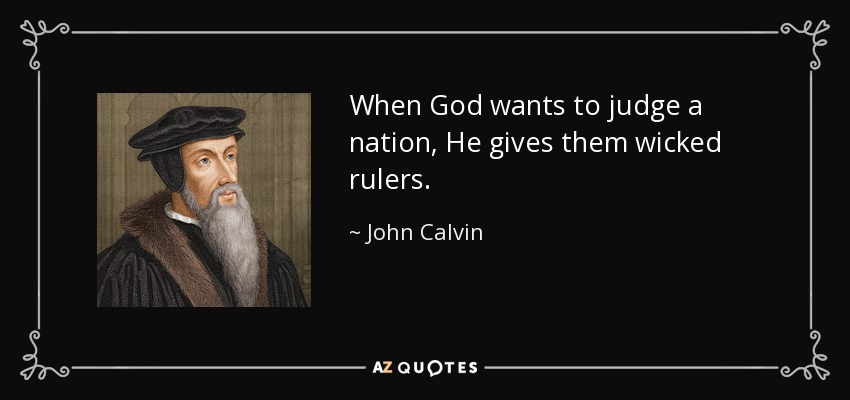
On the political front, I recently saw a quote from John Calvin.
When God wants to judge a nation, He gives them wicked rulers.
Or maybe you'd prefer the more biblical version.
When the righteous increase, the people rejoice, but when the wicked rule, the people groan. (Prov 29:2)
Welcome to the 2016 Presidential Election.

Trumping the GOP
Over and over stories are coming out about Republicans declaring their support for Hillary. They're not just pulling support from Trump; they're throwing it behind Hillary. In the case of Meg Whitman, she actually said, "I have decided to support Hillary Rodham Clinton. It is clear to me that Secretary Clinton’s temperament, global experience and commitment to America's bedrock national values make her the far better choice in 2016 for President of the United States." Really? "Commitment to America's bedrock national values"?

I warned before that one of the serious dangers of Donald Trump is that he held the potential to explode the Republican party. That is, he has the capability of completely derailing anything remotely like a "platform", a "shared position", a "commitment to America's bedrock national values". Republicans no longer know what those are, apparently. Welcome to the end.

Going on in this destruction of anything remotely "Republican" or conservative, when Ted Cruz told Republicans to "vote your conscience", he got booed ... for starters. The vitriol that followed was amazing with prominent Republicans assuring America that Cruz had just ended his career. Because, you see, it is an anti-Republican, anti-conservative position to vote your conscience. Wait ... what? Of course, the anger from Republicans toward Cruz was over the fact that he did not declare his support of the Republican nominee for president. Bad! Bad senator! So why is it when Trump refuses to support Republicans running for office who actually did endorse him, no one particularly cares? This is what happens when you Trump the GOP.

More on Voting
I'm still having difficulty in deciding the course to take on voting this year. It came home to me the other day. This election cycle with its particular choice of candidates is like I'm being told, "You can shoot your wife or you can shoot your mother. No matter what, one of them will be shot. So choose." If I participate in electing Hillary -- placing my vote for her -- or in electing Trump -- marking his name on my ballot -- I believe I will be complicit in the evil they will perpetrate. I believe that the evil either will try to produce is far beyond what we've seen thus far. I cannot vote for a candidate who favors killing babies on demand (and having the government pay for it). Nor can I add my name to the list of people who asked Donald Trump to be our president. Which will I shoot? Neither. Will there be consequences? Without a doubt. I just don't want to be one who supported them. "But if you don't vote for Donald, you're voting for Hillary!" Not true. 1) A failure to vote for one is not a vote for the other. 2) Most states are not "battleground states". The outcome is known. If you live in one of those where the outcome is a given, your vote for or against the candidate you oppose will not change that. 3) I need to vote my conscience and leave the outcome to God. I recognize that others -- people whom I love and respect -- are not as limited in that as I am. But I can do nothing else.

Update on Slippery Slope
And then there's this. Dr. Stephen Kershnar has written a philosophical analysis of pedophilia. The Diagnostic and Statistical Manual of Mental Disorders, 5th Edition already recognizes pedophilia as a sexual orientation. Now (as expected ... slippery slope and all that) Dr. Kershnar is arguing that it is a "natural function", causes no harm to a "willing" child or the adult participant, and ought to be normalized as protected sexual orientation and moral behavior. Thus we can see that morality premised on the "harm factor" and sexual relations premised on "consent" don't work. Again, it's not a slippery slope fallacy if it happens.

Friday, August 05, 2016

Feelings as Foundation

I've seen advertisements lately. In one, an older woman is trying to find out if she and her husband can get life insurance. Oh, good. They can. The husband asks what the agent is saying. "She says we can get insured," she answers. "I feel good about this." In an ad for a product for cleaning your teeth, an advocate says, "When I floss, it feels like I'm hurting my gums; when I use this product, it feels like I'm healing them." There you have it. Good reasons to buy the insurance or the floss substitute. We feel good about it.

We live in the Age of Empathy, a term coined to speak of today's version of "reality" which is determined by "how I feel". In today's world "I feel" trumps "I think" or any other facts you might want to bring to bear. It is this single principle that has changed the positions of countless people on the topic of homosexual behavior as a sin. Time and again we have heard of people that held (with Scripture) that the behavior was a sin ... until someone close to them "came out", and all of the sudden their position (and apparently Scripture) changes. Why? Because "I feel" it's so.

The odd thing is that no one has to be told that feelings are often wrong. Although "Trust your feelings" has become axiomatic today, it really makes little sense. People have panic attacks over small things. There is depression and narcissism when neither is justified. And how often is "self-righteous anger" a product of clear facts? Sure, we might get a "gut feeling" about something and it might be wise to heed it in some cases, but the truth is that our emotions are a product of how we think. It would be far better to think through things rather than allow our emotions to be our foundation for our choices and values.

Demagogues excel at emotional manipulation. America today excels at embracing demagogues. "The right thing" in our society today is most often "how I feel". It is considered taboo to question that. But you can see why Satan would want us to go in that direction. The Bible says our hearts are deceitful and wicked (Jer 17:9). The Bible says the gospel is foolishness to the unsaved (1 Cor 1:23). The Bible says that those in the world are blinded (2 Cor 4:4). It would seem obvious that clear thinking would not be a benefit to Satan's followers. What we ought to do is trust in the Lord (Prov 3:5-6) and be transformed by the renewing of the mind (Rom 12:2). We can't change how the world operates, but we can be sure we're not operating on the shaky ground of "how I feel" as a foundation for what is right. We've been given a better foundation (1 Cor 3:11; 2 Tim 2:19). Feelings have their place; it's just not as the foundation.

Thursday, August 04, 2016

Worship Music

I know. Grand title. The truth is I don't intend to discuss worship music. I'm not planning to analyze style, content, techniques, whether or not we should be using screens or drums or anything of the sort. What I want to know is ... what's the point? What is the purpose of today's worship music?

You would think the answer would be obvious. "Well, uh, to worship, right?" Seems like that would be the answer. But there has been a burst of articles written in the past few years about why we're not singing anymore. What?! How can that be? Worship music is for worship and Christians want to worship, so ... why does it seem like there is a growing problem of not singing in church?

Part of the problem, let's be honest, is men. The truth is that some singing makes some men uncomfortable. They're just not into singing these "Jesus is my boyfriend" kinds of songs, where a very slight shift in the lyrics -- like substitute "guy" for "Jesus" and the like -- and it wouldn't be distinguishable from a pop love song. The best illustration is what they did in Sister Act with a choir of nuns singing "My Guy", substituting "God" for "guy". Face it; men aren't so much into it.

A bigger problem is education. No, not because we didn't get the right stuff in school. It's just that we've been taught by observation in life that when someone is performing, you do not interrupt. If you do sing along with a favorite tune, make sure you do it quietly so as not to disturb the rest of the audience. It used to be that music was part of life. When I was a kid everyone did music. Everyone learned to read music. A junior high choir (made up of everyone in the class) would be given sheets of music and expected to sing four part harmony for the PTA at the end of the semester. That kind of ubiquity ("ubiquity": something that is present or found everywhere) is gone. Only a few read music. Many (most?) churches no longer bother with hymnals or any other printed music because so few read it anymore. No, we've been taught to listen. We've been taught that music is a "performing art" and probably best left to the professionals or the privacy of your home.

Oh, there are truly many reasons that congregations are singing less. There is the glut of "new" -- the idea that "new is better", an almost worship of "novel" -- so that so few congregants ("congregant": a member of a congregation) even know the words anymore. In some cases they can't sing it. Older music was fairly predictable; newer music not so much, and the newer is often written in a key outside the range of the majority with complex rhythms and, of course, no notations, so they can't sing it. A big problem is that no one can hear others singing when the music is so loud. I've been in churches where the music is so loud you can't hear the worship leaders sing and you just have to rely on the words on the screen to know what they're singing. Just to list a few reasons.

My problem is that music is biblical. As it turns out, those Old Testament prophets spoke primarily in verse -- they sang their prophecies. (Look, for instance, at the bulk of Isaiah and Jeremiah and you'll see that they're written out in verse structure.) Beyond the history of it, Scripture commands it. In Ephesians we read that we are supposed to be "speaking to one another in psalms and hymns and spiritual songs, singing and making melody with your heart to the Lord; always giving thanks for all things in the name of our Lord Jesus Christ to God, even the Father." (Eph 5:19-20) Did you see that? "Speaking to one another" with our music. In so many of today's churches you can't even hear one another and in too many it's only the worship team doing the singing anyway. Paul told the Colossian church more. "Let the word of Christ richly dwell within you, with all wisdom teaching and admonishing one another with psalms and hymns and spiritual songs, singing with thankfulness in your hearts to God." (Col 3:16) You have to admit that's even bigger -- "teaching and admonishing one another" with music. In our day most of what we're getting is an attempt at making us feel something. Teaching and admonishing ("admonish": to firmly warn or reprimand someone)? Not happening.

There is a purpose for worship music. I'm just afraid that too many churches have forgotten what it is. It is not to make people feel. It is not to draw in the unsaved or unchurched. It is not to put on a good show. Somehow, somewhere along the way, too many have forgotten that we are there to worship, that God is the audience and the congregation the performers for His pleasure. The problem is misplaced affections, whether it's the male ego or the performer's ego or a love for the new over the old or a faulty aim to compete with the entertainment of the world. The solution is repentance and return to worship. Of course, I suppose I'm preaching to the choir ... or do I need to define that term, too?

Wednesday, August 03, 2016

Moral Superiority

We've all seen it, that ol' "I'm better than you" attitude. Unless you're the one exhibiting it, no one likes it. You know what I'm talking about. It's the body builder who looks down his nose at the "normals", the vegan who disdains the barbaric carnivorous humans, the "church lady" who physically avoids the "leperous" low-lives, the country club member who hurries by the homeless. So it is not a surprise when Christians come across as morally superior and are not appreciated for it. Nor should we be.

Religion in general is most often about morality. Be good and get to heaven. Of course, "good" varies from religion to religion. In one it is "honor your ancestors and don't hurt any living things" and in another it is "kill the infidels!" Clearly not the same definition. But the concept is the same. So it is no surprise that Christianity -- which is, despite what you may have heard, definitely a religion -- might be perceived as another moral code. Of course, what sets Christianity apart from all other religions is not as much its definition of "good" as its claim that we are not saved by doing good, but by faith in Christ. And yet, even among Christians, there is the continuing sense that Christianity is about being good. And when I am and you're not, I am clearly morally superior.

So where did I go wrong? I've already said no one likes the self-proclaimed superior, including the morally superior. And yet it appears that I just made a good case for it. Why not?

Well, of course, the problem is the premise. Christianity is not about being moral. Christianity is about being dead in sin and becoming alive in Christ. Death to life is not the same as "be good". And the morality so often associated with Christianity is not the aim; it is the result. It is the grateful response of the dead-to-life person. And it is the product of God working in the believer (Phil 2:13). So we're not trying to be good to earn favor, and any good that we achieve is not even our achievement.

How is it, then, that Christians are so often viewed as seeing themselves as morally superior? The perception is that we look down our noses at those homosexuals and the Democrats and all. Oh, we are so much better than they are. Where does that come from? Well, first it comes from either misguided Christians or deluded "Christians" who miss the point and thought it was about being good. They feel it is their task to make everyone good. At least, as good as they are. Sometimes their favorite moral work is done in areas at which they fail but don't admit it. That is, in some cases the "moral superiority" protest is accurate.

In others, however, it isn't so accurate. It might be because of a misunderstanding. If I say, for instance, that activity X is a sin, some may conclude I'm simply being morally superior while the truth may be that I'm not. Recognizing that activity X is a sin doesn't mean that I don't struggle with it, you see. Because, at the core, we're all morally inferior. We're all short of what God requires. Not one of us is "good enough". I suspect, then, that the "morally superior" moniker will get assigned to us when we fail to admit that the problem is not their sin, but also our own.

It has been said that Christianity is a crutch. This, of course, is nonsense. We need far more than a crutch. In fact, there is no medical-assist metaphor to parallel it. "You were dead in your trespasses and sins ... But God, being rich in mercy, because of His great love with which He loved us, even when we were dead in our transgressions, made us alive together with Christ (by grace you have been saved), and raised us up with Him, and seated us with Him in the heavenly places in Christ Jesus." (Eph 2:1, 4-6) This leaves no room for moral superiority. Now, when we point out that sin is sin (because God says so, sure, but mostly because we suffer from it ourselves), we might be accused of being morally superior. Let it be a false accusation. Let us embrace other sinners with love, instead, offering the same resurrection power that we have experienced and they desperately need. If you do experience that sense of moral superiority, repent! Paul said, "It is a trustworthy statement, deserving full acceptance, that Christ Jesus came into the world to save sinners, among whom I am foremost of all." (1 Tim 1:15) I can echo that sentiment.

Tuesday, August 02, 2016

Husbands

The other day there was someone on the television who spoke of his "husband". (Note the pronoun.) It made me think. What is the meaning of the word, "husband"? I ask myself that because of the apparent connection to the term "husbandry". Husbandry is the conservation and careful management of resources. Usually it's referring to farm management, but not necessarily. And, as it turns out, this is the idea of the verb, "husband". (Did you know there was a verb form?) The verb means precisely that ... to use economically, to conserve. The word comes from Old Norse, originally meaning "a peasant with his own farm". The prefix, hus, refers to (of all things) a house, and the suffix, bondi, speaks of an owner, of one who has a household. This is where the modern "head of household" comes from and the origin of "manage a farm" as well.

In our day "husband" has been largely boiled down to "the male spouse". Biblically, however, what we read in Scripture looks a lot more like the ancient form. Husbands are supposed to be "head of household" (1 Cor 11:3; Eph 5:22; Eph 6:4), but we are supposed to be something other than "lords". We are supposed to be "husbanders", so to speak. We are supposed to husband.

Husbands are not called to be taskmasters or kings. We are supposed to "manage the farm". We are to lead in service. We are supposed to love our wives and "sanctify her ... by the washing of water with the word" (Eph 5:26). We are supposed to make a lifelong practice of understanding her and honoring her (1 Peter 3:7). And I'll tell you a secret, Christian husbands. If we were the husbands that God commands, no one would complain about it. Not our wives. Not the general public. Because we would be "growing" our wives, tending to them, taking care of them, husbanding them.

It's really a shame, you know. Believing husbands ought to be the ambassadors for a biblical view of what it means to be a husband and father. Instead, we mostly just model "the male spouse". Some are cruel and domineering. The majority are just "along for the ride". We ought to be models of husbandry, managing our limited resources, both in "stuff" and the people who are our families, as well as tending to that extremely limited resource that is that one wife God has given us. That is the image of Christ and His Bride, the Church. That is my prayer for myself.

Monday, August 01, 2016

Making the Bible Relevant

In the period between the Old and New Testaments, the Pharisees came to be. Right after the Maccabean revolt, they emerged as a group of laymen and scribes, distinct from the Sadducees -- the party of the priesthood -- who wanted to make the Scriptures relevant. The Sadducees refused to accept anything that wasn't from the Torah. The Pharisees tried to harmonize what they found in the Torah with their own ideas. The Law, they held, wasn't set. They argued that it was evolving, that "men must use their reason in interpreting the Torah and applying it to contemporary problems." Working to make Scripture relevant, they came up with new rules. The 613 found in the Old Testament may have been tough to follow, but they produced the Midrash, a compilation of layered and complicated regulations that were placed on the backs of the Jews. For instance, God commanded, "Six days you shall labor and do all your work, but the seventh day is a sabbath of the LORD your God; in it you shall not do any work, you or your son or your daughter, your male or your female servant or your cattle or your sojourner who stays with you." (Exo 20:9-10) Working on "relevance", they broke "work" down into 39 different categories with their own sub-categories. For instance, in order to make it more clear, they required that you were not allowed to take more than 3,000 steps from your property. Thus, 3,001 constituted "work" and you'd be a Sabbath-breaker. Of course, they also figured out that you could bury pieces of "property" within 3,000 steps of each other that would allow you to be within 3,000 steps of your "property" and you could go almost anywhere. But it was relevant, you see? Not some literalistic, legalistic book.

Christians, thanks to the New Testament image, have come to dislike the Pharisees. To call someone "Pharisaical" is not a compliment. And if someone calls you that, you will likely feel the need to defend yourself. Yet, in our day "relevant" is the key word. Youth leaders try to jazz up the Word to catch the attention of their students. If you looked around recently you would have seen a lack of "VBS" and a substitute of other things because "Vacation Bible School" isn't cool. Now "Summer Blast" is cooler and kids would be much more likely to attend a Mega Sports Camp" than some silly event with the word "Bible" in it. But it's not just the youth in view. Seminaries teach pastors-to-be to make their sermons applicable. Teach doctrine? Not really relevant. You need to provide application. Oh, it's not that it's bad. "God said it, so you need to ____." That much is true. But how often is the pastor right about what God wants you to do with the text he preached on?

Back in 2001 I was attending a rather large church. Pretty good pastor. Preaching through Ephesians. That's good. But I have to admit, on the Sunday following September 11, I wasn't really keen on going to church. I had already endured too many conversations in the media and with people regarding the event and I was pretty sure we'd get it there, too. And then I remembered. The text for this Sunday would be Eph 1:11-12. Hold on! This had real potential! Because what we Christians really needed to hear at this moment was exactly that.
In Him also we have obtained an inheritance, having been predestined according to His purpose who works all things after the counsel of His will, to the end that we who were the first to hope in Christ would be to the praise of His glory. (Eph 1:10-12)
Yes! That's what we needed to hear. God had not lost control. These events, as tragic as they were, were not without purpose. We could trust Him!

Well, the pastor did preach on the text, but didn't expand on the phrase at all. Just read on over it. No help at all. Why? Well, I realized when he started preaching on Ephesians 2 (beginning with "And you were dead in your trespasses and sins, in which you formerly walked according to the course of this world, according to the prince of the power of the air, of the spirit that is now working in the sons of disobedience. (Eph 2:1-2)) and taught the entire chapter as a guide to marriage that Scripture had suffered the death of "relevance" here.

Nice idea, but misguided. You see, Scripture is relevant (2 Tim 3:16-17). It is applicable -- applied by the Holy Spirit to the lives of each believer. Peter said, "His divine power has granted to us everything pertaining to life and godliness, through the true knowledge of Him who called us by His own glory and excellence." (2 Peter 1:3) What makes us think we can improve on it? Expound on it? Sure. Teach it? Absolutely. Explain it? Yes! What we've tended to do is try to pick out stuff we think would be relevant, blur stuff we think might not be, and even hide some that we consider irrelevant. We've expanded on Scripture to make it more "real" and dumbed it down to make it more palatable. We've become modern-day Pharisees.

It is not our job to make Scripture relevant. It is our job to give them Scripture. Explain it, teach it, cover it all. Sure, some applications are easy. "This is a sin" means "Don't do it." "This is a command" means "Do it." But Scripture is what is needed, not our tricks, our modifications, our creative renditions. Because it is complete (2 Tim 3:16-17) and effective (Heb 4:12) and is not the tool of the pastor or the teacher as much as it is the Holy Spirit (Eph 6:17). It is relevant. We just need to give it to each other.

Sunday, July 31, 2016

Hope and Change

Our current president ran with the flag words, "hope" and "change". The right might respond, "Yes, and we're hoping for a change." But a little peek at politics today should assure you that, while we might possibly get some sort of change, there is precious little reason for hope. Fortunately, I'm not anticipating some sort of salvation from a political source, I take to heart the words of the psalmist: "Do not trust in princes, In mortal man, in whom there is no salvation." (Psa 146:3)

If you share some of my skepticism for politics, let me share a different hope ... a better hope. Paul wrote,
Of this church I was made a minister according to the stewardship from God bestowed on me for your benefit, so that I might fully carry out the preaching of the word of God, that is, the mystery which has been hidden from the past ages and generations, but has now been manifested to His saints, to whom God willed to make known what is the riches of the glory of this mystery among the Gentiles, which is Christ in you, the hope of glory. (Col 1:25-27)
Paul spoke of a "mystery", a mystery hidden from past ages, a mystery that "has now been manifested to His saints." Paul was a minister of a hidden mystery that is now abundantly clear in God's people. What is that mystery? Simply put, "Christ in you."

Politicians may promise hope and change. Political forces may even produce hope and change, although the former is not often fully realized and the latter is not always change we want. The good news is that in Christ there is the real hope, the certain change. In Christ we have the absolute certainty of glory to come. Now that is hope and change. What insures that certainty? Christ in you. We, His saints, are indwelt by the Holy Spirit. We have Christ in us. Christ -- the "image of the invisible God" (Col 1:15), the "head of the body" (Col 1:18), the one in whom all the fullness of the Father dwells (Col 1:19) -- lives in us.

Don't expect help from the world. It won't be coming. On the other hand, don't expect defeat, either. We have the certainty of the Son of God dwelling in us, producing absolute hope and genuine change.
Praise the LORD! Praise the LORD, O my soul! I will praise the LORD while I live; I will sing praises to my God while I have my being. (Psa 146:1-2)

Saturday, July 30, 2016

Who's looking out for the B's?

I'm sure you've seen the acronym, LGBT. Maybe it was spelled differently. I don't know the rules. Often there are added letters, like LGBTQ or LGBTQa or something. I've seen LGBTQIA. I've even seen LGBTQQIP2SAA. Way too much to figure out. But in the shorter versions I do okay. Let's see, the "L" is for lesbian and the "G" is for gay. Now, to be honest, I'm not actually clear on the distinction there. I thought "gay" referred to anyone with same-sex attraction, but, hey, what do I know? The "T" is clearly for transgender (or transsexual, I suppose). The "Q" can be confusing because some sources say it refers to "queer" which, as I understood it, was the same as "gay" which, as I understood it, referred to anyone with same-sex attraction, but, as we've already seen, what do I know? Others say the "Q" refers to "questioning", which is equally mysterious since everyone asks questions. But let's assume it's about someone not sure if they are any of the other letters or maybe just an H (heterosexual). In the "IA" version the "I" is for "intersex" which, as far as I can tell, is, in the final analysis, no defined gender at all, and the "A" is for "allies" of the LGBTQQIP ... well, you get the idea.

If you were paying attention, I skipped one. No, not one of the obscure ones. Not even one of the extended ones. Given the "standardized" LGBT acronym, I skipped the "B". Now, defining it is pretty easy. It refers to the bisexual, people who are attracted to both sexes. Fine. We understand the concept. But what I'm wondering is this. In all the work that the LGBT groups and organizations and movements are doing, who is looking out for the B's? We've all seen where the LG groups have come out of the closet in order to push all sorts of new rights (like the right to redefine "marriage" into oblivion) while wielding unprecedented power of the courts and the lawmakers until the public has been swayed to set aside their minds and embrace their feelings instead. Morality aside, the only way this could take place is by, well, putting morality aside. And they have managed to do that by simply defining it away and sweet talking some and bullying others into agreeing. We've recently seen the shift for the so-called "T" group, where now their gender is so well defined that no one knows anymore what it actually means ... but it is well protected. Now they can use any bathroom they feel like. If you doubt the mainstreaming of the gender insanity issue, just look at the American winner of the 1974 Olympics men's decathlon -- "Call me Caitlyn, please" -- and we have mainstream "T" with a vengeance. You had better get your pronouns right. (So, is he going to return those medals from the men's events he competed in as a girl?) In these and many other ways we see that the LGBT has worked hard for the L and the G and the T. What about the B?

If the bisexuals were to get their rights secured, wouldn't we need to allow for polygamy and/or polyamory? (Polygamy would be one gender married to multiples of the opposite gender. Polyamory is mixed genders -- say, three guys and four girls married. Or not married. And it's not new.) If one of the key aims of the LGBT is to secure equal rights, this would have to be key. Somehow it hasn't been. Somehow even the LGBT crowd seems to prefer to define "marriage equality" as "what we say it is" and not "what works for the bisexual as well". They seem to say, "That 'only a husband and wife' thing? It's out. Any two will do. But, no, not more than two. Why? Because we say so." So, who is looking out for the B's?

Did you know there exists in the community that calls themselves "homosexual" a condition known as "biphobia"? (The source -- a gay pride location -- says it's "rampant in the LGT community.") That's right. There is a condition of discrimination among the LGBT (minus, of course, the "B") against the B's. So, who is looking out for the B's?

Well, I will if no one else will. I will -- and will encourage my fellow believers to -- give them the gospel just like anyone else. I'll encourage my fellow Christians to embrace the sinner without embracing the sin just like everyone else's sin. Someone has to look out for them. Clearly the LGBTLMNOP's aren't. But we know a Savior who will, don't we? We need that Savior. The "LGT" folk need that Savior. And the B's need that Savior, too. Total equality!

Friday, July 29, 2016

Substitutes

It seems as if we're making a real art of substitution in America these days. High on the list of the dieter's list, for instance, is the "sugar substitute". We don't want to give up sweet, so we'll find something that will substitute for sugar. Oh, it's not easy. That one has been shown to cause cancer and this one has been shown to cause memory loss. I suppose if you used them both you would get cancer, but it wouldn't matter since you couldn't remember.

We're all aware of the "surrogate mother" concept. In this approach to producing children parents will find a substitute sperm, substitute egg, or maybe just a substitute womb.

Philosophically, modernism was once king. Modernism believed that careful, rational thought could provide the answers to all of life's questions. We now have a substitute: post-modernism. Replacing modernism is the complete rejection of rationalism. We've substituted "I think" with "I feel and, therefore, it's right."

For the first 200-or-so years of our national history, the Judeo-Christian ethic has been our moral guide for the most part. Well, not any longer. We've found a substitute. In sexual matters, instead of a sexual morality that called for marriage before sex we've substituted "adult" and "consent" as the only requirements. Anything else is fine. And they're working on removing the "adult" part. Some don't want to limit it to "human". Of course, it has been a long time since we substituted the primary purpose of sex from procreation to recreation.

Our country was founded on a Bill of Rights that outlined necessary protections of basic rights against government encroachment. We've started substituting new rights for these old ones. Last year the courts substituted gay mirage for the longstanding, historical, traditional definition of marriage ... in the name of "equal rights". States have moved to put protections in place for religious rights promised by the First Amendment, but "gay rights" preclude those. When a clerk in Kentucky refused to issue marriage licenses to same-sex couples, there was an outcry. When a gay judge in Texas refused to perform heterosexual marriages, there wasn't a peep. The florist who suggested that her gay friends use a different florist for their marriage ceremony found that exercising her First Amendment rights to the free exercise of religion cost her her business. As have others. The Bill of Rights was a nice idea, but today we're making some substitutions.

It certainly isn't new, but most don't really notice the substitution of "love your neighbor as yourself" (which even unbelievers applaud) with "love yourself before your neighbor". I suppose that's why we're doing this substitution with a vengeance.

Then there's the gospel. Most Americans in the mid-20th century had heard it. Today, it's a mangled mess. "Hell" has become "unpleasant circumstances" and even "a better place to be" ("I wouldn't want to be in heaven if my friends, family, or dog wasn't there."). "Heaven" has become little better than the Islamic "72 virgins" where all my personal preferences are catered to. The road to avoiding one and achieving the other is basically "Be all you can be." We've selected a substitute gospel with a substitute Christ to avoid a substitute Hell and achieve a substitute Heaven.

Sugar substitutes can harm your body. This final substitute will destroy your soul. Substitutions are not always a good idea.

Thursday, July 28, 2016

American Christianity

From my youth I've seen many examples of "American heroes" on the TV and movie screens. John Wayne was probably the quintessential hero. He stood alone, strong, individual, fighting for what was right, that sort of thing. Most of them are like that in American lore. In comic books and their television and movie offshoots we have superheroes like Batman, Superman, and Spiderman. And they're not all fictional types. Abraham Lincoln, for instance, stood alone against slavery and, by his positions and choices brought about the emancipation of slaves in America. Heroic. That's our hero image, a stand-alone kind of hero who does what is right with strength and courage.

It's interesting to me how this image has leaked into American Christianity ... and not in a good way. Recently I read that actor Bruce Willis was an atheist. Another source, however, denied this. Willis was quoted as saying he had no use for organized religion. Thus, "atheist". But another quote was offered that said he believed in God. So, not "atheist". The "no use for organized religion" concept seems to be a direct offshoot of American Christianity where we admire the lone wolf, the Lone Ranger, the rugged individual who needs no one and just does what is right. "That's the kind of Christian I want to be," many American Christians might say. So they stay away from church and just slog their way through life, "Just me and Jesus."

How odd that Scripture never presents Christianity this way. Yes, sure, it's "me and Christ", but never "Just me and Christ." Biblical Christianity is presented as Christians in a body (1 Cor 12). Paul says, "For just as the body is one and has many members, and all the members of the body, though many, are one body, so it is with Christ." (1 Cor 12:12) He says, "Now you are the body of Christ and individually members of it." (1 Cor 12:27) He warns against the two extremes -- either "I'm not that part, so I'm not important" (1 Cor 12:15-17) and "They're not the part that I am, so they're not important." (1 Cor 12:21-22) The claim, in fact, is not that we're simply supposed to be a body, but that "God arranged the members in the body, each one of them, as He chose." (1 Cor 12:18)

This "body" functionality, where each has his or her own function to perform for the body, is accomplished by the gifting of the Spirit. "Oh," I've heard far more than a few times, "that doesn't include me." Or they'll tell me, "I know my gift ... the gift of gab." But Scripture says, "To each is given the manifestation of the Spirit for the common good." (1 Cor 12:7) It's not that some get a spiritual gift and some do not. Each gets a gift. More importantly, that gift is not for your personal pleasure. it is "for the common good."

It seems to me that many American Christians have carefully removed passages like 1 Corinthians 12 from their Bibles. "Christianity is about relationship, not religion. We don't need a church to commune with God." Oh, and the ever popular "Just me and Jesus." Sounds brave, except it is not what Scripture describes. The Christian life is an interconnected life where we serve one another and are, in turn, served by one another. God's Word says that each of us has been given a spiritual gift and if you're not actually connected to believers, particularly a local body, you're not likely using that gift for what it was intended, for the purpose it was given. Imagine the insult to the Holy Spirit! "Thanks for that gift of ____. I'll just put it in the closet, stored nicely. I don't think I'll really use it."

Christianity is a uniquely "other" way of life. Built on "love one another" (John 13:34) and functioning as an interconnected body of Christ where "If one member suffers, all suffer together; if one member is honored, all rejoice together" (1 Cor 12:26), we are not designed to be a John Wayne or Captain America or Wonder Woman. We are designed to heroically invest our lives in each other. When we fail to do it, we weaken the body of Christ. When we succeed, we become a powerful force for God's work in this world. There is no room in Christianity for Lone Ranger Christians, no matter what American individualism tries to tell you.

Wednesday, July 27, 2016

A Communion Inquiry

Every Christian knows (or should know) about Communion. It goes by various names -- Communion, the Eucharist, the Lord's Supper. (Why they call it that last is odd since a tiny piece of bread and a thimble of juice hardly qualifies as a "supper". But I digress.) I've always had questions about this, one of the few sacraments common to all Christians.

Paul's explanation is succinct and often quoted at various celebrations of the event:
For I received from the Lord what I also delivered to you, that the Lord Jesus on the night when He was betrayed took bread, and when He had given thanks, He broke it, and said, "This is My body which is for you. Do this in remembrance of Me." In the same way also He took the cup, after supper, saying, "This cup is the new covenant in My blood. Do this, as often as you drink it, in remembrance of Me." For as often as you eat this bread and drink the cup, you proclaim the Lord's death until He comes. (1 Cor 11:23-26)
You may have heard that word for word at your latest honoring of the Lord's Supper.

I get the part about remembering the Lord's death in the broken bread (representing His broken body) and the cup (representing His shed blood). That's all clear and good. The part I don't really understand is "as often as you eat this bread and drink the cup." To what bread and what cup is He referring? It's interesting to see the wide range of "as often as you" do this in various churches. Some do it weekly. Some monthly. Some quarterly. I think there are some who do it once a year. How often was this to be done? The reference to the bread and the cup would be a clue, I think.

I've heard some argue that it means that any time we eat and drink anything we should remember His death and proclaim it. Okay, I only heard that from one person. The most common view is that the bread and cup to which he refers is simply the elements of the Lord's Supper. But I've also heard from Jewish Christian sources that Jesus was in a specific point in the Passover celebration and that there is significance to the bread and the cup that we Gentiles don't realize. Could he have been referring to the Passover bread and cup? That would put it at once a year ... or never for Gentiles. But that surely can't be right.

For kids like me who grew up in church, the Lord's Supper became somewhat passé. The symbolism was lost on us. Look, there was no "bread broken". It was prefab crackers. And that grape juice we got was not the product of us having "drained the blood of grapes", so to speak. It came from a bottle of juice. Yet, Paul said, "We preach Christ crucified" (1 Cor 1:23) and "I decided to know nothing among you except Jesus Christ and Him crucified." (1 Cor 2:2) The sacrifice of Christ on the cross on our behalf is the critical message of the gospel and our sole means of salvation. So how is it that this essential "proclaim the Lord's death until He comes" piece can get so diluted?

I'm asking questions here. I'm not trying to call for change or make a point. It just seems to me that remembering His sacrifice and proclaiming it to others is, well, part of our purpose statement. And it feels like a cracker tab and a thimble of juice is a poor way to do that. We know, for instance, that the early church did much more. Paul's explanation of Communion is in a passage where he is berating the Corinthians for their excess at the Lord's Supper (1 Cor 11:20-30). My history of celebrations of the Eucharist give no reference point for the concept of "excess". We know as well that the early church was "day by day, attending the temple together and breaking bread in their homes" (Acts 2:46), which sounds a lot like both sharing meals and celebrating the Lord's Supper together. I'm not saying we need to do that. I'm not saying we shouldn't. But I'm wondering if this often quarterly cracker and juice exercise is the best way to remember and proclaim His death. Just wondering.

Tuesday, July 26, 2016

The Danger of OSAS

You know OSAS, right? "Once saved, always saved." When I was growing up, I thought I was a Calvinist because I believed "once saved, always saved" and those miscreant Arminians didn't. Of course, I didn't realize that "Calvinism" (poorly named) has 5 points and I was ignoring 4 of them. Imagine my surprise, then, when I came across the rest of them, saw the Scripture involved, and rejected OSAS.

"Okay, now, hold on," I can hear you saying. "Aren't you a Calvinist? Don't you subscribe to that point as a Calvinist?" No, I don't, and I'll tell you why. I cannot tell you how many people in my lifetime I've heard tell me "I'm a Christian" while they indulged in open, admitted sinful practices which they defended on the basis of "OSAS". "You can't tell me I'm going to hell," they would tell me, "because I accepted Christ when I was younger and once saved, always saved, right?" This is a problem.

"Why?" some might ask. "Because it violates your views?" No, because it violates Scripture. It ignores all the biblical warnings about testing yourself and falling short. It ignores all the biblical statements about the nature of a genuine believer. John wrote something that was startling. "No one born of God makes a practice of sinning, for God's seed abides in him, and he cannot keep on sinning because he has been born of God." (1 John 3:9) When Paul wrote, "If anyone is in Christ, he is a new creation. The old has passed away; behold, the new has come" (2 Cor 5:17), it wasn't trivial. OSAS would argue that it is not only trivial; it is wrong.

If I told you, "It is God who works in you, both to will and to work for His good pleasure" (Phil 2:13) and left it at that, I think you'd find that I had told a half-truth. That is, left alone, it sounds like God working in believers is all that is needed and we can just go about our merry way. But the statement is actually at the end of a previous sentence. "Therefore, my beloved, as you have always obeyed, so now, not only as in my presence but much more in my absence, work out your own salvation with fear and trembling, for ..." (Phil 2:12-13) Yes, it is God who works in you, but this is something He does so you will do something. So you will do what? So you will "work out your own salvation." "Well, sure," you might say, "but we're not saved by works." No, we aren't. But this working out of salvation is not minor or incidental. It is accompanied by "fear and trembling". Yes, God is at work in us to have both the will and the power to do it, but we must do it. Where does that leave the OSAS side which insists we don't have to do anything? Where is the fear and trembling of adherents to OSAS? Going with the popular perspective of OSAS, where we can sin all we want once we're saved because salvation can't be lost, it would suggest that we don't have the sense that demons have (James 2:19).

The other problem is that OSAS is cavalier about salvation. It is more of a "I've got my 'get out of hell free' card so I can do whatever I want" mindset. It doesn't take into account the cost. It doesn't take into account the change in nature that a relationship with Christ brings.

I should be clear here. I'm not saying you can lose your salvation. If you are able to simply go on sinning to your heart's content, you never had it. That's what John said. "They went out from us, but they were not of us; for if they had been of us, they would have continued with us. But they went out, that it might become plain that they all are not of us." (1 John 2:19) Jesus said that those who are in the Father's hand cannot be removed (John 10:28-29). Paul said, "He who began a good work in you will bring it to completion at the day of Jesus Christ." (Phil 1:6) If He does not, the work was not begun. The work that we do doesn't secure our salvation, make us more acceptable to God, or anything of the sort. It is Christ working in us. From that perspective, we cannot not work. The "5th point" is not "once saved, always saved". It is the claim that God will keep His own and that, through the working out of His power in our lives, we will be changed, transformed, sanctified, conformed to the image of Christ. No change? No salvation to start with. Saved? Then change will occur. It's as simple as that.


Monday, July 25, 2016

Christian Liberty Relinquished

The standard definition for the doctrine of Christian Liberty is something like this. Believers are free to do that which God has not commanded them not to do or to not do that which God has not commanded them to do in accordance with faith. That is, if God didn't say anything about the subject, your conscience (guided by the Holy Spirit, of course) should be your guide. The doctrine comes from a couple of biblical passages. One is Romans 14 and the other is 1 Corinthians 8. And most Christians who have heard of this principle are rather pleased with it.

Odd thing, however. If you actually read the texts involved, you would actually come away with something rather different. Romans 14, for instance, speaks about each of us being responsible to God. He offers examples -- eating meat or being a vegetarian, observing days or considering them all equal -- and suggests that we don't pass judgment on each other for either position. See? Christian liberty. Paul says, "I know and am persuaded in the Lord Jesus that nothing is unclean in itself, but it is unclean for anyone who thinks it unclean." (Rom 14:14) Again, Christian liberty. He does warn that "whatever does not proceed from faith is sin" (Rom 14:23), but it's still about Christian liberty, right? Well, in truth, this is not the message Paul is trying to convey. He goes on to say, "If your brother is grieved by what you eat, you are no longer walking in love. By what you eat, do not destroy the one for whom Christ died." (Rom 14:15) And therein lies Paul's main thrust. "Do not destroy the one for whom Christ died."

He really drives this point home in the 1 Corinthians 8-10. Here he points out that food offered to idols means nothing since "an idol has no real existence" (1 Cor 8:14). So it doesn't matter, right? Paul says it doesn't. But, Paul argues for another consideration. "Food will not commend us to God. We are no worse off if we do not eat, and no better off if we do, but take care that this right of yours does not somehow become a stumbling block to the weak." (1 Cor 8:8-9) This is his key idea. He says, in fact, "Therefore, if food makes my brother stumble, I will never eat meat, lest I make my brother stumble." (1 Cor 8:13)

Lots of Christians like this Christian Liberty principle. If God didn't say anything about it, we're free to live up to our consciences. Nice. And while this principle is valid, we need to be aware that it is not what Paul was trying to convey. The principle by which we ought to live is the principle of surrendered rights in favor of love for the brethren. The principle that Paul teaches is "Let no one seek his own good, but the good of his neighbor." (1 Cor 10:24)
So, whether you eat or drink, or whatever you do, do all to the glory of God. Give no offense to Jews or to Greeks or to the church of God, just as I try to please everyone in everything I do, not seeking my own advantage, but that of many, that they may be saved. (1 Cor 10:31-33)