When I speak of redefining marriage, you, my faithful readers, will automatically leap to "He's talking about same-sex marriage." Sometimes. Not this time. You see, the process of redefining marriage did not start with the LGBT alphabet soup. We've been at it a long time. My wife received a piece of official mail yesterday and I noticed the address. It gave her the title of "Ms." And I caught it, right there. Redefining marriage has been in the works for decades -- most intensely from the 1960's. That's when they yanked "love" from its moorings of seeking the best for others and dragged it into "sex," as in "making love." That phrase originally meant doing things that inspired a connection, close feelings, likely aiming at a permanent relationship that we called (back then) "marriage." Today's version, oddly enough, doesn't even need to include warm feelings. Two people in today's world can "make love" without feeling warmly toward each other -- friends with benefits or maybe a one-night stand.
Enter the '70's. Having hacked down the root of marriage -- genuine love -- and replaced it primarily with sex, we went to work on the permanence of marriage. "No fault divorce" took the country by storm. Not only should we be allowed to divorce for cause; we should be allowed to dismember this "two become one" for no cause except "irreconcilable difference" (read "whatever I want it to mean"). Feminists kicked in with vigor, demanding to no longer be called "Mrs" but now be just "Ms" because marital status was irrelevant. "We will not be defined by our marital status." So "two become one" shifted into oblivion. I had someone ask me (15 years ago, now) "My fiance wants to keep our money separate. Is that okay?" How do you practice "two become one" by keeping your lives separate? But that wasn't an outlandish question; it was normal. And, of course, that other pesky problem had to be addressed -- reproduction. In 1958 we hit a peak 3.6 births per woman. In 1979 we bottomed out at 1.8 births per woman. Marriage and procreation had been untied. In 1970 roughly 8 million children lived in single-parent families. In 2022 that number was 19 million.
The biblical definition of marriage is the union for life of a man and a woman for the purposes of procreation and mutual support. God thought so (Gen 2:24). So did Jesus (Matt 19:4-5). So did Paul (Eph 5:31). So when, in 2008, the Supreme Court of California knowingly rejected the "longstanding, traditional definition of marriage" and instituted something we term "same-sex marriage," it was clearly a redefinition. But it wasn't the first. More to the point, it was more like the last. The last vestiges of God's version of marriage were brought down. We took it down, piece by piece, over decades. It was so subtle and so gradual that Christians often miss it. Christians operate under this new un-definition of marriage. Is it any wonder then that divorce rates have jumped dramatically since the 1950's while "marriage" rates (in quotes since "marriage" is no longer clearly defined) are way down and single-parent children are way up? Is it really a surprise that, given the fact that the foundational concept of family as "married with children" is now a punchline from a TV show, our society is devolving? Why would we expect better values, better morality, better kids, better lives? But I want to point out that, in fact, the redefinition of marriage was not the actual target here. The actual target was God and His values and His plans. Marriage was designed to represent the relationship of Christ and His bride (Eph 5:31-32). This is a larger coup attempt than merely taking down marriage. As such, expect it to have a larger effect than is readily apparent.
Showing posts with label Same-sex marriage. Show all posts
Showing posts with label Same-sex marriage. Show all posts
Friday, February 10, 2023


Wednesday, August 07, 2019
Marriage or Mirage?
I am not opposed to gay marriage.
I know that must be a stunning statement for many, coming from me, but it's true.
Recently I heard of a generally reliable Christian source publishing an opinion on what to do if a gay person is married to another gay person and he or she becomes a Christian. They should not divorce because God hates divorce. Right? How do we get here? How do we arrive at such an answer, even from a generally reliable source? The answer to that is also the answer for the question people asked me back in 2008 when the courts in California were consciously redefining "marriage."
You can see the problem, I'm sure. Scripture speaks about a spouse married to an unbeliever (1 Cor 7:12-16). "Stay with them," Paul exhorts. And when Jesus was asked on what grounds divorce was suitable, He answered, "What therefore God has joined together, let not man separate" (Matt 19:6). This isn't rocket science. It's pretty clear. So the gay guy that comes to Christ should remain married to his gay partner ... right? It's biblical.
What we've done here is taken a term -- in this case "marriage" -- stripped off its original meaning (Matt 19:4-6), invested it with a completely new meaning, and then fed it back into Scripture. Now it's a scriptural issue. Because we don't know what "marriage" means anymore.
Here's the right answer to the question about a person who comes to Christ while they're in that gay mirage. (Perhaps my intentional spelling gives you a hint.) Gay marriage is not a thing. People tell me that you can't find a definition of marriage in the Bible, but no one can deny that no one in biblical times who said or wrote anything regarding marriage had any sense of the union of two people of the same gender. Never. Not once. Our current society may include that concept in their term, "marriage," but neither Jesus nor Paul nor any other writer of the new or old testaments had that concept in mind. So if we are going to properly understand what they intended, it's not fair to redefine their term to something new and then feed back to them what they never meant to say.
How, then, am I not opposed to gay marriage? On the same basis that I'm not opposed to unicorns, pixies, or zombies. They do not exist. "Marriage" is a word symbol intended to convey what the Creator meant when He expressed "A man shall leave his father and his mother and hold fast to his wife, and they shall become one flesh" (Gen 2:24; Matt 19:4-6; Eph 5:31). It has a form and a purpose that "same-sex" doesn't fit into. So if someone who identifies as homosexual in some sense opts to leave his family and hold fast to his wife or leave her family and hold fast to her husband, that's a good thing to me and I'm in favor of it. (I'm sorry; this "non-binary gender" stuff is equally incomprehensible in a scriptural perspective. "Husband" is male and "wife" is female by definition.) Oh, and what was the question they asked me in 2008? "What difference does it make to you if they redefine marriage?" Precisely this. They've managed to twist the thinking of a generation -- even Christians -- and in so doing they've managed to twist God's Word and the whole idea of what marriage really is. And that is going to cost us (Eph 5:31-32).
I know that must be a stunning statement for many, coming from me, but it's true.
Recently I heard of a generally reliable Christian source publishing an opinion on what to do if a gay person is married to another gay person and he or she becomes a Christian. They should not divorce because God hates divorce. Right? How do we get here? How do we arrive at such an answer, even from a generally reliable source? The answer to that is also the answer for the question people asked me back in 2008 when the courts in California were consciously redefining "marriage."
You can see the problem, I'm sure. Scripture speaks about a spouse married to an unbeliever (1 Cor 7:12-16). "Stay with them," Paul exhorts. And when Jesus was asked on what grounds divorce was suitable, He answered, "What therefore God has joined together, let not man separate" (Matt 19:6). This isn't rocket science. It's pretty clear. So the gay guy that comes to Christ should remain married to his gay partner ... right? It's biblical.
What we've done here is taken a term -- in this case "marriage" -- stripped off its original meaning (Matt 19:4-6), invested it with a completely new meaning, and then fed it back into Scripture. Now it's a scriptural issue. Because we don't know what "marriage" means anymore.
Here's the right answer to the question about a person who comes to Christ while they're in that gay mirage. (Perhaps my intentional spelling gives you a hint.) Gay marriage is not a thing. People tell me that you can't find a definition of marriage in the Bible, but no one can deny that no one in biblical times who said or wrote anything regarding marriage had any sense of the union of two people of the same gender. Never. Not once. Our current society may include that concept in their term, "marriage," but neither Jesus nor Paul nor any other writer of the new or old testaments had that concept in mind. So if we are going to properly understand what they intended, it's not fair to redefine their term to something new and then feed back to them what they never meant to say.
How, then, am I not opposed to gay marriage? On the same basis that I'm not opposed to unicorns, pixies, or zombies. They do not exist. "Marriage" is a word symbol intended to convey what the Creator meant when He expressed "A man shall leave his father and his mother and hold fast to his wife, and they shall become one flesh" (Gen 2:24; Matt 19:4-6; Eph 5:31). It has a form and a purpose that "same-sex" doesn't fit into. So if someone who identifies as homosexual in some sense opts to leave his family and hold fast to his wife or leave her family and hold fast to her husband, that's a good thing to me and I'm in favor of it. (I'm sorry; this "non-binary gender" stuff is equally incomprehensible in a scriptural perspective. "Husband" is male and "wife" is female by definition.) Oh, and what was the question they asked me in 2008? "What difference does it make to you if they redefine marriage?" Precisely this. They've managed to twist the thinking of a generation -- even Christians -- and in so doing they've managed to twist God's Word and the whole idea of what marriage really is. And that is going to cost us (Eph 5:31-32).
Friday, August 03, 2018
Devolution
They asked "How will it affect you if we redefine marriage to include same-sex couples?" (No, they didn't, actually. While the courts were quite clear that it was a redefinition, that side of the lobby never admitted to it. Still ...) The suggestion is that we could go on being "married" our way and they could be "married" their way and it wouldn't matter. We said it would. It has.
Under Traditional Marriage, the idea is that two become one. As one it was a working together and a union and a lifelong commitment and connection. Divorce was rare because it made no sense in this version. Under Traditional Marriage, one of the primary functions was the bearing and raising of children. Under Traditional Marriage, there were always clear and obvious male and female roles, distinct and complimentary. These facts were true whether you used the secular traditional definition or the biblical definition.
They assured us that wouldn't have to change for those who didn't embrace the "new definition" (which, to the best of my knowledge, has never actually been produced). In Modern Marriage you have two individuals. If they can work together, good. If they give each other what they want or feel they need, fine. If not, end it. End it now. Terminate it with extreme prejudice -- so extreme that all around will think twice about trying marriage themselves. In Modern Marriage it is not about offspring. Purely optional, like tinted glass on your new car. No, it's about self-realization, individual autonomy, self-expression. In a "good marriage" these days you might hear, "She completes me" because she is contributing to her partner something that her partner wants. In Modern Marriage, we're no longer looking at distinct roles for husband and wife. (In Modern Marriage, we may not even have "husband" and "wife", even when the terms are used.) We have gender neutrality, where gender is believed to be irrelevant. No "fathers" or "mothers" are necessary. Just "us". If I happen to be a "father figure" or a "mother figure" is not connected to my actual gender. It's about me. Modern Marriage simply feeds the modern standard of good conduct -- narcissism.
It is irrefutable that marriage has changed ... by definition. It is also a fact that it has impacted all of modern society, traditionalists and "new marriage" advocates alike.
Procreation was always the name of the game in marriage. In the past 70 years we've tossed that aside. Decrease procreation and you eliminate the need for a father figure, patriarchy, the social power of a traditional father, male economic provision, male responsibility. Decrease procreation by normalizing contraception, sterilization, and abortion and maximizing "sex for fun" -- "if it feels good, do it." Decreasing procreation and, subsequently fathers, the union of two, and the male and female roles, and you end up in an "equality" where everyone is equal ... and no one is significant. It makes self-determination the ultimate good. It argues for "diversity" while removing the possibility (since we're all equal -- the same). Decrease the role and responsibility of fathers, and it doesn't take a genius to figure out the devastating and long term harm to society in general and children in particular.
Side effects are rampant and critical. Marriage is by definition "us" but modern marriage is now "me and you." This decreases mutual care and the effort put into Modern Marriage. By changing the focus from "us" as a couple and as a family, it diminishes fathers in their roles and authority. By edging out the role of father, it decreases respect for authority, starting first with human authority such as governments, teachers, or law enforcement and ending with (and likely ultimately aimed at) God. Sidelining fathers and maximizing self (with a particular focus on women), of course, will cause less men to have an interest in taking responsibility -- responsibility for their sexual desires, offspring, families, etc. Why would they? No one is making any demands anymore. There is a decline of the worth of marriage, the couple, the family, self-sacrifice, and society and an elevation of the importance of self -- self-realization, self-expression, self-vision, self-esteem, etc.
Truthfully, this was predicted in Scripture (2 Tim 3:1-5). Honestly, I'm not sure any society that continues by this kind of moral mandate -- "me first" -- can survive. Already we see the elimination of procreation as a primary function of marriage has produced a fertility rate that is below the replacement rate, the rate required for the continuation of the species. If "harm" is the basis for moral good, this Modern Marriage qualifies as evil. If God is the basis for moral good, this "new morality" -- essential narcissism -- is evil. The remedy, however, isn't better laws and nicer people. The remedy is repentance and faith. We who believe can call for it, but God who reigns is the only one who can bring it about. We should be working on that.
Under Traditional Marriage, the idea is that two become one. As one it was a working together and a union and a lifelong commitment and connection. Divorce was rare because it made no sense in this version. Under Traditional Marriage, one of the primary functions was the bearing and raising of children. Under Traditional Marriage, there were always clear and obvious male and female roles, distinct and complimentary. These facts were true whether you used the secular traditional definition or the biblical definition.
They assured us that wouldn't have to change for those who didn't embrace the "new definition" (which, to the best of my knowledge, has never actually been produced). In Modern Marriage you have two individuals. If they can work together, good. If they give each other what they want or feel they need, fine. If not, end it. End it now. Terminate it with extreme prejudice -- so extreme that all around will think twice about trying marriage themselves. In Modern Marriage it is not about offspring. Purely optional, like tinted glass on your new car. No, it's about self-realization, individual autonomy, self-expression. In a "good marriage" these days you might hear, "She completes me" because she is contributing to her partner something that her partner wants. In Modern Marriage, we're no longer looking at distinct roles for husband and wife. (In Modern Marriage, we may not even have "husband" and "wife", even when the terms are used.) We have gender neutrality, where gender is believed to be irrelevant. No "fathers" or "mothers" are necessary. Just "us". If I happen to be a "father figure" or a "mother figure" is not connected to my actual gender. It's about me. Modern Marriage simply feeds the modern standard of good conduct -- narcissism.
It is irrefutable that marriage has changed ... by definition. It is also a fact that it has impacted all of modern society, traditionalists and "new marriage" advocates alike.
Procreation was always the name of the game in marriage. In the past 70 years we've tossed that aside. Decrease procreation and you eliminate the need for a father figure, patriarchy, the social power of a traditional father, male economic provision, male responsibility. Decrease procreation by normalizing contraception, sterilization, and abortion and maximizing "sex for fun" -- "if it feels good, do it." Decreasing procreation and, subsequently fathers, the union of two, and the male and female roles, and you end up in an "equality" where everyone is equal ... and no one is significant. It makes self-determination the ultimate good. It argues for "diversity" while removing the possibility (since we're all equal -- the same). Decrease the role and responsibility of fathers, and it doesn't take a genius to figure out the devastating and long term harm to society in general and children in particular.
Side effects are rampant and critical. Marriage is by definition "us" but modern marriage is now "me and you." This decreases mutual care and the effort put into Modern Marriage. By changing the focus from "us" as a couple and as a family, it diminishes fathers in their roles and authority. By edging out the role of father, it decreases respect for authority, starting first with human authority such as governments, teachers, or law enforcement and ending with (and likely ultimately aimed at) God. Sidelining fathers and maximizing self (with a particular focus on women), of course, will cause less men to have an interest in taking responsibility -- responsibility for their sexual desires, offspring, families, etc. Why would they? No one is making any demands anymore. There is a decline of the worth of marriage, the couple, the family, self-sacrifice, and society and an elevation of the importance of self -- self-realization, self-expression, self-vision, self-esteem, etc.
Truthfully, this was predicted in Scripture (2 Tim 3:1-5). Honestly, I'm not sure any society that continues by this kind of moral mandate -- "me first" -- can survive. Already we see the elimination of procreation as a primary function of marriage has produced a fertility rate that is below the replacement rate, the rate required for the continuation of the species. If "harm" is the basis for moral good, this Modern Marriage qualifies as evil. If God is the basis for moral good, this "new morality" -- essential narcissism -- is evil. The remedy, however, isn't better laws and nicer people. The remedy is repentance and faith. We who believe can call for it, but God who reigns is the only one who can bring it about. We should be working on that.
Thursday, January 18, 2018
What has changed?
What are the modern assaults on the concept of marriage? Well, in the latter half of the 20th century there was a concerted effort to strip "procreation" from "marriage" with the careful insertion of contraception as a norm. The Sexual Revolution came right on its heals urging "Make love, not war" and calling for "free love". Powered even further today by the ubiquity of porn and the mistaken idea that sex is recreational and "for my pleasure", the obvious result was to strip sexual morality from its moorings in marriage and leave that to your choice. Sex is no longer a union and marriage is no longer linked to procreation, and an unprecedented number of children are the products of unmarried mothers these days.
Soon after the embrace of contraception, it became unwise to make marriage permanent. We call it "no-fault divorce," and the purpose was to make available the easy termination of what was intended to be a lifelong relationship. The result of that was higher divorce rates. In the early 20th century, divorce rates in America were down in the teens -- 8 to 16%. There was a peak at the end of World War II up around 43%, but that dropped off again to something in the twenties. In 1950 it was 26% and in 1967 it was 26%. But as the divorce laws changed, it went to 33% in 1970, 48% in 1975, and up to 52% in 1980. Beyond that, in 1980 the ratio of men divorcing their wives to wives divorcing their husbands was about 600 to 1; for every 1 woman who sought divorce from her husband, 600 men divorced their wives. In 1990, that ratio was 12:1 ... in reverse. For every 1 man who divorced his wife, 12 women divorced their husbands -- in a decade. It remains the same today; women initiate divorce more often than men. Today, divorce has moved from "disaster" to "celebration".
The current "go to" position is to be expected from these first two factors; overall less marriage and more fornication. (They call it "cohabitation.") "Two become one"? No, not really.
In the 21st century the hits keep coming. First, was the conscious redefinition of marriage as "a man and a woman" to any gender. You know it as "same-sex marriage". I call it "same-sex mirage" simply because there is no definition in that redefinition. "Man and woman" (Eph 5:31)? No, not really. And to further convolute this we have the whole "gender dysphoria" issue where "man and woman" lose all definition all on their own. Where God clearly discriminates against "same-sex marriage" (Gen 2:24; Matt 19:4-6), our society has tossed out His ideas in favor of their irrational versions.
So what? I mean, we have sin going on everywhere, don't we? Why is this particularly significant?
Consider. The fundamental basis of our relationship with God is "in Christ." We are told that our hope is predicated on "Christ in you" (Col 1:27). "If Christ is in you, although the body is dead because of sin, the Spirit is life because of righteousness." (Rom 8:10) We are secure from God's wrath when we are clothed in righteousness (Isa 61:10), and that righteousness is His (2 Cor 5:21). It is this vast, mysterious union of Christ and His people that is illustrated by God in marriage (Eph 5:31-32).
Then consider communication. How does that work? Well, you take something -- a word, a phrase, a picture, a symbol, a concept -- that is common to two people and you use that something to connect those two people. That's how communication works. I use terms or concepts you understand and you grasp what I'm trying to communicate by that common understanding.
Now, if you wanted to undermine God, to undercut His relationship with us and God's salvation for us, where exactly would you make the first cut? Well, it seems me you'd remove the possibility of communication. Oh, wait, isn't that what Scripture says? "If our gospel is veiled, it is veiled to those who are perishing. In their case the god of this world has blinded the minds of the unbelievers, to keep them from seeing the light of the gospel of the glory of Christ, who is the image of God." (2 Cor 4:3-4) Yes, that. Then, cut loose the moorings of the Gospel -- in Christ -- by cutting loose marriage as a symbol of that Gospel. Now "The Gospel is like a marriage" has no real meaning.
You and I are no longer free to maintain our convictions regarding God, His Word, or His definition of marriage. Ask the Christian shop owners who tried to do so. It is no longer an issue of religious freedom. It is no longer tolerated. It is called "hate" and will cost you. But I urge you, believers, if you are concerned at all about the Gospel, don't give it up. The cost of redefining marriage is too high. It is the very Gospel -- your very salvation -- that is at stake. Communicate as God has about marriage as the union of a man and a woman as an understandable illustration of the mystery of Christ's union with His own that is the hinge pin of our salvation, and you'll be speaking nonsense to a world that has rejected that version of marriage. It is not trivial.
Soon after the embrace of contraception, it became unwise to make marriage permanent. We call it "no-fault divorce," and the purpose was to make available the easy termination of what was intended to be a lifelong relationship. The result of that was higher divorce rates. In the early 20th century, divorce rates in America were down in the teens -- 8 to 16%. There was a peak at the end of World War II up around 43%, but that dropped off again to something in the twenties. In 1950 it was 26% and in 1967 it was 26%. But as the divorce laws changed, it went to 33% in 1970, 48% in 1975, and up to 52% in 1980. Beyond that, in 1980 the ratio of men divorcing their wives to wives divorcing their husbands was about 600 to 1; for every 1 woman who sought divorce from her husband, 600 men divorced their wives. In 1990, that ratio was 12:1 ... in reverse. For every 1 man who divorced his wife, 12 women divorced their husbands -- in a decade. It remains the same today; women initiate divorce more often than men. Today, divorce has moved from "disaster" to "celebration".
The current "go to" position is to be expected from these first two factors; overall less marriage and more fornication. (They call it "cohabitation.") "Two become one"? No, not really.
In the 21st century the hits keep coming. First, was the conscious redefinition of marriage as "a man and a woman" to any gender. You know it as "same-sex marriage". I call it "same-sex mirage" simply because there is no definition in that redefinition. "Man and woman" (Eph 5:31)? No, not really. And to further convolute this we have the whole "gender dysphoria" issue where "man and woman" lose all definition all on their own. Where God clearly discriminates against "same-sex marriage" (Gen 2:24; Matt 19:4-6), our society has tossed out His ideas in favor of their irrational versions.
So what? I mean, we have sin going on everywhere, don't we? Why is this particularly significant?
Consider. The fundamental basis of our relationship with God is "in Christ." We are told that our hope is predicated on "Christ in you" (Col 1:27). "If Christ is in you, although the body is dead because of sin, the Spirit is life because of righteousness." (Rom 8:10) We are secure from God's wrath when we are clothed in righteousness (Isa 61:10), and that righteousness is His (2 Cor 5:21). It is this vast, mysterious union of Christ and His people that is illustrated by God in marriage (Eph 5:31-32).
Then consider communication. How does that work? Well, you take something -- a word, a phrase, a picture, a symbol, a concept -- that is common to two people and you use that something to connect those two people. That's how communication works. I use terms or concepts you understand and you grasp what I'm trying to communicate by that common understanding.
Now, if you wanted to undermine God, to undercut His relationship with us and God's salvation for us, where exactly would you make the first cut? Well, it seems me you'd remove the possibility of communication. Oh, wait, isn't that what Scripture says? "If our gospel is veiled, it is veiled to those who are perishing. In their case the god of this world has blinded the minds of the unbelievers, to keep them from seeing the light of the gospel of the glory of Christ, who is the image of God." (2 Cor 4:3-4) Yes, that. Then, cut loose the moorings of the Gospel -- in Christ -- by cutting loose marriage as a symbol of that Gospel. Now "The Gospel is like a marriage" has no real meaning.
You and I are no longer free to maintain our convictions regarding God, His Word, or His definition of marriage. Ask the Christian shop owners who tried to do so. It is no longer an issue of religious freedom. It is no longer tolerated. It is called "hate" and will cost you. But I urge you, believers, if you are concerned at all about the Gospel, don't give it up. The cost of redefining marriage is too high. It is the very Gospel -- your very salvation -- that is at stake. Communicate as God has about marriage as the union of a man and a woman as an understandable illustration of the mystery of Christ's union with His own that is the hinge pin of our salvation, and you'll be speaking nonsense to a world that has rejected that version of marriage. It is not trivial.
Saturday, August 06, 2016
Odds and Ends
Slippery Slope
We said it would happen. Some of you assured us it wouldn't. You were so sure it was a "slippery slope" argument. We said it was the logical conclusion. One person sued for a license to marry an animal and another for a license to marry his laptop. You can't make this stuff up. As I've said before, it's not a slippery slope argument if it actually happens.
Politics as Usual
On the political front, I recently saw a quote from John Calvin.
Trumping the GOP
Over and over stories are coming out about Republicans declaring their support for Hillary. They're not just pulling support from Trump; they're throwing it behind Hillary. In the case of Meg Whitman, she actually said, "I have decided to support Hillary Rodham Clinton. It is clear to me that Secretary Clinton’s temperament, global experience and commitment to America's bedrock national values make her the far better choice in 2016 for President of the United States." Really? "Commitment to America's bedrock national values"?
I warned before that one of the serious dangers of Donald Trump is that he held the potential to explode the Republican party. That is, he has the capability of completely derailing anything remotely like a "platform", a "shared position", a "commitment to America's bedrock national values". Republicans no longer know what those are, apparently. Welcome to the end.
Going on in this destruction of anything remotely "Republican" or conservative, when Ted Cruz told Republicans to "vote your conscience", he got booed ... for starters. The vitriol that followed was amazing with prominent Republicans assuring America that Cruz had just ended his career. Because, you see, it is an anti-Republican, anti-conservative position to vote your conscience. Wait ... what? Of course, the anger from Republicans toward Cruz was over the fact that he did not declare his support of the Republican nominee for president. Bad! Bad senator! So why is it when Trump refuses to support Republicans running for office who actually did endorse him, no one particularly cares? This is what happens when you Trump the GOP.
More on Voting
I'm still having difficulty in deciding the course to take on voting this year. It came home to me the other day. This election cycle with its particular choice of candidates is like I'm being told, "You can shoot your wife or you can shoot your mother. No matter what, one of them will be shot. So choose." If I participate in electing Hillary -- placing my vote for her -- or in electing Trump -- marking his name on my ballot -- I believe I will be complicit in the evil they will perpetrate. I believe that the evil either will try to produce is far beyond what we've seen thus far. I cannot vote for a candidate who favors killing babies on demand (and having the government pay for it). Nor can I add my name to the list of people who asked Donald Trump to be our president. Which will I shoot? Neither. Will there be consequences? Without a doubt. I just don't want to be one who supported them. "But if you don't vote for Donald, you're voting for Hillary!" Not true. 1) A failure to vote for one is not a vote for the other. 2) Most states are not "battleground states". The outcome is known. If you live in one of those where the outcome is a given, your vote for or against the candidate you oppose will not change that. 3) I need to vote my conscience and leave the outcome to God. I recognize that others -- people whom I love and respect -- are not as limited in that as I am. But I can do nothing else.
Update on Slippery Slope
And then there's this. Dr. Stephen Kershnar has written a philosophical analysis of pedophilia. The Diagnostic and Statistical Manual of Mental Disorders, 5th Edition already recognizes pedophilia as a sexual orientation. Now (as expected ... slippery slope and all that) Dr. Kershnar is arguing that it is a "natural function", causes no harm to a "willing" child or the adult participant, and ought to be normalized as protected sexual orientation and moral behavior. Thus we can see that morality premised on the "harm factor" and sexual relations premised on "consent" don't work. Again, it's not a slippery slope fallacy if it happens.
We said it would happen. Some of you assured us it wouldn't. You were so sure it was a "slippery slope" argument. We said it was the logical conclusion. One person sued for a license to marry an animal and another for a license to marry his laptop. You can't make this stuff up. As I've said before, it's not a slippery slope argument if it actually happens.
Politics as Usual
On the political front, I recently saw a quote from John Calvin.
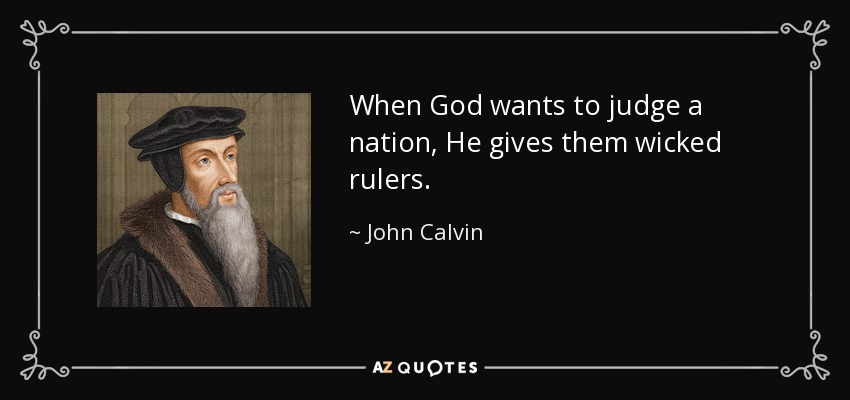
When God wants to judge a nation, He gives them wicked rulers.Or maybe you'd prefer the more biblical version.
When the righteous increase, the people rejoice, but when the wicked rule, the people groan. (Prov 29:2)Welcome to the 2016 Presidential Election.
Trumping the GOP
Over and over stories are coming out about Republicans declaring their support for Hillary. They're not just pulling support from Trump; they're throwing it behind Hillary. In the case of Meg Whitman, she actually said, "I have decided to support Hillary Rodham Clinton. It is clear to me that Secretary Clinton’s temperament, global experience and commitment to America's bedrock national values make her the far better choice in 2016 for President of the United States." Really? "Commitment to America's bedrock national values"?
I warned before that one of the serious dangers of Donald Trump is that he held the potential to explode the Republican party. That is, he has the capability of completely derailing anything remotely like a "platform", a "shared position", a "commitment to America's bedrock national values". Republicans no longer know what those are, apparently. Welcome to the end.
Going on in this destruction of anything remotely "Republican" or conservative, when Ted Cruz told Republicans to "vote your conscience", he got booed ... for starters. The vitriol that followed was amazing with prominent Republicans assuring America that Cruz had just ended his career. Because, you see, it is an anti-Republican, anti-conservative position to vote your conscience. Wait ... what? Of course, the anger from Republicans toward Cruz was over the fact that he did not declare his support of the Republican nominee for president. Bad! Bad senator! So why is it when Trump refuses to support Republicans running for office who actually did endorse him, no one particularly cares? This is what happens when you Trump the GOP.
More on Voting
I'm still having difficulty in deciding the course to take on voting this year. It came home to me the other day. This election cycle with its particular choice of candidates is like I'm being told, "You can shoot your wife or you can shoot your mother. No matter what, one of them will be shot. So choose." If I participate in electing Hillary -- placing my vote for her -- or in electing Trump -- marking his name on my ballot -- I believe I will be complicit in the evil they will perpetrate. I believe that the evil either will try to produce is far beyond what we've seen thus far. I cannot vote for a candidate who favors killing babies on demand (and having the government pay for it). Nor can I add my name to the list of people who asked Donald Trump to be our president. Which will I shoot? Neither. Will there be consequences? Without a doubt. I just don't want to be one who supported them. "But if you don't vote for Donald, you're voting for Hillary!" Not true. 1) A failure to vote for one is not a vote for the other. 2) Most states are not "battleground states". The outcome is known. If you live in one of those where the outcome is a given, your vote for or against the candidate you oppose will not change that. 3) I need to vote my conscience and leave the outcome to God. I recognize that others -- people whom I love and respect -- are not as limited in that as I am. But I can do nothing else.
Update on Slippery Slope
And then there's this. Dr. Stephen Kershnar has written a philosophical analysis of pedophilia. The Diagnostic and Statistical Manual of Mental Disorders, 5th Edition already recognizes pedophilia as a sexual orientation. Now (as expected ... slippery slope and all that) Dr. Kershnar is arguing that it is a "natural function", causes no harm to a "willing" child or the adult participant, and ought to be normalized as protected sexual orientation and moral behavior. Thus we can see that morality premised on the "harm factor" and sexual relations premised on "consent" don't work. Again, it's not a slippery slope fallacy if it happens.
Friday, June 26, 2015
Gay Marriage Ban
Just to be clear, one last time, as we wave goodbye to marriage and substitute something new and not wholly defined, but not marriage ...
For a long time I've had a "same-sex marriage" label I have applied to posts on the topic. I suppose I can retire it now. The news is announcing that "states cannot ban same-sex marriage." To be clear, no state has ever banned same-sex marriage that I'm aware of. They have defined marriage as "X" (you know ... the "X" that it has always been) and said "Anyone at all can participate in X", but no state to my knowledge has ever banned same-sex mirage (that's not a misspelling). If defining marriage as X is a ban, it is a ban on A-Z with the exception of X, not merely Q. When the news says, "Gays will be able to participate in marriage just like everyone else," they completely miss the point because they have always been able to participate in marriage like everyone else ... just not in something that has never been marriage and calling it marriage.
Having carefully, step by step in my lifetime, undercut and overturned marriage so far that there are no more foundations, we reach the end here where "everyone can participate" but we don't know in what. Polygamy (one guy marries multiple women)? Why not? Polyamory (multiple people of both genders marry)? On what basis can we say no? Why not allow marriage to a pet or a fence or yourself (it has been done)? Because we don't have a definition anymore.
The sad part, of course, is the loss of the image. While people clamor to remove the offense of the Confederate Flag and others wonder why, we have conveniently pulled down the marriage flag, a symbol of the great mystery of the relationship of Christ and the Church (Eph 5:31-32). There is controversy over removing the flag. The courts have ruled against marriage. And there is no substitute. But, of course, they won't have to answer to me for that. They'll have to answer to God. And God will not be pleased. Ask Moses about what happens when you assault the symbols God puts into place (Num 20:12).
________
Postscript: In 2003, the courts redefined marriage in Massachusetts. In 2008, the courts redefined marriage in Connecticut. In 2009, the courts redefined marriage in Iowa and Vermont; voters or the legislature changed the law in Washington DC and New Hampshire. In total, 11 states redefined marriage via voters or legislature. All the rest were forced into it by judicial action. Welcome to your democracy.
Update
This piece is just ... wow.
For a long time I've had a "same-sex marriage" label I have applied to posts on the topic. I suppose I can retire it now. The news is announcing that "states cannot ban same-sex marriage." To be clear, no state has ever banned same-sex marriage that I'm aware of. They have defined marriage as "X" (you know ... the "X" that it has always been) and said "Anyone at all can participate in X", but no state to my knowledge has ever banned same-sex mirage (that's not a misspelling). If defining marriage as X is a ban, it is a ban on A-Z with the exception of X, not merely Q. When the news says, "Gays will be able to participate in marriage just like everyone else," they completely miss the point because they have always been able to participate in marriage like everyone else ... just not in something that has never been marriage and calling it marriage.
Having carefully, step by step in my lifetime, undercut and overturned marriage so far that there are no more foundations, we reach the end here where "everyone can participate" but we don't know in what. Polygamy (one guy marries multiple women)? Why not? Polyamory (multiple people of both genders marry)? On what basis can we say no? Why not allow marriage to a pet or a fence or yourself (it has been done)? Because we don't have a definition anymore.
The sad part, of course, is the loss of the image. While people clamor to remove the offense of the Confederate Flag and others wonder why, we have conveniently pulled down the marriage flag, a symbol of the great mystery of the relationship of Christ and the Church (Eph 5:31-32). There is controversy over removing the flag. The courts have ruled against marriage. And there is no substitute. But, of course, they won't have to answer to me for that. They'll have to answer to God. And God will not be pleased. Ask Moses about what happens when you assault the symbols God puts into place (Num 20:12).
________
Postscript: In 2003, the courts redefined marriage in Massachusetts. In 2008, the courts redefined marriage in Connecticut. In 2009, the courts redefined marriage in Iowa and Vermont; voters or the legislature changed the law in Washington DC and New Hampshire. In total, 11 states redefined marriage via voters or legislature. All the rest were forced into it by judicial action. Welcome to your democracy.
"A system of government that makes the People subordinate to a committee of nine unelected lawyers does not deserve to be called a democracy." - Justice ScaliaPost-Postscript: Can anyone tell me how this ruling "unequivocally affirmed that equal justice under the law means marriage equality for gay, lesbian, bisexual and transgender Americans" as Pelosi said? I don't see any "marriage equality" (using their term) for bisexuals. They still only get to marry one gender. Oh, sorry, too much reality. (And for those of you who are going to object--"They can marry the person of their choice"--on what grounds do you limit it to only two people? We're still waiting for the new definitive definition of "marriage", and I can hardly wait to hear what creative basis you come up with to argue "only two".)
Update
This piece is just ... wow.
Tuesday, May 26, 2015
I Need a New Word
It just seems like yesterday my wife and I were married. Oh, no, we weren't married yesterday. It is ... let's see ... more than 22 years now. But I'm not talking about weddings. I'm talking about married. Because sometime in the first decade of the 21st century ... we stopped being married.
Now, calm yourself. My wife and I are still together. No divorce. Not even a hiccup. Still happily a couple. But sometime prior to 2008 the ground shifted and the earth opened up and swallowed "marriage". Oh, you and I still use the word. I mean, I still tell people I'm married and all. But the truth is that what I am to my wife that I term "married" is not what the culture at large means when they say "married." If I tell someone I'm married it's like describing what it's like to sit in a fire as "warm".
To be fair, I don't actually know what the term means today. While they went about wrenching it loose from its moorings and setting it adrift in this new direction, they didn't seem to set the sails, to keep the boating metaphor going. I mean, not only is it no longer what it used to mean, but it also seems that no one is able to explain to me what it means now let alone where it's going. They just tell me it doesn't mean what it has meant since time immemorial. And that's obviously true.
So, my wife and I are still ... hitched. We're still a couple. We're still husband and wife, united in one flesh for mutual support and for procreation for life. (Well, to be clear, we've done our procreation part.) I just don't have a word anymore for that thing. They took the perfectly good word I had and didn't bother leaving me a substitute. I wonder what word I can use now when I want to convey my marital status, since "single" is clearly wrong and "married" doesn't convey it properly anymore?
Now, calm yourself. My wife and I are still together. No divorce. Not even a hiccup. Still happily a couple. But sometime prior to 2008 the ground shifted and the earth opened up and swallowed "marriage". Oh, you and I still use the word. I mean, I still tell people I'm married and all. But the truth is that what I am to my wife that I term "married" is not what the culture at large means when they say "married." If I tell someone I'm married it's like describing what it's like to sit in a fire as "warm".
To be fair, I don't actually know what the term means today. While they went about wrenching it loose from its moorings and setting it adrift in this new direction, they didn't seem to set the sails, to keep the boating metaphor going. I mean, not only is it no longer what it used to mean, but it also seems that no one is able to explain to me what it means now let alone where it's going. They just tell me it doesn't mean what it has meant since time immemorial. And that's obviously true.
So, my wife and I are still ... hitched. We're still a couple. We're still husband and wife, united in one flesh for mutual support and for procreation for life. (Well, to be clear, we've done our procreation part.) I just don't have a word anymore for that thing. They took the perfectly good word I had and didn't bother leaving me a substitute. I wonder what word I can use now when I want to convey my marital status, since "single" is clearly wrong and "married" doesn't convey it properly anymore?
Friday, May 01, 2015
What Difference Does It Make?
The question that wins the argument: "How would gay marriage affect you and your marriage?" End of discussion. Point: "gay marriage". Or is it?
The question, as it turns out, is ludicrous. Think about it. The question is irrelevant. The relevant questions, like "Is it right?" or "Is it rational?" or even "Is it moral?" are set aside and the question is about a very limited effect. Here, think about this obvious contrast. Let's say that there was a measure up to legalize polyamory. Any number of people could marry any number of people. Is this not the same question? "How would that affect you and your marriage?" And it wouldn't, would it? No, go even sillier. Now there is a move to allow marrying inanimate objects. Again, "How would that affect you and your marriage?" What is the point of the question? How does it affect me and my marriage if people do stupid things and call it "marriage"? It doesn't. My marriage is my marriage. So the short-term effect is not the question.
Still, there are answers to the question. There are certain, likely, or potential outcomes to consider. I have four primary effects to suggest[1].
First, as we already know, marriage is in trouble in general. More and more people are opting out, either before they get into it or after. Divorce rates are high. Cohabitation (shacking up) rates are high. It is not uncommon to hear, "Why does a little piece of paper make a difference?" Clearly it does (or the whole question wouldn't be in the marketplace of ideas), but marriage is weaker today than it has ever been. According to the CDC just in this century marriage rates in America have dropped from 8.2 per 1,000 people to 6.8 per 1,000 people. Even the Huffington Post reported that marriage rates are at historic lows. Enter this new thing. Already marriage is on the verge of merely being an emotional attachment. We "marry for love" and when that is gone, we stop being married. That's not how it ought to be. That's not what it used to be. That's not what all of history and most of the major world's religions think of it. (And if you think I'm being too alarmist, it has already been proposed that 2-year renewable marriage licenses be issued to cut down on divorce problems.) Marriage is the union, physical and emotional, of a man and a woman with an eye toward children. It is the ideal family unit. It is the functional propagation of the species, the optimum environment for producing and raising children. But, look, let's strip that off, okay? Tina Turner asked, "What's love got to do with it?" We'll ask, "What have kids got to do with it?" And when we, as a society, push propagation out the back window of marriage and usher in "marry for love", it's a paradigm shift. No longer are spouses to maintain an unbroken relationship of commitment and cooperation for the family. Instead, it's a commitment to my emotions first. While traditional marriage brings social pressure to bear to keep couples and families together, redefining it will further ease that pressure and just let things dissolve as they may. Two of the worst things that have happened to marriage are contraception and "no-fault" divorce. One put families on hold, sometimes indefinitely, and the other made ending a lifelong commitment an easy thing. This new definition will simply push it that much further ... on both points.
Second, parenting is in jeopardy today. The skyrocketing rates of single parents is, frankly, frightening. Absentee fathers are a big problem, but mothers today are following similar trends, with more and more women making the news for killing or abusing their children. And why not? We are told that we need to find ourselves, to seek our own happiness. So why let those brats get in the way? Still, we all know that the best possible arrangement for raising children is a stable, mother-father, husband-wife home. There really is no question of that. And recent studies find, shock of shocks, that children fare better in traditional mom-dad families while same-sex parenting may have its risks. I know, I know, the American Psychological Association (APA) came out with its own study a short while ago and assured us that children of same-sex couples did just fine. Well, as it turns out, that whole study seems to be in question now. Enter a new definition of "married". Now the law will require that no regard be given to "husband-wife" marriages over "same-sex" unions ... because they're the same, right? Isn't that the point? They're the same? And then, as obscured as good parenting has become in recent decades, the ideal gets further obscured. The message is clear. Same-sex couples are just as good, just as appropriate, just as ideal as any other couple might be. And now it's the children who take the hit.
Third, we know that America is built on freedom and we know that this freedom includes, at its core, the freedom of religion. This very freedom, however, has caused a difficulty. Americans tend to confuse "equal protection" with "equal validity". Trying to suggest that, while all religions are protected under the law, not all are equally valid will likely get you into a fight. You're narrow-minded, judgmental, intolerant. Never mind that it's the only logical possibility. It's still wrong. Now throw in a governmental ruling on a moral issue that makes the moral issue not only legal, but endorsed. Say goodbye to your religious freedoms in the area of moral issues. And don't consider this a slippery slope argument because it's happening already. In Massachusetts Catholic Charities had to give up its adoption services because they would be required to ignore their principles in regard to placing children with same-sex couples. A student in California was banned from school for stating an opinion about the morality of homosexual behavior. A Court of Appeals in Massachusetts ruled that public schools may teach that homosexual relations are moral without regard for parental disagreement. A New Mexico photographer was sued and lost because she wasn't willing to do photos for a same-sex commitment ceremony. Oh, it's no nebulous slippery slope. It's happening. When the State rules that "marriage" now includes "same-sex" couples the fundamental freedom of religion and your right to express yourself on matters of morality will begin to see their legal end. And that's without even considering the tide of public opinion. It is already a "certainty" that if you stand for traditional marriage, you only do so out of hate and bigotry. It's a lie, but that kind of thinking is becoming more and more dominant and we would expect it to get worse, not better, if the State rules against traditional marriage.
The fourth issue is the change of the norm. When we changed from divorce to "no-fault divorce", the change wasn't simply to make things easier for people. The change produced a fundamental impression of what was normal. It became common to divorce simply because one or the other parties wanted the relationship to end. So no longer was a marriage "for life"; it was just until we decided we didn't want it anymore. The only reason required for divorce was "irreconcilable differences", which could mean just about anything at all. This is just an example of the shift of norm that the changing of laws produces. Adultery was once illegal just about everywhere, but over time we've dropped those laws. The upshot is that adultery has become viewed as relatively normal. Laws have been enacted to give unmarried couples the same rights as married couples and today the general sense is that not only is "shacking up" normal, it is recommended ... despite all the studies to the contrary. By changing the definition of marriage by force of law, we will have our sense of "normal" shifted again.
There are consequences to these things. It may look as if it won't matter. I will remain married to my wife in the same way that I always have, and I will continue to teach my children (okay, they're grown -- make it "grandchildren") right and wrong regardless of what my society says is moral. I will certainly lose some freedom of religion, but the Bible assures me that the animosity of the world is to be expected. And the world around me will continue to shift "normal morality" to match the changes. I have to point out, however, that all of this misses a very important point. Consider a situation that we all agree would be bad. What if they legalized heroin use? The same argument could be used. "Why would you care? How will it affect you?" And, in truth, it wouldn't in the sense that I still wouldn't be taking heroin, legal or not. On the other hand, it would have a large effect. Crime would change, and not necessarily for the better. Attitudes toward heroin use would change. There would be more users, more addicts, and more of the effects that such things cause. Society, then, would be paying for the impact of this new legal addiction. And the change would be permanent. Like Prohibition, it's not possible to put that genie back in the bottle. Legalizing heroin, it might be argued, won't change my life, but it will. It will change the face of the society in which I live and have multiple ramifications that will impact everyone, user or not. Even so with this radical redefinition of marriage. Sure, I'll remain married to my wife in the way I always have, but life will change for everyone in ways that not everyone recognizes will be unpleasant. The face of families will change. The face of parenting will change. The face of religious freedom will change. The face of normal morality will change. And those who would wish to affect change from these changes will be outlawed. Like putting toothpaste back into the tube.
________
The question, as it turns out, is ludicrous. Think about it. The question is irrelevant. The relevant questions, like "Is it right?" or "Is it rational?" or even "Is it moral?" are set aside and the question is about a very limited effect. Here, think about this obvious contrast. Let's say that there was a measure up to legalize polyamory. Any number of people could marry any number of people. Is this not the same question? "How would that affect you and your marriage?" And it wouldn't, would it? No, go even sillier. Now there is a move to allow marrying inanimate objects. Again, "How would that affect you and your marriage?" What is the point of the question? How does it affect me and my marriage if people do stupid things and call it "marriage"? It doesn't. My marriage is my marriage. So the short-term effect is not the question.
Still, there are answers to the question. There are certain, likely, or potential outcomes to consider. I have four primary effects to suggest[1].
First, as we already know, marriage is in trouble in general. More and more people are opting out, either before they get into it or after. Divorce rates are high. Cohabitation (shacking up) rates are high. It is not uncommon to hear, "Why does a little piece of paper make a difference?" Clearly it does (or the whole question wouldn't be in the marketplace of ideas), but marriage is weaker today than it has ever been. According to the CDC just in this century marriage rates in America have dropped from 8.2 per 1,000 people to 6.8 per 1,000 people. Even the Huffington Post reported that marriage rates are at historic lows. Enter this new thing. Already marriage is on the verge of merely being an emotional attachment. We "marry for love" and when that is gone, we stop being married. That's not how it ought to be. That's not what it used to be. That's not what all of history and most of the major world's religions think of it. (And if you think I'm being too alarmist, it has already been proposed that 2-year renewable marriage licenses be issued to cut down on divorce problems.) Marriage is the union, physical and emotional, of a man and a woman with an eye toward children. It is the ideal family unit. It is the functional propagation of the species, the optimum environment for producing and raising children. But, look, let's strip that off, okay? Tina Turner asked, "What's love got to do with it?" We'll ask, "What have kids got to do with it?" And when we, as a society, push propagation out the back window of marriage and usher in "marry for love", it's a paradigm shift. No longer are spouses to maintain an unbroken relationship of commitment and cooperation for the family. Instead, it's a commitment to my emotions first. While traditional marriage brings social pressure to bear to keep couples and families together, redefining it will further ease that pressure and just let things dissolve as they may. Two of the worst things that have happened to marriage are contraception and "no-fault" divorce. One put families on hold, sometimes indefinitely, and the other made ending a lifelong commitment an easy thing. This new definition will simply push it that much further ... on both points.
Second, parenting is in jeopardy today. The skyrocketing rates of single parents is, frankly, frightening. Absentee fathers are a big problem, but mothers today are following similar trends, with more and more women making the news for killing or abusing their children. And why not? We are told that we need to find ourselves, to seek our own happiness. So why let those brats get in the way? Still, we all know that the best possible arrangement for raising children is a stable, mother-father, husband-wife home. There really is no question of that. And recent studies find, shock of shocks, that children fare better in traditional mom-dad families while same-sex parenting may have its risks. I know, I know, the American Psychological Association (APA) came out with its own study a short while ago and assured us that children of same-sex couples did just fine. Well, as it turns out, that whole study seems to be in question now. Enter a new definition of "married". Now the law will require that no regard be given to "husband-wife" marriages over "same-sex" unions ... because they're the same, right? Isn't that the point? They're the same? And then, as obscured as good parenting has become in recent decades, the ideal gets further obscured. The message is clear. Same-sex couples are just as good, just as appropriate, just as ideal as any other couple might be. And now it's the children who take the hit.
Third, we know that America is built on freedom and we know that this freedom includes, at its core, the freedom of religion. This very freedom, however, has caused a difficulty. Americans tend to confuse "equal protection" with "equal validity". Trying to suggest that, while all religions are protected under the law, not all are equally valid will likely get you into a fight. You're narrow-minded, judgmental, intolerant. Never mind that it's the only logical possibility. It's still wrong. Now throw in a governmental ruling on a moral issue that makes the moral issue not only legal, but endorsed. Say goodbye to your religious freedoms in the area of moral issues. And don't consider this a slippery slope argument because it's happening already. In Massachusetts Catholic Charities had to give up its adoption services because they would be required to ignore their principles in regard to placing children with same-sex couples. A student in California was banned from school for stating an opinion about the morality of homosexual behavior. A Court of Appeals in Massachusetts ruled that public schools may teach that homosexual relations are moral without regard for parental disagreement. A New Mexico photographer was sued and lost because she wasn't willing to do photos for a same-sex commitment ceremony. Oh, it's no nebulous slippery slope. It's happening. When the State rules that "marriage" now includes "same-sex" couples the fundamental freedom of religion and your right to express yourself on matters of morality will begin to see their legal end. And that's without even considering the tide of public opinion. It is already a "certainty" that if you stand for traditional marriage, you only do so out of hate and bigotry. It's a lie, but that kind of thinking is becoming more and more dominant and we would expect it to get worse, not better, if the State rules against traditional marriage.
The fourth issue is the change of the norm. When we changed from divorce to "no-fault divorce", the change wasn't simply to make things easier for people. The change produced a fundamental impression of what was normal. It became common to divorce simply because one or the other parties wanted the relationship to end. So no longer was a marriage "for life"; it was just until we decided we didn't want it anymore. The only reason required for divorce was "irreconcilable differences", which could mean just about anything at all. This is just an example of the shift of norm that the changing of laws produces. Adultery was once illegal just about everywhere, but over time we've dropped those laws. The upshot is that adultery has become viewed as relatively normal. Laws have been enacted to give unmarried couples the same rights as married couples and today the general sense is that not only is "shacking up" normal, it is recommended ... despite all the studies to the contrary. By changing the definition of marriage by force of law, we will have our sense of "normal" shifted again.
There are consequences to these things. It may look as if it won't matter. I will remain married to my wife in the same way that I always have, and I will continue to teach my children (okay, they're grown -- make it "grandchildren") right and wrong regardless of what my society says is moral. I will certainly lose some freedom of religion, but the Bible assures me that the animosity of the world is to be expected. And the world around me will continue to shift "normal morality" to match the changes. I have to point out, however, that all of this misses a very important point. Consider a situation that we all agree would be bad. What if they legalized heroin use? The same argument could be used. "Why would you care? How will it affect you?" And, in truth, it wouldn't in the sense that I still wouldn't be taking heroin, legal or not. On the other hand, it would have a large effect. Crime would change, and not necessarily for the better. Attitudes toward heroin use would change. There would be more users, more addicts, and more of the effects that such things cause. Society, then, would be paying for the impact of this new legal addiction. And the change would be permanent. Like Prohibition, it's not possible to put that genie back in the bottle. Legalizing heroin, it might be argued, won't change my life, but it will. It will change the face of the society in which I live and have multiple ramifications that will impact everyone, user or not. Even so with this radical redefinition of marriage. Sure, I'll remain married to my wife in the way I always have, but life will change for everyone in ways that not everyone recognizes will be unpleasant. The face of families will change. The face of parenting will change. The face of religious freedom will change. The face of normal morality will change. And those who would wish to affect change from these changes will be outlawed. Like putting toothpaste back into the tube.
________
[1] I say "suggest", but, in fact, these are mostly derived from the effects already present in other countries where marriage was legally redefined to include two people of the same sex. All of these are already occurring in Canada, for instance. There is no reason we shouldn't anticipate the same. And as I've often said, a "slippery slope fallacy" is not a fallacy if it is already happening.
Tuesday, April 28, 2015
Gay Marriage in the Bible
Any casual reader of my stuff will know that the title is misleading if only because I don't believe that such a thing as "gay marriage" actually exists. As I have repeatedly and consistently held, marriage has a definition and "two people of the same sex" cannot be included in the definition any more than "four men and three women" or "a man and his goat" or any other of a large variety of other versions. So the title is somewhat misleading because 1) I don't believe in such a thing as "gay marriage" and 2) you won't find it in the Bible, either in defense or offense. It's not mentioned. Because it doesn't exist.
In the public domain, my argument against the subject is not a biblical one. I don't argue that it's immoral. I argue that marriage means something--has always had a core definition--and this is not it. It is not the same question as the morality of homosexual relations or the like. It is the meaning of the term.
Having said that, however, Christians ought to consider the question in light of what the Bible does say on the subject of marriage.
The first mention of marriage is, of course, Adam and Eve, where "a man shall leave his father and his mother and hold fast to his wife, and they shall become one flesh" (Gen 2:24) becomes the standard biblical concept. I call it "standard" because both Jesus (Matt 19:5) and Paul (Eph 5:31) refer to it as the explanation of marriage. "This is what marriage is." So at the beginning we have "man" and "woman" in union ("one flesh") for the purpose of mutual support (Gen 2:18) and procreation (Gen 1:28)[1].
After that, "marriage" becomes somewhat repetitive. That is, it simply references "husband" and "wife" (and, of course, children) ... over and over and over. Sometimes there were singular husbands with multiple wives--polygamy. But always "husband" and always "wife". Never "husbands" as in two of the same gender either married to one or more women or to each other.
It's only much later that instructions for marriage are offered. In Ephesians, for instance, Paul commands "Wives, submit to your own husbands as to the Lord" and "Husbands, love your wives as Christ loved the church" (Eph 5:22-33). He repeats something similar for the Colossians (Col 3:18-19). Marriage of women (to men) is assumed in most of Scripture as evidenced by the general command "train the young women to love their husbands and children" (Titus 2:4-5) or the instruction that women with questions at church should ask their husbands (1 Cor 14:35). When we come to Peter's comments on the topic, they are mostly the same ... but not quite. He tells wives, "Be subject to your own husbands" (1 Peter 3:1-6) but specifies beyond that they they should do so "even if some do not obey the word." He does not command husbands to love their wives, but, rather, to live with them in an understanding way and to honor them (1 Peter 3:7). This clearly supersedes any cultural "women are chattel" concepts as is so often falsely accused by Bible skeptics.
So, what have we learned? We've learned that there is no explicit statement in Scripture that says, "Two men cannot marry." Of course, if "a man shall leave his father and his mother and hold fast to his wife, and they shall become one flesh" is the biblical concept of marriage, then "Two men cannot marry" is nonsense ... since marriage is defined for us as "man" and "woman" in union. While the text does not say, "This is God's definition of marriage", it is quite clear that the Bible sees it as such given 1) the consistent use of this description in the New Testament and 2) lack of anything else. Beyond this, we have clear instructions for married couples. We know, for instance, that despite our society's aim to subvert this concept, the Bible teaches that "the head of every man is Christ, the head of a wife is her husband, and the head of Christ is God." (1 Cor 11:3) In fact, every marriage command is couched in "husband" and "wife" terms. Each role--husband and wife--has distinct commands (as in "the head of the wife is her husband" and "wives, submit to your husbands" as opposed to "the head of every man is Christ" and "husbands, live with your wives in an understanding way").
So, here we are. What does the Bible say about "gay marriage"? Nothing. Nothing at all. No reference, no hint, no subtle concept. Nothing. So, there are a few possibilities here. Maybe God didn't know that in the 21st century we'd be marrying men to men so He didn't have any input on that. Or maybe He knew and didn't have any commands that "husbands, submit to your husband" or "wives, submit to your wives" or otherwise. Heterosexual couples have commands; homosexual couples don't. Or maybe ... just maybe ... God defined marriage for us at the beginning and anything and everything that deviates from that is not marriage. Because trying to force "gay marriage" into anything remotely biblical on the subject is impossible, an argument from silence, completely in opposition to and incompatible with everything biblical about marriage.
So when "gay marriage" can be "husband" and "wife", "man" and "woman", a union for the purpose of mutual support and procreation like it's described in the Bible, then I'll be on board. Of course, that's just for Bible-believing Christians. The rest of you are on your own.
________
In the public domain, my argument against the subject is not a biblical one. I don't argue that it's immoral. I argue that marriage means something--has always had a core definition--and this is not it. It is not the same question as the morality of homosexual relations or the like. It is the meaning of the term.
Having said that, however, Christians ought to consider the question in light of what the Bible does say on the subject of marriage.
The first mention of marriage is, of course, Adam and Eve, where "a man shall leave his father and his mother and hold fast to his wife, and they shall become one flesh" (Gen 2:24) becomes the standard biblical concept. I call it "standard" because both Jesus (Matt 19:5) and Paul (Eph 5:31) refer to it as the explanation of marriage. "This is what marriage is." So at the beginning we have "man" and "woman" in union ("one flesh") for the purpose of mutual support (Gen 2:18) and procreation (Gen 1:28)[1].
After that, "marriage" becomes somewhat repetitive. That is, it simply references "husband" and "wife" (and, of course, children) ... over and over and over. Sometimes there were singular husbands with multiple wives--polygamy. But always "husband" and always "wife". Never "husbands" as in two of the same gender either married to one or more women or to each other.
It's only much later that instructions for marriage are offered. In Ephesians, for instance, Paul commands "Wives, submit to your own husbands as to the Lord" and "Husbands, love your wives as Christ loved the church" (Eph 5:22-33). He repeats something similar for the Colossians (Col 3:18-19). Marriage of women (to men) is assumed in most of Scripture as evidenced by the general command "train the young women to love their husbands and children" (Titus 2:4-5) or the instruction that women with questions at church should ask their husbands (1 Cor 14:35). When we come to Peter's comments on the topic, they are mostly the same ... but not quite. He tells wives, "Be subject to your own husbands" (1 Peter 3:1-6) but specifies beyond that they they should do so "even if some do not obey the word." He does not command husbands to love their wives, but, rather, to live with them in an understanding way and to honor them (1 Peter 3:7). This clearly supersedes any cultural "women are chattel" concepts as is so often falsely accused by Bible skeptics.
So, what have we learned? We've learned that there is no explicit statement in Scripture that says, "Two men cannot marry." Of course, if "a man shall leave his father and his mother and hold fast to his wife, and they shall become one flesh" is the biblical concept of marriage, then "Two men cannot marry" is nonsense ... since marriage is defined for us as "man" and "woman" in union. While the text does not say, "This is God's definition of marriage", it is quite clear that the Bible sees it as such given 1) the consistent use of this description in the New Testament and 2) lack of anything else. Beyond this, we have clear instructions for married couples. We know, for instance, that despite our society's aim to subvert this concept, the Bible teaches that "the head of every man is Christ, the head of a wife is her husband, and the head of Christ is God." (1 Cor 11:3) In fact, every marriage command is couched in "husband" and "wife" terms. Each role--husband and wife--has distinct commands (as in "the head of the wife is her husband" and "wives, submit to your husbands" as opposed to "the head of every man is Christ" and "husbands, live with your wives in an understanding way").
So, here we are. What does the Bible say about "gay marriage"? Nothing. Nothing at all. No reference, no hint, no subtle concept. Nothing. So, there are a few possibilities here. Maybe God didn't know that in the 21st century we'd be marrying men to men so He didn't have any input on that. Or maybe He knew and didn't have any commands that "husbands, submit to your husband" or "wives, submit to your wives" or otherwise. Heterosexual couples have commands; homosexual couples don't. Or maybe ... just maybe ... God defined marriage for us at the beginning and anything and everything that deviates from that is not marriage. Because trying to force "gay marriage" into anything remotely biblical on the subject is impossible, an argument from silence, completely in opposition to and incompatible with everything biblical about marriage.
So when "gay marriage" can be "husband" and "wife", "man" and "woman", a union for the purpose of mutual support and procreation like it's described in the Bible, then I'll be on board. Of course, that's just for Bible-believing Christians. The rest of you are on your own.
________
[1] For those of you, Christians and skeptics, who wish to disagree with "for mutual support and procreation", let me say this. These are the aims, not the "definition". You know that. I know that. In biblical terms, a woman who was barren in Scripture was still married. She didn't like being barren, but it didn't dissolve the union. By the same token, if a wife ends up taking care of her husband after a traumatic brain injury, for instance, we wouldn't suggest he is no longer married because he is not offering mutual support. It's the aim, but not the definition. Thus, defining marriage as "the union of a man and a woman for the purpose of mutual support and procreation" works fine as long as we understand that "the purpose" in that statement doesn't require success, just intent. A husband who marries with no intention of offspring or a wife who marries with no expectation that she'll be supportive of her husband (examples, mind you) are not entering into a marriage that is the same aim as the biblical marriage.
Saturday, February 07, 2015
As Predicted
You can't make this stuff up. Filed under the 'told you so heading, a woman in Houston married herself.
I've complained (often) in the past that the definition of marriage being imposed on us by the 2.5% and the courts has no substance. This redefining of marriage is removing a definition. Here, look in any dictionary for a definition. Regardless of which one you take, there is a common core--union. Whether it is interpersonal relationships or some sort of melding of, say, technology and art, for instance, it is a union. But as this woman illustrates, our version today is without definition.
It would appear that I have been wrong all along. I've claimed consistently that it is a redefinition of marriage to include "gay marriage". It is not. It is an undefinition. It is a removal of definition. So when they ask, "What difference will it make if we allow gay marriage?" I will point to that. It isn't inclusion. It is dissolution. Marriage itself is being dissolved. And I find no one offering any rationale to suggest that marrying herself or marrying your pet or marrying three other people should not be included since we appear to no longer have a definition of the term. Oh, the humanity! Who will stand up for the rights of those who wish to marry their fence?? Whatever "marry" might mean.
I've complained (often) in the past that the definition of marriage being imposed on us by the 2.5% and the courts has no substance. This redefining of marriage is removing a definition. Here, look in any dictionary for a definition. Regardless of which one you take, there is a common core--union. Whether it is interpersonal relationships or some sort of melding of, say, technology and art, for instance, it is a union. But as this woman illustrates, our version today is without definition.
It would appear that I have been wrong all along. I've claimed consistently that it is a redefinition of marriage to include "gay marriage". It is not. It is an undefinition. It is a removal of definition. So when they ask, "What difference will it make if we allow gay marriage?" I will point to that. It isn't inclusion. It is dissolution. Marriage itself is being dissolved. And I find no one offering any rationale to suggest that marrying herself or marrying your pet or marrying three other people should not be included since we appear to no longer have a definition of the term. Oh, the humanity! Who will stand up for the rights of those who wish to marry their fence?? Whatever "marry" might mean.
Friday, October 17, 2014
Another One Bites the Dust
In 1996 Arizona passed a law defining marriage as the union of a man and a woman. In 2008, the voters pushed it further, by a large margin, to make that definition a part of the State constitution. And in early October U.S. District Judge John Sedwick decided to outlaw marriage. When the Supreme Court decided not to hear any of the cases from states defending their constitutional definitions of marriage, the court effectively redefined marriage for 11 states. Not rationally, of course. It didn't matter that the states had spoken. It didn't matter that the laws were passed, the constitutions were made, the definition was set. All that mattered was the new, false definition had to be allowed to replace the definition that has been in place for all recorded human history and made law in those states.
Will you notice? Not likely. The media is reporting that they've struck down a "gay marriage ban". This is what is known as "a lie".. The news outlets are celebrating freedom. This isn't entirely honest either, since those who will find themselves forced by law and by arms if necessary to support such ceremonies as florists, photographers, bakers, and the like will have no recourse. A matter of principle? No, not really. Your principles are legally irrelevant. They say that it's a big step forward. Not so. Sticking the knife into the neck of the suffering institution of marriage can't be a step forward.
Marriage in Arizona, along with Alaska and Wyoming, went down today. It won't go quietly. The rationale one man on the street offered was, "It's America. People should be allowed to do whatever they want ... you know, as long as it doesn't hurt anyone." Oh, it's gonna hurt. But the damage will be slow and deep ... like the proverbial frog in the pot. Unfortunately it's likely the next generation who will be stewed in the process. But since marriage was God's idea, I suspect that the final response from Him toward those who have stolen it and murdered it will be more unpleasant the what we will see in our lifetime.
Update:
This just in. "The city of Coeur d’Alene, Idaho, is taking a step many opponents of same-sex marriage feared would come – forcing those with religious objections to perform same-sex marriages or risk facing prosecution for violating non-discrimination laws." Now, the line is somewhat misleading--the ruling is for a wedding chapel, not a church--but it doesn't matter. When they tell you "It won't make any difference to you!" don't believe it.
Will you notice? Not likely. The media is reporting that they've struck down a "gay marriage ban". This is what is known as "a lie".. The news outlets are celebrating freedom. This isn't entirely honest either, since those who will find themselves forced by law and by arms if necessary to support such ceremonies as florists, photographers, bakers, and the like will have no recourse. A matter of principle? No, not really. Your principles are legally irrelevant. They say that it's a big step forward. Not so. Sticking the knife into the neck of the suffering institution of marriage can't be a step forward.
Marriage in Arizona, along with Alaska and Wyoming, went down today. It won't go quietly. The rationale one man on the street offered was, "It's America. People should be allowed to do whatever they want ... you know, as long as it doesn't hurt anyone." Oh, it's gonna hurt. But the damage will be slow and deep ... like the proverbial frog in the pot. Unfortunately it's likely the next generation who will be stewed in the process. But since marriage was God's idea, I suspect that the final response from Him toward those who have stolen it and murdered it will be more unpleasant the what we will see in our lifetime.
Update:
This just in. "The city of Coeur d’Alene, Idaho, is taking a step many opponents of same-sex marriage feared would come – forcing those with religious objections to perform same-sex marriages or risk facing prosecution for violating non-discrimination laws." Now, the line is somewhat misleading--the ruling is for a wedding chapel, not a church--but it doesn't matter. When they tell you "It won't make any difference to you!" don't believe it.
Saturday, September 13, 2014
The Tide Rolls In
Okay, in case you were unclear, here's how it works.
Two Arizona men went to California to get what California calls "married". They went to California because the Arizona State Constitution does not recognize marriage as the union of a man and a man. So they went to where it was recognized. "So?" you may ask. "What difference does that make?" Well, you might think it makes no difference. Marriage is still defined as the union of a man and a woman in Arizona. But it may not last.
As the story unfolds, one of the two men died of cancer. The surviving man sued to have his name listed on the death certificate as "surviving spouse", making him eligible for death benefits. Sued? Yes, because the state didn't recognize him as married. But U.S. District Judge John Sedwick allowed it and "signaled that Arizona's gay marriage ban may not hold up after he hears a broader challenge to the constitutionality of the law."
You see, that's how it works. The plaintiff, Fred McQuire, said it was "something as simple and sensitive as a death certificate." No big deal. But it isn't the case. No matter how it is accomplished, marriage will be overridden. Californians voted to put it in their state law and the courts threw it out as unconstitutional. So they voted to put it in their constitution and the courts threw it out again. Now any state that stands for a definition of marriage that has been the traditional, longstanding, historical definition is being sued. And other methods, like this "We'll go someplace where it's legal and then force the place we live where it isn't legal to recognize it and that should help eliminate the longstanding, traditional, historical definition."
Why did the judge rule in his favor? The judge ruled that McQuire "demonstrated that he faced irreparable emotional harm" from not being allowed to be listed as the surviving spouse. Note that it was specifically not financial consequences. When we start determining truth from a person's perception of "emotional harm", we are lost.
Now, I could complain again about the false statement that Arizona has a ban on gay marriage, but who's listening, right? Clearly it is not a matter of logic, a matter of history, a matter of reasoning, a matter of the will of the people, a matter of what's right. It's a matter of an extreme minority coercing an entire population to redefine a key societal concept and claiming it is a constitutional right so loudly that no one seems to be able to hear the truth anymore.
And here's the kicker paragraph in the story.
So all of you that urge me to vote for the most conservative candidate even if he's not a good candidate because "Think of the judges he may appoint", you're going to have to do better than that. Because these judges appointed by conservative presidents do not have a very good track record.
Two Arizona men went to California to get what California calls "married". They went to California because the Arizona State Constitution does not recognize marriage as the union of a man and a man. So they went to where it was recognized. "So?" you may ask. "What difference does that make?" Well, you might think it makes no difference. Marriage is still defined as the union of a man and a woman in Arizona. But it may not last.
As the story unfolds, one of the two men died of cancer. The surviving man sued to have his name listed on the death certificate as "surviving spouse", making him eligible for death benefits. Sued? Yes, because the state didn't recognize him as married. But U.S. District Judge John Sedwick allowed it and "signaled that Arizona's gay marriage ban may not hold up after he hears a broader challenge to the constitutionality of the law."
You see, that's how it works. The plaintiff, Fred McQuire, said it was "something as simple and sensitive as a death certificate." No big deal. But it isn't the case. No matter how it is accomplished, marriage will be overridden. Californians voted to put it in their state law and the courts threw it out as unconstitutional. So they voted to put it in their constitution and the courts threw it out again. Now any state that stands for a definition of marriage that has been the traditional, longstanding, historical definition is being sued. And other methods, like this "We'll go someplace where it's legal and then force the place we live where it isn't legal to recognize it and that should help eliminate the longstanding, traditional, historical definition."
Why did the judge rule in his favor? The judge ruled that McQuire "demonstrated that he faced irreparable emotional harm" from not being allowed to be listed as the surviving spouse. Note that it was specifically not financial consequences. When we start determining truth from a person's perception of "emotional harm", we are lost.
Now, I could complain again about the false statement that Arizona has a ban on gay marriage, but who's listening, right? Clearly it is not a matter of logic, a matter of history, a matter of reasoning, a matter of the will of the people, a matter of what's right. It's a matter of an extreme minority coercing an entire population to redefine a key societal concept and claiming it is a constitutional right so loudly that no one seems to be able to hear the truth anymore.
And here's the kicker paragraph in the story.
"The court has not yet decided whether there is a conflict between Arizona law and the Constitution, but the court has decided that it is probable that there is such a conflict that Arizona will be required to permit same-sex marriages," said Sedwick, who was nominated to the federal bench in 1992 by President George H.W. Bush.First, there is no recognition that "same-sex marriage" is a non sequitur. Fine. Second, there is no recognition that Arizona already answered the question because the courts -- the courts, mind you -- are going to decide that "Arizona will be required" to redefine marriage. Most chilling, though, is the tail tacked on the end. This judge was an appointee of a conservative president.
So all of you that urge me to vote for the most conservative candidate even if he's not a good candidate because "Think of the judges he may appoint", you're going to have to do better than that. Because these judges appointed by conservative presidents do not have a very good track record.
Wednesday, August 27, 2014
The Bibical Option
The whole "homosexual" debate has not cooled down. As our society shifts its moral view to amorality -- mostly "anything goes" -- Bible-believing Christians are still forced to hang onto their "homosexual behavior is a sin" position or surrender the Bible as a viable book of truth at all. Between these two extremes are a million shades of opinion.
Part of the difficulty in this dialog is, as seems to often be the case, a definition of terms. "Gay", which used to mean "happy", became "homosexual" and "homosexual", which used to be sexual interaction between two people of the same sex, became a lifestyle rather than an activity. You no longer had a "sexual preference"; you had an "orientation". Interestingly, we can see this very evolution of terms in the translations of the Bible. The King James Bible translates ἀρσενοκοίτης -- arsenokoitēs -- in 1 Cor 6:9 "abusers of themselves with mankind." Kind of a generic concept. A later translation, Young's Literal Translation, prefers "sodomites", a reference to a particular sexual act. Later still, the New American Standard uses "homosexuals" since the term "homosexual" was now available to the English language. (It wasn't used prior to until 1869.) But it changed its meaning again, so the most recent ESV uses the phrase "men who practice homosexuality" because the practice is in view here, not the modern "gay as a state of being" kind of thinking. So we've come up against these "gay Christian" debates. The question is already hazy, you see? Are you talking about the behavior or the same-sex attraction? Are you talking about the lifestyle or the act?
The Bible does not comment on the temptations of individuals that we use to define people today. It doesn't reference heterosexuals as a definition of a type of person, for instance. You are an adulterer not by virtue of any temptation to the deed, but by violating the moral law on the deed. A woman tempted to steal is not a thief until she steals. A man who thinks of lying but tells the truth is not a liar until he fails to tell the truth. The Bible defines people by their sins, not by their temptations. So "homosexual" in today's use of the term isn't really addressed in the Bible.
What is the biblical option? Is there anything in the Bible that suggests what a person of same-sex attraction should do in order to remain in line with biblical morality? I know. The answer most people who agree with Scripture about the morality of the act would expect would be "gay reparation therapy". Get free of the desire! Oddly enough, I have to admit I don't find it in my Bible. Well, of course I don't. They didn't think that way about that particular sin. To the mind of biblical writers, mankind is sinful by nature and we choose what actions we will make in response. So what does the Bible say on this?
Believe it or not, Jesus gives the answer to that question. In Matthew 19 the Pharisees tested Him with a question on divorce. Jesus's response provides a confirmed definition of marriage.
But, as it turns out, the Bible is abundantly clear on biblical morality regarding sexual activity. It is only moral if it occurs in the marriage bed. Thus, it cannot be classified as moral outside of marriage, and marriage is defined as the union of a man and a woman. This rules out any sexual relations between people who are not married and, by definition, absolutely eliminates the possibility of moral sexual relations between two people of the same sex.
The disciples were struck with Jesus's response. They saw the enormity of it. They understood that divorce was right out. So they parried, "If such is the case of a man with his wife, it is better not to marry" (Matt 19:10). And here was Jesus's response to them.
And there, dear readers, is the biblical option. If a person finds himself or herself with same-sex attraction, is a genuine Christian, and wishes to follow the instructions of Christ, there are options. He or she can take efforts to find and marry someone of the opposite sex (because marrying someone of the same sex is not marriage) and engage in the standard heterosexual practices (1 Cor 7:2-5). You might think of this as reparative therapy. Or, he or she can be a eunuch -- celibate. In this way and only in this way can a person (using current terminology) be classified as a "gay Christian". (Remember, Jesus said, "If you love Me you will keep My commandments.") I would classify a person who has same-sex attractions that he or she does not indulge just as Christian as a heterosexual who is not married and remains celibate. That seems to be the biblical position. There are options for the modern "gay Christian". Don't let anyone tell you otherwise. However, "God made me this way, so I should be allowed to violate the biblical standards on this" is not one of them.
Part of the difficulty in this dialog is, as seems to often be the case, a definition of terms. "Gay", which used to mean "happy", became "homosexual" and "homosexual", which used to be sexual interaction between two people of the same sex, became a lifestyle rather than an activity. You no longer had a "sexual preference"; you had an "orientation". Interestingly, we can see this very evolution of terms in the translations of the Bible. The King James Bible translates ἀρσενοκοίτης -- arsenokoitēs -- in 1 Cor 6:9 "abusers of themselves with mankind." Kind of a generic concept. A later translation, Young's Literal Translation, prefers "sodomites", a reference to a particular sexual act. Later still, the New American Standard uses "homosexuals" since the term "homosexual" was now available to the English language. (It wasn't used prior to until 1869.) But it changed its meaning again, so the most recent ESV uses the phrase "men who practice homosexuality" because the practice is in view here, not the modern "gay as a state of being" kind of thinking. So we've come up against these "gay Christian" debates. The question is already hazy, you see? Are you talking about the behavior or the same-sex attraction? Are you talking about the lifestyle or the act?
The Bible does not comment on the temptations of individuals that we use to define people today. It doesn't reference heterosexuals as a definition of a type of person, for instance. You are an adulterer not by virtue of any temptation to the deed, but by violating the moral law on the deed. A woman tempted to steal is not a thief until she steals. A man who thinks of lying but tells the truth is not a liar until he fails to tell the truth. The Bible defines people by their sins, not by their temptations. So "homosexual" in today's use of the term isn't really addressed in the Bible.
What is the biblical option? Is there anything in the Bible that suggests what a person of same-sex attraction should do in order to remain in line with biblical morality? I know. The answer most people who agree with Scripture about the morality of the act would expect would be "gay reparation therapy". Get free of the desire! Oddly enough, I have to admit I don't find it in my Bible. Well, of course I don't. They didn't think that way about that particular sin. To the mind of biblical writers, mankind is sinful by nature and we choose what actions we will make in response. So what does the Bible say on this?
Believe it or not, Jesus gives the answer to that question. In Matthew 19 the Pharisees tested Him with a question on divorce. Jesus's response provides a confirmed definition of marriage.
"Have you not read that He who created them from the beginning made them male and female, and said, 'Therefore a man shall leave his father and his mother and hold fast to his wife, and the two shall become one flesh'? So they are no longer two but one flesh. What therefore God has joined together, let not man separate." (Matt 19:4-6).It is unavoidable both in human history and in biblical text that the definition of marriage is "man and woman joined". But the question at hand is not marriage. The question is regarding sexual activity, specifically for the "homosexual".
But, as it turns out, the Bible is abundantly clear on biblical morality regarding sexual activity. It is only moral if it occurs in the marriage bed. Thus, it cannot be classified as moral outside of marriage, and marriage is defined as the union of a man and a woman. This rules out any sexual relations between people who are not married and, by definition, absolutely eliminates the possibility of moral sexual relations between two people of the same sex.
The disciples were struck with Jesus's response. They saw the enormity of it. They understood that divorce was right out. So they parried, "If such is the case of a man with his wife, it is better not to marry" (Matt 19:10). And here was Jesus's response to them.
"Not everyone can receive this saying, but only those to whom it is given. For there are eunuchs who have been so from birth, and there are eunuchs who have been made eunuchs by men, and there are eunuchs who have made themselves eunuchs for the sake of the kingdom of heaven. Let the one who is able to receive this receive it." (Matt 19:11-12)What is Jesus saying here? Jesus admits that it is austere. "Not everyone can receive this saying." Then He gives two options. You may marry and engage in genuine, godly, beautiful sexual union, or you can be a eunuch. Jesus defines three types of eunuch -- "from birth", "by men", or "made themselves". That is, a person can be born with the nature of celibacy, can be forced into celibacy by others, or can choose to be celibate "for the sake of the kingdom of heaven."
And there, dear readers, is the biblical option. If a person finds himself or herself with same-sex attraction, is a genuine Christian, and wishes to follow the instructions of Christ, there are options. He or she can take efforts to find and marry someone of the opposite sex (because marrying someone of the same sex is not marriage) and engage in the standard heterosexual practices (1 Cor 7:2-5). You might think of this as reparative therapy. Or, he or she can be a eunuch -- celibate. In this way and only in this way can a person (using current terminology) be classified as a "gay Christian". (Remember, Jesus said, "If you love Me you will keep My commandments.") I would classify a person who has same-sex attractions that he or she does not indulge just as Christian as a heterosexual who is not married and remains celibate. That seems to be the biblical position. There are options for the modern "gay Christian". Don't let anyone tell you otherwise. However, "God made me this way, so I should be allowed to violate the biblical standards on this" is not one of them.
Thursday, August 07, 2014
False Advertising
Here in Arizona, like many other states, we wait for a ruling on what the news outlets refer to as the "gay marriage ban". Ladies and gentleman, welcome to the world of false advertising. Well, okay, maybe "advertising" is the wrong term. Shall we call it what it is? Lying. Nothing more. Nothing less.
What is happening? (And, please note, it isn't just Arizona -- it has either happened or is happening in almost every state in the Union.) Well, Arizona, like many other states, as part of their Constitution made a definition of marriage as the union of a man and a woman. According to every single media outlet -- printed, radio, television, Internet -- that I can find, this constitutes a "gay marriage ban". Now, why is that?
Here's how definitions work. If we define "bleevoid" (a word I just made up to avoid conflict) as "a green and red striped circle", what do we know? We know that our bleevoid is ... wait for it ... a green and red striped circle. But we actually know a lot more. We know that a bleevoid is not an animal. It does not have four paws. It is not a tree or a ficus plant. It isn't a person. No human being is "a green and red striped circle". I suppose there are some bleevoid fans that might dress up as a bleevoid and be a bleevoid imitator, but they would not be actual bleevoids. Our fictitious item, then, is one thing ... by definition. Anything else is not a bleevoid. So let me ask you. Would you consider this a "ban on animals, plants, and people"? Well, by its nature, it does exclude these things, but the point of a definition is to ... define something. Defining something precludes everything else.
So, Arizona, like so many other states, with the vote of the people, like so many other states, determined to define "marriage" in the way that every other society in history has done as the union of a man and a woman. Is this a "gay marriage ban"? Well, I suppose, if you want to be technical, it is. It is a ban on cats marrying cats, dogs marrying dogs, women marrying fence posts, men marrying five women, four guys marrying three gals, and any other random and bizarre combination you might care to think of. (Please note: I didn't make up a single one of those possibilities. People have suggested all of them.)
It is, therefore, false advertising to suggest that a definition of marriage as it has always been defined is a "ban" on anything. What is the truth? The truth is that what will likely be overturned in Arizona as it was in California, Utah, Virginia, Oklahoma, and will be in nearly every state going forward is a definition. Make no mistake. It isn't a ban being overturned. It is a definition. When you hear "marriage equity" and "equal rights" arguments, remember this. It is not "equal rights" or "marriage equity". It is "marriage redefinition". We know this because it is a definition that is being challenged. And please note in addition that I don't have to go to religion, the Bible, or moral outrage to make this case. It simply is a fact. The aim is not "equal rights" or "marriage equity" unless they will admit that by "marriage equity" they mean "an equal definition of marriage that does not match anything prior to this and is only applicable to the new definition we give it to suit ourselves" (because, after all, they are sternly -- and arbitrarily -- denying the admission of polygamy, polyamory, bestiality, or the marrying of inanimate objects as part of their definition).
Look, you are obviously going to decide what you think is right here. Just don't buy the patent lie that it's about a "gay marriage ban." It is not about "love" or "equal rights" or any such thing. It is definitively about a marriage definition. It cannot be otherwise.
What is happening? (And, please note, it isn't just Arizona -- it has either happened or is happening in almost every state in the Union.) Well, Arizona, like many other states, as part of their Constitution made a definition of marriage as the union of a man and a woman. According to every single media outlet -- printed, radio, television, Internet -- that I can find, this constitutes a "gay marriage ban". Now, why is that?
Here's how definitions work. If we define "bleevoid" (a word I just made up to avoid conflict) as "a green and red striped circle", what do we know? We know that our bleevoid is ... wait for it ... a green and red striped circle. But we actually know a lot more. We know that a bleevoid is not an animal. It does not have four paws. It is not a tree or a ficus plant. It isn't a person. No human being is "a green and red striped circle". I suppose there are some bleevoid fans that might dress up as a bleevoid and be a bleevoid imitator, but they would not be actual bleevoids. Our fictitious item, then, is one thing ... by definition. Anything else is not a bleevoid. So let me ask you. Would you consider this a "ban on animals, plants, and people"? Well, by its nature, it does exclude these things, but the point of a definition is to ... define something. Defining something precludes everything else.
So, Arizona, like so many other states, with the vote of the people, like so many other states, determined to define "marriage" in the way that every other society in history has done as the union of a man and a woman. Is this a "gay marriage ban"? Well, I suppose, if you want to be technical, it is. It is a ban on cats marrying cats, dogs marrying dogs, women marrying fence posts, men marrying five women, four guys marrying three gals, and any other random and bizarre combination you might care to think of. (Please note: I didn't make up a single one of those possibilities. People have suggested all of them.)
It is, therefore, false advertising to suggest that a definition of marriage as it has always been defined is a "ban" on anything. What is the truth? The truth is that what will likely be overturned in Arizona as it was in California, Utah, Virginia, Oklahoma, and will be in nearly every state going forward is a definition. Make no mistake. It isn't a ban being overturned. It is a definition. When you hear "marriage equity" and "equal rights" arguments, remember this. It is not "equal rights" or "marriage equity". It is "marriage redefinition". We know this because it is a definition that is being challenged. And please note in addition that I don't have to go to religion, the Bible, or moral outrage to make this case. It simply is a fact. The aim is not "equal rights" or "marriage equity" unless they will admit that by "marriage equity" they mean "an equal definition of marriage that does not match anything prior to this and is only applicable to the new definition we give it to suit ourselves" (because, after all, they are sternly -- and arbitrarily -- denying the admission of polygamy, polyamory, bestiality, or the marrying of inanimate objects as part of their definition).
Look, you are obviously going to decide what you think is right here. Just don't buy the patent lie that it's about a "gay marriage ban." It is not about "love" or "equal rights" or any such thing. It is definitively about a marriage definition. It cannot be otherwise.
Tuesday, July 01, 2014
Times They Are A-changin'
So a majority may have decided that marriage is actually the union of a man and a woman and it is not the union of anything else and a majority may have voted that their state constitutions will reflect just that, but times are changing. If the shifting tide of public opinion hasn't overturned that, either the legislature or the judiciary has ... or will. Currently 19 states and the District of Columbia have redefined "marriage" to include same-sex unions. Only 3 of them were by popular vote. Eight were by State legislature and 8 others by court decisions. Of the rest, 31 states have defined marriage as it has always been defined and hold either constitutional amendments or state laws or both to keep it that way. Most of these are either in the courts defending these positions, facing repeals already, or about to be. The Washington Post says that there is no state in America that has not either allowed same-sex marriage or has had the standard, historical, longstanding, traditional definition of marriage definition challenged in court. Ten states have had their definition declared unconstitutional, pending appeal, and the rest are being challenged. Your vote on this issue doesn't count. You will accept new definitions and you will like it.
So what? So what if marriage is redefined? So what if they change things around? I mean, they're not undefining it, right? That is, it still includes the union of a man and a woman, doesn't it? So why do you care?
On the surface it may look like nothing changes for traditional marriage supporters, but this would be a naïve perspective. You can't rip out the foundation of a building and expect it to continue standing as it always has. So what can we expect?
If "marriage" is now defined as "two people who love each other and want to commit to each other", we're at a different place. Almost immediately the question arises "Why two?" On what shaky ground do we base the prohibition of three or four or more? Most pro-marriage folk argue that marriage is the union of one man and one woman, but history suggests that this isn't necessarily the limit, so defending it today as such is questionable. And to avoid the accusation of a "slippery slope" argument, it must be pointed out that last December a federal judge declared that Utah laws criminalizing polygamy were unconstitutional. It's not a slippery slope argument if it actually happens.
Next, when "marriage" no longer means "man and woman", then polyamory is around the corner. Canadian courts have already heard arguments on it and American courts expect the same. Without the undergirdings, then, of the historical, longstanding, traditional definition, the edifice of marriage shifts again.
So, having ruled out "man and woman" and "one" -- one man and one woman -- as definitive for the term, marriage, there remains no basis for monogamy. The fact that many anti-marriage advocates (those who call same-sex unions "marriage") overtly make this claim ought to be an eye-opener. The fact that many in the homosexual world openly admit that monogamy is outdated in their view and "marriage for life" is pointless ought to be a wake-up call. You can't go down this path without shredding the entire structure.
With the historical, longstanding, traditional definition of marriage out the window, you also will have to consider the eternal concept of family as unsupportable. It has always been known that a family works best when a children have a mother and a father and that, when they don't, it's a problem, not an asset. But today's redefinition of "marriage" coupled irrevocably with the redefinition of gender means that "father" and "mother" are fluid terms and of questionable necessity. What's wrong with "father and father" or "mother and mother"? How is the traditional concept better? So the certainty that children are better off with a loving mother and a loving father than anything else is out and children will suffer the consequences.
For Christians, there is more. When God created us, "male and female created He them" (Gen 1:27). God defined marriage as "a man shall leave his father and his mother and hold fast to his wife, and they shall become one flesh" (Gen 2:24) and Jesus confirmed it (Matt 19:5-6). The exclusivity of male and female marriage in Scripture cannot be avoided. Paul wrote, "Each man should have his own wife and each woman her own husband" (1 Cor 7:2), and there is no room for anything else in that. And why did God institute the union of a man and a woman as marriage? For "godly offspring" (Mal 2:14-15). So God has laid down a definition -- man and woman -- and a purpose -- godly offspring -- and it is not possible to fit "same-sex unions" into any of that. Of course, you can ask Phil Robertson (no hero of mine -- just an example) what the world thinks of God's view of the topic (1 Cor 6:9-10). It is "homophobic", "hateful", "anti-gay", "bigoted" ... you can fill in the list for yourself. So if you believe in the truth of Scripture and the sufficiency of Scripture, then you will be a problem in this new world of "marriage" that doesn't mean what they think it means. And how could you not be a problem? You're a follower of an archaic God who hates the homosexual and an archaic tradition that the Holy Spirit would lead His own into the truth when clearly He never did. The enlightened "believer" today knows that history has always been wrong, the Church has always been wrong, tradition has always been wrong, the Bible has always been wrong, and if you hold to all that Church and Bible and history and orthodoxy stuff, you're an idiot and a threat.
There is one more thing you lose when we go down this path. The Bible tells of the classic story of David and Jonathan, two men who loved each other. The Bible says that when the rich young ruler asked Jesus what he had to do to inherit eternal life, Jesus "loved him" (Mark 10:17-21). We are commanded to love one another. But in this new climate that connects love and sex and does so without regard to morality, one important thing you will lose will be the ability, regulated by outside forces, to love one another. If you do, you will be regarded as homosexual. If you deny it, you will be regarded as homophobic 1.
What do you lose when you redefine marriage?
- A basis for monogamy, either in terms of marriage to one person or in terms of sexual monogamy -- fidelity to one person.
- A basis for definition. Marriage can be two people of the opposite sex or same sex or more than two. It can include incestuous relationships and perhaps not even be limited to humans.
- A basis for preference to have a mother and a father for children.
- A reliable Bible, followed by Christianity (since a reliable Bible is required to have a basis for Christianity) and ending up with religious freedom (if being a Bible-believing Christian is your aim).
- The freedom to openly, biblically love someone of the same gender (you know, as we're commanded) without the accusation of being homosexual.
Oh, yeah. Times they are a-changin'. Don't expect it to be pleasant. Progress is not always positive. Don't expect this to be.
________
1 Note: This is not speculation. There are already voices out there saying that David and Jonathan were gay, were "in romantic, committed, sexual partnership". (I could give the link, but I will not.) There are already voices proclaiming that Jesus was gay. Don't think you will be immune.
So what? So what if marriage is redefined? So what if they change things around? I mean, they're not undefining it, right? That is, it still includes the union of a man and a woman, doesn't it? So why do you care?
On the surface it may look like nothing changes for traditional marriage supporters, but this would be a naïve perspective. You can't rip out the foundation of a building and expect it to continue standing as it always has. So what can we expect?
If "marriage" is now defined as "two people who love each other and want to commit to each other", we're at a different place. Almost immediately the question arises "Why two?" On what shaky ground do we base the prohibition of three or four or more? Most pro-marriage folk argue that marriage is the union of one man and one woman, but history suggests that this isn't necessarily the limit, so defending it today as such is questionable. And to avoid the accusation of a "slippery slope" argument, it must be pointed out that last December a federal judge declared that Utah laws criminalizing polygamy were unconstitutional. It's not a slippery slope argument if it actually happens.
Next, when "marriage" no longer means "man and woman", then polyamory is around the corner. Canadian courts have already heard arguments on it and American courts expect the same. Without the undergirdings, then, of the historical, longstanding, traditional definition, the edifice of marriage shifts again.
So, having ruled out "man and woman" and "one" -- one man and one woman -- as definitive for the term, marriage, there remains no basis for monogamy. The fact that many anti-marriage advocates (those who call same-sex unions "marriage") overtly make this claim ought to be an eye-opener. The fact that many in the homosexual world openly admit that monogamy is outdated in their view and "marriage for life" is pointless ought to be a wake-up call. You can't go down this path without shredding the entire structure.
With the historical, longstanding, traditional definition of marriage out the window, you also will have to consider the eternal concept of family as unsupportable. It has always been known that a family works best when a children have a mother and a father and that, when they don't, it's a problem, not an asset. But today's redefinition of "marriage" coupled irrevocably with the redefinition of gender means that "father" and "mother" are fluid terms and of questionable necessity. What's wrong with "father and father" or "mother and mother"? How is the traditional concept better? So the certainty that children are better off with a loving mother and a loving father than anything else is out and children will suffer the consequences.
For Christians, there is more. When God created us, "male and female created He them" (Gen 1:27). God defined marriage as "a man shall leave his father and his mother and hold fast to his wife, and they shall become one flesh" (Gen 2:24) and Jesus confirmed it (Matt 19:5-6). The exclusivity of male and female marriage in Scripture cannot be avoided. Paul wrote, "Each man should have his own wife and each woman her own husband" (1 Cor 7:2), and there is no room for anything else in that. And why did God institute the union of a man and a woman as marriage? For "godly offspring" (Mal 2:14-15). So God has laid down a definition -- man and woman -- and a purpose -- godly offspring -- and it is not possible to fit "same-sex unions" into any of that. Of course, you can ask Phil Robertson (no hero of mine -- just an example) what the world thinks of God's view of the topic (1 Cor 6:9-10). It is "homophobic", "hateful", "anti-gay", "bigoted" ... you can fill in the list for yourself. So if you believe in the truth of Scripture and the sufficiency of Scripture, then you will be a problem in this new world of "marriage" that doesn't mean what they think it means. And how could you not be a problem? You're a follower of an archaic God who hates the homosexual and an archaic tradition that the Holy Spirit would lead His own into the truth when clearly He never did. The enlightened "believer" today knows that history has always been wrong, the Church has always been wrong, tradition has always been wrong, the Bible has always been wrong, and if you hold to all that Church and Bible and history and orthodoxy stuff, you're an idiot and a threat.
There is one more thing you lose when we go down this path. The Bible tells of the classic story of David and Jonathan, two men who loved each other. The Bible says that when the rich young ruler asked Jesus what he had to do to inherit eternal life, Jesus "loved him" (Mark 10:17-21). We are commanded to love one another. But in this new climate that connects love and sex and does so without regard to morality, one important thing you will lose will be the ability, regulated by outside forces, to love one another. If you do, you will be regarded as homosexual. If you deny it, you will be regarded as homophobic 1.
What do you lose when you redefine marriage?
- A basis for monogamy, either in terms of marriage to one person or in terms of sexual monogamy -- fidelity to one person.
- A basis for definition. Marriage can be two people of the opposite sex or same sex or more than two. It can include incestuous relationships and perhaps not even be limited to humans.
- A basis for preference to have a mother and a father for children.
- A reliable Bible, followed by Christianity (since a reliable Bible is required to have a basis for Christianity) and ending up with religious freedom (if being a Bible-believing Christian is your aim).
- The freedom to openly, biblically love someone of the same gender (you know, as we're commanded) without the accusation of being homosexual.
Oh, yeah. Times they are a-changin'. Don't expect it to be pleasant. Progress is not always positive. Don't expect this to be.
________
1 Note: This is not speculation. There are already voices out there saying that David and Jonathan were gay, were "in romantic, committed, sexual partnership". (I could give the link, but I will not.) There are already voices proclaiming that Jesus was gay. Don't think you will be immune.
Saturday, June 21, 2014
Presbyterian Church USA Rejects Christianity
Okay, that's not what the headlines read. They should. What the stories did say was "the nation's largest Presbyterian denomination voted Thursday to change its definition of marriage." (Emphasis mine, but it is in just about every story on the event that I read.)
It's not like I'm surprised. Just dismayed. I mean, the PCUSA has pastors that believe that there never was an actual Jesus, that there was no Resurrection, that are avowed atheists. Why would I be surprised if they reject all the biblical and historical teaching on marriage? But it can be said of them, "The name of God is blasphemed among the Gentiles because of you" (Rom 2:24).
I am stunned ... still. I'm stunned by the massive arrogance. "Yes, we know (because we are purposely and consciously changing it) that the definition of marriage is the union of a man and a woman. We know that it has always been this. We know that the Church has always held this. We know that the Bible is uniformly opposed to homosexual behavior as sin. We know that historical orthodoxy opposes our move. We know that the Bible claims that Jesus was sending the Holy Spirit to lead us into all truth. We acknowledge all that. We just think that all of history, the entire historical Church, the Bible (which we still refer to as "the Word of God"), and the Holy Spirit have been wrong for all time and we have figured out the truth."
Someone? Anyone? Is there a person out there that can explain to me how this can be considered reasonable, rational, or Christian? Can one consciously reject the Word of God and not reject the Word which was made flesh and dwelt among us? Is that possible? Clearly I don't think it is.
It's not like I'm surprised. Just dismayed. I mean, the PCUSA has pastors that believe that there never was an actual Jesus, that there was no Resurrection, that are avowed atheists. Why would I be surprised if they reject all the biblical and historical teaching on marriage? But it can be said of them, "The name of God is blasphemed among the Gentiles because of you" (Rom 2:24).
I am stunned ... still. I'm stunned by the massive arrogance. "Yes, we know (because we are purposely and consciously changing it) that the definition of marriage is the union of a man and a woman. We know that it has always been this. We know that the Church has always held this. We know that the Bible is uniformly opposed to homosexual behavior as sin. We know that historical orthodoxy opposes our move. We know that the Bible claims that Jesus was sending the Holy Spirit to lead us into all truth. We acknowledge all that. We just think that all of history, the entire historical Church, the Bible (which we still refer to as "the Word of God"), and the Holy Spirit have been wrong for all time and we have figured out the truth."
Someone? Anyone? Is there a person out there that can explain to me how this can be considered reasonable, rational, or Christian? Can one consciously reject the Word of God and not reject the Word which was made flesh and dwelt among us? Is that possible? Clearly I don't think it is.
Tuesday, April 15, 2014
A Biblical Definition
Now concerning the matters about which you wrote: "It is good for a man not to have sexual relations with a woman." But because of the temptation to sexual immorality, each man should have his own wife and each woman her own husband (1 Cor 7:1-2)With that Paul starts the 7th chapter in his first epistle to the church at Corinth where he lays down some rather startling commands surrounding marriage. There is the command that "The husband should give his wife her conjugal rights" (1 Cor 7:3) and "The wife does not have authority over her own body, but the husband does. Likewise the husband does not have authority over his own body, but the wife does" (1 Cor 7:4). There is the encouragement to remain single (in a world that thought it was stupid to do so) (1 Cor 7:7) and the famous "it is better to marry than to burn (with passion)" (1 Cor 7:9). There is that whole "Don't leave an unbelieving spouse" thing (1 Cor 7:12-14) and its subsequent, "But if the unbelieving partner separates, let it be so" (1 Cor 7:15). What is all that about "the unbelieving husband is made holy because of his wife" (1 Cor 7:14)? Paul takes a hard-line stance about remaining married and not divorcing and all that and it's all an interesting read.
Something in the middle of all of this struck me between the eyes, though. Right there at the beginning Paul says, "Each man should have his own wife and each woman her own husband." At least, that's the translation we get. That's not what he wrote. What he actually wrote was that ἕκαστος should have his own γυνή and each γυνή should have her own ἀνήρ. "Wow, Stan, thanks! That's really something ... not!" Okay, that really was all Greek to you, so let me explain.
Paul said most literally (putting those Greek word translations in bold and italics) that each (he didn't say "man", but ...) should have his own woman (from which we infer "wife") and each woman (this time in context it just translates "woman") should have her own man (from which we infer "husband"). There, that should clear it up. No?
Okay, look, γυνή (phonetically gunē) means "woman" and, in context, can refer to anyone of the female sex. It might be a virgin (an unmarried woman), a wife, or a widow. It's any woman at all. And ἀνήρ (phonetically anēr) means "man". Any man -- single, married, or widowed. Any member of the male sex. Now, in our day we've managed to shift the meanings of "husband" and "wife" slightly to accommodate the latest redefinition of "marriage" so that two men can refer to one another as "husband" and "wife" or two women can refer to one another as "husband" and "wife", but this isn't possible in these biblical texts. The words mean "man" and "woman".
And Paul is saying here that marriage is solely the union of a man and a woman. It can be none other. In fact, every biblical instruction on marriage includes instructions to men ("husbands") and women ("wives"), the standard make-up of a married couple. Indeed, the two genders receive differing instructions based on their gender. Thus, the modern version of "marriage" collides head on with the biblical version and anyone trying to make any sense out of biblical instructions to the married would be at a loss to make heads or tails out of them with today's deviant1 definition. Now, they will try to tell you that there have been lots of definitions. It's not true. Or they will try to tell you that there is no biblical definition. Again, not true. And you know that "not true" is a euphemism for "a lie". The only way to align today's popular definition of "marriage" is to discard the biblical version. I would think that discarding the biblical ... anything ... would have its own implications about the religious values of the one doing it.
________
1 I know, I know, "deviant" is a potentially inflammatory term, but just look at any dictionary. They will tell you the word simply means, "different from traditional norm". Even the California court that threw out the law defining marriage as the union of a man and a woman recognized that it was the "longstanding, traditional definition", so the new one by definition is a deviation from the traditional norm.
Thursday, April 03, 2014
Why Can't We All Just Get Along?
Kristen Howerton wrote a piece entitled Christians: Is the Debate Over Gay Marriage What We Want to Be Known For? Springing off of the recent World Vision misstep as well as the Phil Robertson and Chick-fil-A kerfuffles, she wants to know, "Why can't we all just get along?"
She has three primary questions:
Why, then, is same-sex marriage such an issue? Well, I'd like to answer that, Kristen. It's because the Bible isn't unclear about God's intentions for marriage. It is for the union of a man and a woman to become one flesh (Gen 2:24; Matt 19:4-6). (I needed to put that Matthew reference because these are Jesus's words.) It is for the male-female "helpmeet" relationship (Gen 2:18). It is for the propagation of the species (Gen 1:28). And, beyond and above all that, it is a picture of the relationship of Christ to the Church (Eph 5:31-32) (which, by the way, includes a built-in requirement of male and female, husband and wife - Eph 5:22-33). It isn't small and it isn't trivial and it isn't merely a difference of opinion. It is at the heart of the question, "Is the Bible reliable?" It is at the core of the question, "Is the Holy Spirit able to accomplish what He intends to accomplish?"
Kristen conflates two issues here, and this just adds to the confusion. One issue is "marriage". What is it? What does it mean? What does God say about it? You see, the primary reason that "same-sex marriage" is an issue is not because homosexual behavior is a sin. It is because marriage means something, and "same-sex" is not part of it. The question, then, isn't the morality of same-sex relationships, but marriage. But she, like the majority of others, throws in homosexual behavior as the issue. This is a separate issue. It's not part of the "marriage" question.
Kristen asks, "How can we find unity in this division?", and I'll answer this as well. We can't. Why? Because one side is confusing the issues. I don't call "same-sex marriage" a sin; I call it nonsense. I call it an affront to God's definition of the term. I call it a violation of God's explanation of what marriage is about and what it stands for. If that was the issue, I suppose we could find unity by hashing it out. But that, no matter how fanciful, can't be done because no one on that side of the question sees that as the issue. They, like Howerton, are stuffing "same-sex marriage" together with "homosexual behavior" (and buying the notion that "homosexual" is a definition rather than a behavioral choice). So now I have my Bible, the Word of God, that says the homosexual behavior is a sin and that those who engage without repentance in that particular sin (along with a list of others) have no part in the kingdom of God (1 Cor 6:9-10). And voices out there like Howerton's would like us to just get along. How? Well, we need to put down our Bibles, put down our certainty, put down our principles, set aside Church history, set aside everything that the Bible says about this particular sin (see, for instance, Jude 1:7), and just say, "Oh, it's okay; everything is fine."
No, it's not. If there is such a thing as "LGBT brothers and sisters" -- unrepentant folks engaging in what the Bible deems sexual immorality -- and if there is such a thing as "same-sex marriage", then we don't merely need to "just get along". We need to move on. We need to give up the whole concept of a reliable Bible and a Holy Spirit that can accomplish what He intends. We need to abandon Christianity as a solid belief system because we have no firm footing on which to stand. The Bible is obscure, the Spirit is incapable, and what can we really know at all? Now we can all get along. Of course, it is a "get along" into a hopeless morass of relativism and subjectivism. Maybe the Kristen's of this world are happy with that. I can't go there. How do I hope to affect "our LGBT brothers and sisters"? I hope to call them to repentance, to bring them to Christ, to offer them a solution, because that is love. I hope to offer them the same thing I need, a relationship with Christ on His terms. We don't get to do that by standing on the ground He forbids. It's not unity or loving to suggest we do.
She has three primary questions:
1. Why is same-sex marriage such a fraught issue?When I read the last question, I tried to think what she meant. Is she referring to "our LGBT brothers and sisters" in the sense of "fellow human beings" or in the sense of "brothers and sisters in Christ"? I read on. When she said, "I asked a gay Christian friend ...", I had my answer. She was thinking of fellow Christians, not fellow human beings.
2. How can we find unity in this division?
3. How is this affecting our LGBT brothers and sisters?
Why, then, is same-sex marriage such an issue? Well, I'd like to answer that, Kristen. It's because the Bible isn't unclear about God's intentions for marriage. It is for the union of a man and a woman to become one flesh (Gen 2:24; Matt 19:4-6). (I needed to put that Matthew reference because these are Jesus's words.) It is for the male-female "helpmeet" relationship (Gen 2:18). It is for the propagation of the species (Gen 1:28). And, beyond and above all that, it is a picture of the relationship of Christ to the Church (Eph 5:31-32) (which, by the way, includes a built-in requirement of male and female, husband and wife - Eph 5:22-33). It isn't small and it isn't trivial and it isn't merely a difference of opinion. It is at the heart of the question, "Is the Bible reliable?" It is at the core of the question, "Is the Holy Spirit able to accomplish what He intends to accomplish?"
Kristen conflates two issues here, and this just adds to the confusion. One issue is "marriage". What is it? What does it mean? What does God say about it? You see, the primary reason that "same-sex marriage" is an issue is not because homosexual behavior is a sin. It is because marriage means something, and "same-sex" is not part of it. The question, then, isn't the morality of same-sex relationships, but marriage. But she, like the majority of others, throws in homosexual behavior as the issue. This is a separate issue. It's not part of the "marriage" question.
Kristen asks, "How can we find unity in this division?", and I'll answer this as well. We can't. Why? Because one side is confusing the issues. I don't call "same-sex marriage" a sin; I call it nonsense. I call it an affront to God's definition of the term. I call it a violation of God's explanation of what marriage is about and what it stands for. If that was the issue, I suppose we could find unity by hashing it out. But that, no matter how fanciful, can't be done because no one on that side of the question sees that as the issue. They, like Howerton, are stuffing "same-sex marriage" together with "homosexual behavior" (and buying the notion that "homosexual" is a definition rather than a behavioral choice). So now I have my Bible, the Word of God, that says the homosexual behavior is a sin and that those who engage without repentance in that particular sin (along with a list of others) have no part in the kingdom of God (1 Cor 6:9-10). And voices out there like Howerton's would like us to just get along. How? Well, we need to put down our Bibles, put down our certainty, put down our principles, set aside Church history, set aside everything that the Bible says about this particular sin (see, for instance, Jude 1:7), and just say, "Oh, it's okay; everything is fine."
No, it's not. If there is such a thing as "LGBT brothers and sisters" -- unrepentant folks engaging in what the Bible deems sexual immorality -- and if there is such a thing as "same-sex marriage", then we don't merely need to "just get along". We need to move on. We need to give up the whole concept of a reliable Bible and a Holy Spirit that can accomplish what He intends. We need to abandon Christianity as a solid belief system because we have no firm footing on which to stand. The Bible is obscure, the Spirit is incapable, and what can we really know at all? Now we can all get along. Of course, it is a "get along" into a hopeless morass of relativism and subjectivism. Maybe the Kristen's of this world are happy with that. I can't go there. How do I hope to affect "our LGBT brothers and sisters"? I hope to call them to repentance, to bring them to Christ, to offer them a solution, because that is love. I hope to offer them the same thing I need, a relationship with Christ on His terms. We don't get to do that by standing on the ground He forbids. It's not unity or loving to suggest we do.
Friday, June 28, 2013
The Benefits of Same-Sex Marriage
I don't think anyone who reads my stuff has any question what I think on the subject of "same-sex marriage". Indeed, the quotes around the term is an easy indicator. It's like asking me, "What is your opinion of unicorns?" I have none. They don't exist. Nor does "same-sex marriage". Well, the courts have decided and the people are concurring that marriage doesn't actually exist and they're now using that term for something else, something new, something different. They'd like to say, "new and improved!" And when pressed, I'm sure it comes as no surprise that I don't consider it an improvement.
First, a side note. The loudest voices are all rejoicing that the Supreme Court struck down DOMA and Prop 8 when, in fact, it didn't. Here's what SCOTUS did. They struck down the part of DOMA that withheld benefits from same-sex couples, and they refused to rule on Prop 8. DOMA, the Defense of Marriage Act, has two parts. One defines marriage as the union of a man and a woman. The other says that the federal government is not required to give marriage benefits to marriages that do not fall in that category. The Supreme Court struck down the second part, but not the first. And on Prop 8, California's constitutional amendment that only recognizes marriage between a man and a woman, SCOTUS simply ruled that the people bringing the suit to the Supreme Court had no grounds on which to do so. They did not rule that Prop 8 was illegal, unconstitutional, or any other. The effect will certainly be that marriage will now be utterly redefined, even in your state and mine, but that is not what the court ruled.
Okay, so, we're all clear that I think there will be serious damage from this new definition of marriage. Marriage is already in trouble and this will push the dying beast a little farther down the road. Parenting has become horrendous and this will further blur the lines. Religious freedom is already classified as "optional" in any real sense and this will make it less tolerable. And anyone carrying around a biblical view on the topic will become legally rather than simply emotionally or rhetorically classified as hateful. The backwash will make it vastly more difficult for future generations to comprehend "marriage" in any genuine or even historical sense, given that we typically believe that was is has always been, and anyone with a biblical view of marriage, therefore, is a loon. This does not bode well for genuine marriage, healthy families, and religious freedom.
Still, I think there might be some benefits. What benefit can come from this? Well, there is certainly one, I think, and it can obviously spawn more. And this benefit comes, first, from nearly the beginning of mankind and second from the mind of the Creator, so I have to say that it's a good one.
Back in the Garden of Eden the serpent (placed there by God, please remember) tempted Eve (also placed there by God, please remember) to sin. She did, and "gave some to her husband who was with her" (also placed there by God, please remember). Thus, an Omniscient God put in place all the components that would, as He surely knew, produce a sinful race of humans. "That's bad," we might say, but not so God. Instead, He had in mind from the beginning (Titus 1:1-3) (We are not currently in "Plan B".) a demonstration of His wrath and power and mercy (Rom 9:22-23) with the offering of His Son for the sin He knew that would occur in order to be both just and justifier (Rom 3:23-26), to illustrate His wrath, holiness, grace, and mercy. Thus, He turned evil to His good purposes. That was the plan. And I can see many benefits here in that light.
First, living genuine marriage will become visible. Indeed, we need to model and live genuine marriage! Marriage has been declining for decades under our very noses and we need to step up to a biblical version of marriage and live it in front of our friends, family, and neighbors. You see, just because we don't agree to wed two men or two women doesn't mean what we've been doing is genuine marriage. Now that they're ripping out the definition, the meaning of genuine marriage should be much easier to illustrate by those who live it.
Second, we are sent as lights (Matt 5:14). Part of the "good works" we are to display to the world (Matt 5:16) is genuine, biblical marriage. This display of truth provides all sorts of clarification not found in many of the relationships currently classified as "marriage" simply by government assent. For instance, living a genuine marriage will better illustrate the connection of Christ and the Church. After all, that is one of God's primary purposes in marriage in the first place.
Third, the certain negative effects of redefined marriage will provide an increasingly sharp contrast with the positives of genuine marriage and its benefits. This, in turn, will more clearly illustrate the need for repentance. "We view ourselves as married, so why do we not have the same wonderful lives that that family does? What's the difference?" And the questions will provide clear opportunities for presenting God's perspective on marriage as a starter but more importantly on sin in general and on the Gospel in particular.
Fourth, this will give us an opportunity to demonstrate love that holds to God's Truth while offering the Gospel of repentance and salvation without ire or hate. It is my suspicion that many Christians -- genuine Christians -- have been fighting against the sin of homosexual behavior for so long that we've lost some of our compassion. Do we recognize how hard it is for those with same-sex desires to follow Christ? (Do we realize how hard it is for any of those with a besetting sin to follow Christ?) We're happily telling people to repent. In so doing we're following the example of Christ. But when Jesus did it He did it with compassion. We need that compassion for the lost without succumbing to acceptance of sin. They need love that we, through Christ, can give.
Finally, Jesus came to seek and to save lost sinners. In this action, our world is making itself more visibly and closely aligned with the tag, "lost sinners". In a culture where 70% of Americans like to classify themselves as Christians, this just makes it easier and easier to identify those who are not. That's a good thing. Debating the fine points of the Trinity or discussing the merits of Predestination is perfectly suitable among fellow Christians, but fairly pointless between believers and unbelievers. This should make it much clearer which is which. If nothing else, it will provide more clearly a common ground for discussion. For Christians to Christians, the common ground is Scripture. For Christians to unbelievers, the common ground is the need for repentance. Much clearer.
Clearly we do not live in a "Christian nation". A biblical view of marriage is not allowed in the courts. The statement, "God says", carries no weight in our legal system. Morality in our society is fluid, not static like it is in the Bible. And that means that what God considers good is not what our nation considers good. They'll vote on that. Oh, and sometimes that vote won't even count. Don't count on the courts or the Congress or the government or even the people to stand by God's perspective. That will be your job. It won't always be comfortable and it won't always be pleasant. But the sharper the contrast, the easier it is to see. And, based on God's choice to allow sin in the Garden, I have to conclude that it isn't all bad. "You intended it for evil, but God intended it for good" (Gen 50:20) still works here as well. Don't get mad. Get even ... by loving your neighbor ("for you will heap burning coals on his head, and the LORD will reward you" (Prov 25:22)), by shining the light "so that they may see your good works and give glory to your Father who is in heaven" (Matt 5:16), and by sharing the Gospel and making disciples.
First, a side note. The loudest voices are all rejoicing that the Supreme Court struck down DOMA and Prop 8 when, in fact, it didn't. Here's what SCOTUS did. They struck down the part of DOMA that withheld benefits from same-sex couples, and they refused to rule on Prop 8. DOMA, the Defense of Marriage Act, has two parts. One defines marriage as the union of a man and a woman. The other says that the federal government is not required to give marriage benefits to marriages that do not fall in that category. The Supreme Court struck down the second part, but not the first. And on Prop 8, California's constitutional amendment that only recognizes marriage between a man and a woman, SCOTUS simply ruled that the people bringing the suit to the Supreme Court had no grounds on which to do so. They did not rule that Prop 8 was illegal, unconstitutional, or any other. The effect will certainly be that marriage will now be utterly redefined, even in your state and mine, but that is not what the court ruled.
Okay, so, we're all clear that I think there will be serious damage from this new definition of marriage. Marriage is already in trouble and this will push the dying beast a little farther down the road. Parenting has become horrendous and this will further blur the lines. Religious freedom is already classified as "optional" in any real sense and this will make it less tolerable. And anyone carrying around a biblical view on the topic will become legally rather than simply emotionally or rhetorically classified as hateful. The backwash will make it vastly more difficult for future generations to comprehend "marriage" in any genuine or even historical sense, given that we typically believe that was is has always been, and anyone with a biblical view of marriage, therefore, is a loon. This does not bode well for genuine marriage, healthy families, and religious freedom.
Still, I think there might be some benefits. What benefit can come from this? Well, there is certainly one, I think, and it can obviously spawn more. And this benefit comes, first, from nearly the beginning of mankind and second from the mind of the Creator, so I have to say that it's a good one.
Back in the Garden of Eden the serpent (placed there by God, please remember) tempted Eve (also placed there by God, please remember) to sin. She did, and "gave some to her husband who was with her" (also placed there by God, please remember). Thus, an Omniscient God put in place all the components that would, as He surely knew, produce a sinful race of humans. "That's bad," we might say, but not so God. Instead, He had in mind from the beginning (Titus 1:1-3) (We are not currently in "Plan B".) a demonstration of His wrath and power and mercy (Rom 9:22-23) with the offering of His Son for the sin He knew that would occur in order to be both just and justifier (Rom 3:23-26), to illustrate His wrath, holiness, grace, and mercy. Thus, He turned evil to His good purposes. That was the plan. And I can see many benefits here in that light.
First, living genuine marriage will become visible. Indeed, we need to model and live genuine marriage! Marriage has been declining for decades under our very noses and we need to step up to a biblical version of marriage and live it in front of our friends, family, and neighbors. You see, just because we don't agree to wed two men or two women doesn't mean what we've been doing is genuine marriage. Now that they're ripping out the definition, the meaning of genuine marriage should be much easier to illustrate by those who live it.
Second, we are sent as lights (Matt 5:14). Part of the "good works" we are to display to the world (Matt 5:16) is genuine, biblical marriage. This display of truth provides all sorts of clarification not found in many of the relationships currently classified as "marriage" simply by government assent. For instance, living a genuine marriage will better illustrate the connection of Christ and the Church. After all, that is one of God's primary purposes in marriage in the first place.
Third, the certain negative effects of redefined marriage will provide an increasingly sharp contrast with the positives of genuine marriage and its benefits. This, in turn, will more clearly illustrate the need for repentance. "We view ourselves as married, so why do we not have the same wonderful lives that that family does? What's the difference?" And the questions will provide clear opportunities for presenting God's perspective on marriage as a starter but more importantly on sin in general and on the Gospel in particular.
Fourth, this will give us an opportunity to demonstrate love that holds to God's Truth while offering the Gospel of repentance and salvation without ire or hate. It is my suspicion that many Christians -- genuine Christians -- have been fighting against the sin of homosexual behavior for so long that we've lost some of our compassion. Do we recognize how hard it is for those with same-sex desires to follow Christ? (Do we realize how hard it is for any of those with a besetting sin to follow Christ?) We're happily telling people to repent. In so doing we're following the example of Christ. But when Jesus did it He did it with compassion. We need that compassion for the lost without succumbing to acceptance of sin. They need love that we, through Christ, can give.
Finally, Jesus came to seek and to save lost sinners. In this action, our world is making itself more visibly and closely aligned with the tag, "lost sinners". In a culture where 70% of Americans like to classify themselves as Christians, this just makes it easier and easier to identify those who are not. That's a good thing. Debating the fine points of the Trinity or discussing the merits of Predestination is perfectly suitable among fellow Christians, but fairly pointless between believers and unbelievers. This should make it much clearer which is which. If nothing else, it will provide more clearly a common ground for discussion. For Christians to Christians, the common ground is Scripture. For Christians to unbelievers, the common ground is the need for repentance. Much clearer.
Clearly we do not live in a "Christian nation". A biblical view of marriage is not allowed in the courts. The statement, "God says", carries no weight in our legal system. Morality in our society is fluid, not static like it is in the Bible. And that means that what God considers good is not what our nation considers good. They'll vote on that. Oh, and sometimes that vote won't even count. Don't count on the courts or the Congress or the government or even the people to stand by God's perspective. That will be your job. It won't always be comfortable and it won't always be pleasant. But the sharper the contrast, the easier it is to see. And, based on God's choice to allow sin in the Garden, I have to conclude that it isn't all bad. "You intended it for evil, but God intended it for good" (Gen 50:20) still works here as well. Don't get mad. Get even ... by loving your neighbor ("for you will heap burning coals on his head, and the LORD will reward you" (Prov 25:22)), by shining the light "so that they may see your good works and give glory to your Father who is in heaven" (Matt 5:16), and by sharing the Gospel and making disciples.
Thursday, June 27, 2013
Making a Right
You've heard it. Your mom probably said it. "Two wrongs don't make a right." And you know it's true. Well, until now.
Now we're told that homosexual behavior -- which common morality, the nature of things, and the Bible all agreed was immoral -- and stripping away the definition that all of history and cultures have applied to the concept of "marriage" comprise two wrongs that make a right. You see, now the entire discussion on the subject of both homosexual behavior and marriage is predicated on the concept of "civil rights", not morality or accuracy. The Supreme Court has decided that marriage is not worth defending and that doing so violates the Bill of Rights, specifically, the Fifth Amendment. (Idly musing: How can we deprive someone of "property" they never had?)
We should have seen this coming. In the 20th century the concept of "homosexual behavior" was universally viewed as immoral, even in the age of the sexual revolution. It wasn't "normal". It wasn't "right". Even among its practitioners the language was "straight" and "queer". I mean, sexual relations between folks of opposite sex could proceed almost without restriction, but they were all still pretty sure that same-sex sexual relations were wrong. Trying to normalize those relations wasn't working very well, so the strategy changed.
Step 1: Argue that we're "born that way". This throws off the blanket of morality because obviously if you're "born that way", you can't help it and it must be good and moral. (Never mind that this is, first, patently illogical and, ultimately, a dangerous path to follow.)
Step 2: Having persuaded people without evidence or even argument that it is a birth condition, classify these people as a group, a "minority". (Seriously, look up "sexual minority" sometime.) Ah, see? Now you have a minority class of citizens who deserve, in a kind and benevolent society, the special protection of the government and the people. The underdog, you know? Whatever you do, do not bring up "sex" in this strategy. That's just too disturbing. Make it about a class of citizens who deserve their civil rights. People are just not very accepting of the mental picture of homosexual sex or the sexual norms of the homosexual community, so let's leave that out.
Step 3: With the proliferation of pornography as widely available and widely acceptable and the inculcation of society via the mainstream media with homosexual characters on popular movies and TV shows, now we can begin to eliminate the whole question of "that's nasty".
Step 4: Move religion out of the public arena. As in the "civil rights" concept, start with a legal approach ... you know, "separation of Church and State", that sort of nonsense. As the religious voices are moved farther out, portray them as farther "right" or, more importantly, farther "out there". Because, after all, we've moved them out there. Having shifted the societal view from moral to civil and warmed up the audience to the concept of "civil rights" rather than "what is right", we can now label dissenters as "homophobic", "haters", "anti-gay", that sort of thing. Epithets need not be accurate or even reasonable to be useful in casting a negative light on those who would retain that original question, "Is it right?"
Well, we're there, now. We're no longer asking "Is it right?" We largely affirm that the choice to engage in immoral behavior is morally good simply because of the unproven assumption that they're "born that way" and, therefore, have the "civil right" to choose immoral behavior and call it "good". Or, "It is morally acceptable, nay, commendable to pursue this sexual relationship based on the fact that I want to." The courts have decided that the second "wrong" -- radically redefining marriage to include something it never has for the purpose of eliminating the concept entirely -- is their right as well.
So ... what do you do when "rights" are wrong? And now that two wrongs do make a right -- a right to define marriage into oblivion based on one's own personal desires, to take something (marriage) from its original place and make it whatever you wish, a right to do as you please with the protection of the courts -- what else shall we rearrange in society? A recent car commercial said, "Progress isn't about where you've been, but where you're going." I don't think anyone is looking that direction, because our recent version of "progress" seems to be a rocket sled with a brick wall at the end. I hope you're prepared for radical paradigm shifts in a cultural worldview, because they're upon us now.
Now we're told that homosexual behavior -- which common morality, the nature of things, and the Bible all agreed was immoral -- and stripping away the definition that all of history and cultures have applied to the concept of "marriage" comprise two wrongs that make a right. You see, now the entire discussion on the subject of both homosexual behavior and marriage is predicated on the concept of "civil rights", not morality or accuracy. The Supreme Court has decided that marriage is not worth defending and that doing so violates the Bill of Rights, specifically, the Fifth Amendment. (Idly musing: How can we deprive someone of "property" they never had?)
We should have seen this coming. In the 20th century the concept of "homosexual behavior" was universally viewed as immoral, even in the age of the sexual revolution. It wasn't "normal". It wasn't "right". Even among its practitioners the language was "straight" and "queer". I mean, sexual relations between folks of opposite sex could proceed almost without restriction, but they were all still pretty sure that same-sex sexual relations were wrong. Trying to normalize those relations wasn't working very well, so the strategy changed.
Step 1: Argue that we're "born that way". This throws off the blanket of morality because obviously if you're "born that way", you can't help it and it must be good and moral. (Never mind that this is, first, patently illogical and, ultimately, a dangerous path to follow.)
Step 2: Having persuaded people without evidence or even argument that it is a birth condition, classify these people as a group, a "minority". (Seriously, look up "sexual minority" sometime.) Ah, see? Now you have a minority class of citizens who deserve, in a kind and benevolent society, the special protection of the government and the people. The underdog, you know? Whatever you do, do not bring up "sex" in this strategy. That's just too disturbing. Make it about a class of citizens who deserve their civil rights. People are just not very accepting of the mental picture of homosexual sex or the sexual norms of the homosexual community, so let's leave that out.
Step 3: With the proliferation of pornography as widely available and widely acceptable and the inculcation of society via the mainstream media with homosexual characters on popular movies and TV shows, now we can begin to eliminate the whole question of "that's nasty".
Step 4: Move religion out of the public arena. As in the "civil rights" concept, start with a legal approach ... you know, "separation of Church and State", that sort of nonsense. As the religious voices are moved farther out, portray them as farther "right" or, more importantly, farther "out there". Because, after all, we've moved them out there. Having shifted the societal view from moral to civil and warmed up the audience to the concept of "civil rights" rather than "what is right", we can now label dissenters as "homophobic", "haters", "anti-gay", that sort of thing. Epithets need not be accurate or even reasonable to be useful in casting a negative light on those who would retain that original question, "Is it right?"
Well, we're there, now. We're no longer asking "Is it right?" We largely affirm that the choice to engage in immoral behavior is morally good simply because of the unproven assumption that they're "born that way" and, therefore, have the "civil right" to choose immoral behavior and call it "good". Or, "It is morally acceptable, nay, commendable to pursue this sexual relationship based on the fact that I want to." The courts have decided that the second "wrong" -- radically redefining marriage to include something it never has for the purpose of eliminating the concept entirely -- is their right as well.
So ... what do you do when "rights" are wrong? And now that two wrongs do make a right -- a right to define marriage into oblivion based on one's own personal desires, to take something (marriage) from its original place and make it whatever you wish, a right to do as you please with the protection of the courts -- what else shall we rearrange in society? A recent car commercial said, "Progress isn't about where you've been, but where you're going." I don't think anyone is looking that direction, because our recent version of "progress" seems to be a rocket sled with a brick wall at the end. I hope you're prepared for radical paradigm shifts in a cultural worldview, because they're upon us now.
Subscribe to:
Posts (Atom)