Showing posts with label Birds. Show all posts
Showing posts with label Birds. Show all posts
Sunday, August 27, 2023


Thursday, July 29, 2021
Design
I've been reading about owls. Very interesting stuff.
Owls are birds of prey. They catch and eat prey ranging from fish and insects to rodents and birds up to fawns of roe deer (Eurasian Eagle Owl). For this task they are unusually outfitted.
Owls function by night or day, depending on the type. They have large eyes with rod density 5 times that of a human. They can't roll their eyes, but they can turn their heads 270° and even upside down. All of this serves to assist them in locating prey in dim light.
They have specialized hearing. The Great Gray Owl can hear a mouse squeak over a half mile away. Most have round faces that operate like a satellite dish to focus the sound in their two ears (within the disc). Some have asymetric ear placement where one side is lower than the other. With this, they can turn their heads until the sound is loudest and then look up and down to locate their prey within 1.5° both vertically and horizontally.
Owls are almost perfectly silent when they fly, allowing them to sneak up on prey. Large wings enable slower and therefore quieter flight. Structures on the leading edges and special feathers on the trailing edges of the wings break up air turbulence, the primary noise of beating wings. Hair-like structures on owl feathers give the wings a velvety feel and allow the feathers to slide across each other without a sound. Science is mimicking these designs to make quieter turbines, aircraft, and computer fans. Most interesting about this thing about quiet flight is the fact that owl species that hunt only fish or insects -- which can't hear the owl in flight -- don't have these traits.
Owls share other remarkable design features with all birds, but these are particular to owls. They are too complex and specialized to allow for "natural selection." They are too intricate to be reduced to "evolution." They demand -- even by evolutionists -- the designation "designed" and cry out for a Creator. Like the heavens, they declare the glory of God.
Owls are birds of prey. They catch and eat prey ranging from fish and insects to rodents and birds up to fawns of roe deer (Eurasian Eagle Owl). For this task they are unusually outfitted.
Owls function by night or day, depending on the type. They have large eyes with rod density 5 times that of a human. They can't roll their eyes, but they can turn their heads 270° and even upside down. All of this serves to assist them in locating prey in dim light.
They have specialized hearing. The Great Gray Owl can hear a mouse squeak over a half mile away. Most have round faces that operate like a satellite dish to focus the sound in their two ears (within the disc). Some have asymetric ear placement where one side is lower than the other. With this, they can turn their heads until the sound is loudest and then look up and down to locate their prey within 1.5° both vertically and horizontally.
Owls are almost perfectly silent when they fly, allowing them to sneak up on prey. Large wings enable slower and therefore quieter flight. Structures on the leading edges and special feathers on the trailing edges of the wings break up air turbulence, the primary noise of beating wings. Hair-like structures on owl feathers give the wings a velvety feel and allow the feathers to slide across each other without a sound. Science is mimicking these designs to make quieter turbines, aircraft, and computer fans. Most interesting about this thing about quiet flight is the fact that owl species that hunt only fish or insects -- which can't hear the owl in flight -- don't have these traits.
Owls share other remarkable design features with all birds, but these are particular to owls. They are too complex and specialized to allow for "natural selection." They are too intricate to be reduced to "evolution." They demand -- even by evolutionists -- the designation "designed" and cry out for a Creator. Like the heavens, they declare the glory of God.
Sunday, September 27, 2020
Just One of Those Things
I love birds. I really do. I mean, they fly. How cool is that? But, seriously, that's just the tip of the iceberg. Bottom line, the intricacy and wonder of birds are indeed the iceberg that seem to sink the Titanic of Evolution. It is "irreducible complexity."
So recently I came across this article from Livescience.com. No, not a Creationist site. Quite the opposite. The article examines the question of how birds can navigate long distances. Darwin thought they memorized their twists and turns in one direction and simply reversed them to go the other way. Darwin was wrong. According to the article, about "50 animal species, ranging from birds and mammals to reptiles and insects, use Earth's magnetic field for navigation." Earth's magnetic field is so weak that scientists can't figure out how they can possibly do it. Apparently something in the birds' eyes produces a photochemical molecule that acts as a magnetic compass. Birds can "see" north or south. Now how cool is that? (Science still isn't clear on how they use it to navigate.) For me it's just one of those things; one of those "irreducible complexity" things that makes me a theist rather than not.
Now, look, there is a lot of stuff about birds. There is their unique hollow bone structure, their unusual feather coverings, their fascinating "velcro" feather structures, their built-in practices, their unique compositions … their obvious design features. All of this and more combines to scream "Maker!" and not "Chance!" And we know Who that Maker is.
So recently I came across this article from Livescience.com. No, not a Creationist site. Quite the opposite. The article examines the question of how birds can navigate long distances. Darwin thought they memorized their twists and turns in one direction and simply reversed them to go the other way. Darwin was wrong. According to the article, about "50 animal species, ranging from birds and mammals to reptiles and insects, use Earth's magnetic field for navigation." Earth's magnetic field is so weak that scientists can't figure out how they can possibly do it. Apparently something in the birds' eyes produces a photochemical molecule that acts as a magnetic compass. Birds can "see" north or south. Now how cool is that? (Science still isn't clear on how they use it to navigate.) For me it's just one of those things; one of those "irreducible complexity" things that makes me a theist rather than not.
Now, look, there is a lot of stuff about birds. There is their unique hollow bone structure, their unusual feather coverings, their fascinating "velcro" feather structures, their built-in practices, their unique compositions … their obvious design features. All of this and more combines to scream "Maker!" and not "Chance!" And we know Who that Maker is.
Monday, May 01, 2017
Duck!
 Is there anything cuter than a duckling? And, again, in this cute little bird resides an amazing display of God's design.
Ducks, as it turns out, are, like some of our wrist watches, "water resistant". They are nearly waterproof. This isn't true of all birds, but it is essential for water birds. Ducks have a special feather structure that provides sealing along with a waxy coating from a special gland that the duck spreads on the feathers while preening.
There are basically two methods that ducks use to eat, each specific to types. Some breeds eat at the surface, called "dabbling". Mallards and Teals are examples. These will either eat off the surface or dunk themselves under with tails in the air to get a little beneath the surface. Then there are the "divers", the ones that can go completely under and feed at the bottom of the pond. Mergansers do this, as well as Goldeneyes, Widgeons, and other ducks. Here's the funny thing. In some cases baby ducks find themselves being raised by other duck breeds. So a Canvasback (diver) might find itself without a family and being raised by a Mallard (dabbler) mother. This little tyke will swim along with its adopted siblings and do everything they do ... except it will eat as its parents did. Without ever being trained, divers will dive and dabblers will dabble and never the twain shall meet.
A duck's bill is specially designed. It is broader than other birds and includes a comb-like structure on the sides because, after all, ducks forage in mud and such and need to strain food through this structure to get the algae, insects, and crustaceans they eat.
 |
| Mandarin Duck, typically found in southeast Asia |
There are more than 100 species of ducks in the world, with many being uniquely specialized for different habitats and conditions. They are found on every continent except Antarctica, anywhere water (marshes, lakes, rivers, oceans) is found. They have feet designed for swimming, bills designed for their particular method of eating, feathers designed for their watery lifestyle, and can be really cute. Try to express all that without the word "design" in it.
Tuesday, April 18, 2017
Not Enough Faith
The fastest animal on the planet may not be what you expect. Cheetahs are fast, clocked at nearly 75 mph. The Black Marlin is the fastest fish and is said to have a top speed of 80 mph. There is a little bird in Australia in the Swift family that can do 105 mph. But the fastest creature of all by a large amount is the Peregrine Falcon. This bird can do over 200 mph in its power dive to catch prey.
Peregrines occupy most of the Americas, North, South, and Central. They seem to prefer coastal regions, but, then, who doesn't, right? They can be found at the northern rim of Canada and the southern tip of South America. Their cruising speed is maybe 30 mph, and when they pursue prey they may speed up to 60 mph, but when they do their famous dive from on high onto an unsuspecting bird, it's closer to 250 mph. This is, as it turns out, problematic. Breathing at those speeds is difficult. Keeping your eyes open at those speeds is difficult. You know ... doing things you need to do when diving at those speeds is hard to do. And yet ...

Oddly enough nature (read "God", not "Evolution") has provided the Peregrine Falcon with special design features. For instance, when we started building faster jets, we found that the faster they went, the more the engines were choked out. Above a certain speed, the air would split and go around the engine. So researchers looked at falcons and asked how they did it. It turned out that they had a small cone that protrudes slightly in the nostril. The cone changes the airflow and allows air in without suffocation. That small cone you see in the middle of jet engines was borrowed from the Peregrine. Further, structures in the nostril allow air in but provide baffles to prevent too fast of a flow. Another feature is what is called the nictitating membrane. It is a semi-clear third eyelid that serves as a pair of goggles for the bird, allowing him to keep his eyes open in a dive but not exposed to the air. Then there is another really interesting feature. When in a dive, the falcon achieves optimum speed by folding his wings and taking on an aerodynamic bullet shape. Still, at these speeds, air turbulence is a problem. So, what to do? Apparently these birds have specialized feathers that pop up as needed to smooth turbulence as they increase speed as well as providing maneuverability.
These are just a few of the components of the Peregrine Falcon that make it the fastest animal on the planet. Now, you may see these as "adaptations" produced by blind Evolution, but I don't see how that's possible. The whole thing screams "Design!" It is the most reasonable explanation. To me, just because they say it's not designed doesn't mean it isn't. I guess I just don't have enough faith to believe in Evolution.
Peregrines occupy most of the Americas, North, South, and Central. They seem to prefer coastal regions, but, then, who doesn't, right? They can be found at the northern rim of Canada and the southern tip of South America. Their cruising speed is maybe 30 mph, and when they pursue prey they may speed up to 60 mph, but when they do their famous dive from on high onto an unsuspecting bird, it's closer to 250 mph. This is, as it turns out, problematic. Breathing at those speeds is difficult. Keeping your eyes open at those speeds is difficult. You know ... doing things you need to do when diving at those speeds is hard to do. And yet ...

 |
| Peregrine Falcon in dive |
These are just a few of the components of the Peregrine Falcon that make it the fastest animal on the planet. Now, you may see these as "adaptations" produced by blind Evolution, but I don't see how that's possible. The whole thing screams "Design!" It is the most reasonable explanation. To me, just because they say it's not designed doesn't mean it isn't. I guess I just don't have enough faith to believe in Evolution.
Friday, March 01, 2013
The Amazing Feather
So, as I've said before, I'm a big bird fan. I'm a big bird fan primarily because these creatures so beautifully display God's handiwork. It's hard for me to see a bird and not think, "Wow! What a marvelous Designer you have!!" Consider with me, just for a moment, the amazing ... feather.

Part of the definition of all birds is that they have feathers. Now, feathers vary, of course, but they have a variety of features in common, too. Feathers provide protection, insulation, and flight capability. feathers are very important and quite unique to birds.
Feathers are structured with a central shaft and vanes radiating from that shaft. These vanes have their own central shafts called barbs with barbules sticking out of the barbs. Barbules are interlocked with a hooking mechanism (barbicels) that links barbule to barbule like Velcro, making a semi-solid but very flexible and very light surface on the feather. When birds preen themselves, one of their primary aims is to pull apart damaged barbules so they can relink.
Feathers are not random on a bird. They are in rows and columns, linear tracts called pterylae. (If you've ever looked at a plucked chicken, you can see the rows and columns of bumps where the feathers used to be.) That, you see, is a product of random chance, mindless design. Right?
There are several types of feathers. The largest are the flight feathers, called remiges. These are broken down further into primary and secondary remiges, where the primaries are on the outer part of the wing and the secondary on the inner part. Together these form large surfaces for flight. Tail feathers are called retrices. These, too, are typically large, providing stabilizer and control surfaces. Smaller feathers called coverts border the edges of the remiges and retrices to provide streamlining of the wing and tail surfaces along with some insulation. Other feathers provide insulation and waterproofing as well as varied specialized purposes.
The central shaft of the feather is hollow, making it very light. In fact, we have that term, don't we? "Light as a feather." Because feathers are, indeed, very light. And, yet, as it turns out, feathers on a bird typically weigh more than the skeletal structure of the bird. Birds, you see, are designed to be fairly strong, but very light. (Oh, there's that "design" word. Hard to avoid.) That central shaft is round and hollow close in to the bird's body, but as it gets farther from the hard mount on the skin, it changes shape. The outside remains round, but the inside takes on a more rectangular shape. You see, a rectangular shape inside a round shape gives incredible strength and enables the flight feather shafts to transmit the lift and drag forces required for flight.
Feathers are shaped in a particular way. Flight feathers have precisely the same shape as your modern aircraft, without, of course, all the metal. The central shaft provides the structure, and the vanes which are shorter on the leading edge than the trailing edge give the surface. Shaped in an arc, these surfaces are designed to provide a solid surface in one direction and an aerodynamic surface in the opposite ... you know ... like you'd want it to be.
I could go on and on. This simple creature, a bird, only starts as a feathered creature. There are so many other features to birds. And don't get me started on individual birds and their characteristics. No, this was just a touch on a single component common to all birds, their feathers. The whole thing screams design, begs for intelligence, demands a Creator. They call it "irreducible complexity", and just the feather of a bird has it. In all sorts of very real ways, the heavens declare the glory of God, including the birds that fly through them. Anything else takes more faith than I have to believe.

Part of the definition of all birds is that they have feathers. Now, feathers vary, of course, but they have a variety of features in common, too. Feathers provide protection, insulation, and flight capability. feathers are very important and quite unique to birds.
Feathers are structured with a central shaft and vanes radiating from that shaft. These vanes have their own central shafts called barbs with barbules sticking out of the barbs. Barbules are interlocked with a hooking mechanism (barbicels) that links barbule to barbule like Velcro, making a semi-solid but very flexible and very light surface on the feather. When birds preen themselves, one of their primary aims is to pull apart damaged barbules so they can relink.
Feathers are not random on a bird. They are in rows and columns, linear tracts called pterylae. (If you've ever looked at a plucked chicken, you can see the rows and columns of bumps where the feathers used to be.) That, you see, is a product of random chance, mindless design. Right?
There are several types of feathers. The largest are the flight feathers, called remiges. These are broken down further into primary and secondary remiges, where the primaries are on the outer part of the wing and the secondary on the inner part. Together these form large surfaces for flight. Tail feathers are called retrices. These, too, are typically large, providing stabilizer and control surfaces. Smaller feathers called coverts border the edges of the remiges and retrices to provide streamlining of the wing and tail surfaces along with some insulation. Other feathers provide insulation and waterproofing as well as varied specialized purposes.
The central shaft of the feather is hollow, making it very light. In fact, we have that term, don't we? "Light as a feather." Because feathers are, indeed, very light. And, yet, as it turns out, feathers on a bird typically weigh more than the skeletal structure of the bird. Birds, you see, are designed to be fairly strong, but very light. (Oh, there's that "design" word. Hard to avoid.) That central shaft is round and hollow close in to the bird's body, but as it gets farther from the hard mount on the skin, it changes shape. The outside remains round, but the inside takes on a more rectangular shape. You see, a rectangular shape inside a round shape gives incredible strength and enables the flight feather shafts to transmit the lift and drag forces required for flight.
Feathers are shaped in a particular way. Flight feathers have precisely the same shape as your modern aircraft, without, of course, all the metal. The central shaft provides the structure, and the vanes which are shorter on the leading edge than the trailing edge give the surface. Shaped in an arc, these surfaces are designed to provide a solid surface in one direction and an aerodynamic surface in the opposite ... you know ... like you'd want it to be.
I could go on and on. This simple creature, a bird, only starts as a feathered creature. There are so many other features to birds. And don't get me started on individual birds and their characteristics. No, this was just a touch on a single component common to all birds, their feathers. The whole thing screams design, begs for intelligence, demands a Creator. They call it "irreducible complexity", and just the feather of a bird has it. In all sorts of very real ways, the heavens declare the glory of God, including the birds that fly through them. Anything else takes more faith than I have to believe.
Sunday, February 20, 2011
Why Birds?


Consider some of the facts about birds. The fastest animal on the planet is a bird. The Peregrine Falcon doesn't fall on its prey; it dives. In a power dive, the falcon can reach speeds in excess of 200 mph! Or look at the Osprey. The Osprey is a fishing bird. It will fall on its meal and then haul it out of the water. When it does, it holds the fish in its claws one in front of the other to make the fish aerodynamic.

In Australia there is a bird that, when ready to create offspring, will go into the forest and dig a hole in the ground. She will then lay her egg in the hole and cover it with leaves. After that, she's gone for good. The compost that is produced by the leaf barrier provides the necessary heat for the egg to hatch. Once hatched, the baby will eat its way through the compost until it is free and then is off to live its life. Females, at some point, without training or instructions, will repeat the process.


Throw in all the variations. There are high fliers and skimmers, water birds and runners, tiny hummingbirds and huge ostriches, carnivores, herbivores, and omnivores. There are birds that are suited to night hunting and birds that are only out in the daytime. There are scavengers and ground feeders. Some travel phenomenal distances to lay their eggs under seemingly impossible conditions. Some actually fly over the Himalayas. They have special blood cells that absorb the oxygen better because of its scarcity on high altitude. Some fly from Alaska to Hawaii, thousands of miles over water without any place to rest. There are some powerful enough to lift small antelope. Each type of bird is specially designed, carefully equipped for their own particular function and lifestyle.
I like birds. They are graceful. They carry that wonderful mystery of flight. They are unique. They are varied. They are intricate. They are beautiful. And they scream the glory of God. Why birds? That ought to be good enough.
Thursday, October 04, 2007
What Would You Say?
Just for fun ...

"I told you you were mom's favorite."

"Weeeee! Can we go higher?!!!"

"What do you wanna do?"
"I don't know ... what do you wanna do?"

"You can't see me; I am a master of camouflage."

"I told you you were mom's favorite."

"Weeeee! Can we go higher?!!!"

"What do you wanna do?"
"I don't know ... what do you wanna do?"

"You can't see me; I am a master of camouflage."
Thursday, August 09, 2007
Bird Question
Over the year I've received some interesting feedback from some folks. "You sure do write good ... but I'm not entirely sure what you're talking about." Okay. A break today from the more "cerebral" to the more mundane. But don't get used to it.
This blog is titled "Birds of the Air" for multiple reasons. One is that I like birds (and most other wildlife). Another is that I love the concept that God, who takes care of the birds of the air, considers me more important and takes better care of me. At times I've written about birds, stuff I thought was interesting about them, and things I've learned from them. Mostly, though, I post about whatever is on my mind without regard for birds.
Today, however, I'm looking for help, specifically with a birding question. We like to feed birds to get them close enough to watch. Hey, we're in the desert here. They need all the help they can get. So we provide them with water and a variety of seed to satisfy a variety of birds. Of course, occasionally it's the birds we are attracting that become the food for other birds, but that's okay. We like birds.
There is one bird, however, that I do not really enjoy so much. It's the pigeon. Oh, yes, I know, they're actually quite a bird. They're in the dove family. Their more correct name is "rock dove". And they live nearly everywhere on Earth. They are the oldest of the dove family. Some have suggested that it was very likely that it was a rock dove that Noah released from the ark. All well and good, but they're big and voracious and noisy and they're not my favorite bird to watch.
I'm not looking to get rid of them. Most people don't realize the extreme difficulty of getting rid of pigeons. Trap them and carry them 50 miles into the desert and they'll just return. Killing them is just too messy (and against my birding instincts). So they can stay. I just want to find a way to feed other birds without feeding them.
I'm wondering if anyone has a way to feed birds like the quail, the cardinal, or the smaller birds without giving access to the pigeons (and the squirrels, just to keep in mind). It seems like there should be a way to allow smaller birds access while blocking the larger birds.
So, does anyone have a method for me to feed smaller birds without having those big pigeons gobble it up first? Don't worry about them. When the smaller birds eat, they'll knock down enough food to keep the pigeons happy. I just want to find a way to attract, say, the local cardinals (yes, we have local cardinals) so they can eat before the pigeons clean it out. Maybe a covered tray system of some sort? (A lot of birds like to eat off a flat surface rather than a tubular-type feeder.) I'm open for suggestions. You may have an idea that could actually be worth something!
Any suggestions ... anyone?
This blog is titled "Birds of the Air" for multiple reasons. One is that I like birds (and most other wildlife). Another is that I love the concept that God, who takes care of the birds of the air, considers me more important and takes better care of me. At times I've written about birds, stuff I thought was interesting about them, and things I've learned from them. Mostly, though, I post about whatever is on my mind without regard for birds.
Today, however, I'm looking for help, specifically with a birding question. We like to feed birds to get them close enough to watch. Hey, we're in the desert here. They need all the help they can get. So we provide them with water and a variety of seed to satisfy a variety of birds. Of course, occasionally it's the birds we are attracting that become the food for other birds, but that's okay. We like birds.
There is one bird, however, that I do not really enjoy so much. It's the pigeon. Oh, yes, I know, they're actually quite a bird. They're in the dove family. Their more correct name is "rock dove". And they live nearly everywhere on Earth. They are the oldest of the dove family. Some have suggested that it was very likely that it was a rock dove that Noah released from the ark. All well and good, but they're big and voracious and noisy and they're not my favorite bird to watch.
I'm not looking to get rid of them. Most people don't realize the extreme difficulty of getting rid of pigeons. Trap them and carry them 50 miles into the desert and they'll just return. Killing them is just too messy (and against my birding instincts). So they can stay. I just want to find a way to feed other birds without feeding them.
I'm wondering if anyone has a way to feed birds like the quail, the cardinal, or the smaller birds without giving access to the pigeons (and the squirrels, just to keep in mind). It seems like there should be a way to allow smaller birds access while blocking the larger birds.
So, does anyone have a method for me to feed smaller birds without having those big pigeons gobble it up first? Don't worry about them. When the smaller birds eat, they'll knock down enough food to keep the pigeons happy. I just want to find a way to attract, say, the local cardinals (yes, we have local cardinals) so they can eat before the pigeons clean it out. Maybe a covered tray system of some sort? (A lot of birds like to eat off a flat surface rather than a tubular-type feeder.) I'm open for suggestions. You may have an idea that could actually be worth something!
Any suggestions ... anyone?
Sunday, April 01, 2007
The Real Sea Hawk
Dana over at Principled Discovery did such a good job connecting bird migration to homeschooling issues that I was inspired to return to my look at birds, the original reason I started this blog.
The osprey is found throughout western hemisphere. They can be seen year round in Florida and Baja California and the like, but they migrate from the northern areas of Canada and Alaska all the way to Chile and Argentina. Indeed, ospreys can be found on every continent except Antarctica.
Ospreys are one of the largest birds of prey in North America. They are perhaps 2 feet (54-58 cm) long with a wingspan of up to 6 feet (180 cm) and weighing up to 4 pounds (2000 g). (Like most birds, the females are typically larger than the males, up to 20% more in weight.) Their primary (almost exclusive) diet is fish (thus the common name, "fish hawk" or "sea hawk"). These birds were seriously impacted by pesticides in the late 20th century, but their numbers have since increased dramatically thanks to Man's intervention.
As it turns out, ospreys don't seem to mind at all being around humans. They are quite happy to build nests on top of man-made poles, platforms, or any elevated flat surface. (Take a drive across Florica sometime, and you'll likely see a whole bunch of these platforms, mostly with osprey nests on top.) So they have taken up residence wherever they can as long as there is water and fish nearby, and the climate is suitable.
 Ospreys are amazing fishers. Their keen eyesight allows them to see fish from a height. Their flying skills will often put them in a hover over their intended prey. Their brains automatically calculate speed, trajectory, parallax, all that is required to figure out where they will need to be to land on this fish and how to get there. When the time is right, they fold their wings and plummet into the water, hitting feet first. They are known to sometimes completely submerge to reach their fish. Without giving it a thought, they sink their massive claws into the prey, holding it in such a way that when they fly it will be facing forward, making it aerodynamic. Ospreys rarely release the fish they grab. They have been known to latch onto fish bigger than they can fly away with and end up being drowned, but letting go is just not one of their options. Generally there is no reason to let go. They are powerful fliers. They have long, curved talons, spiny pads called "spicules", and a reversible outer toe all to assist them in gripping large, slippery, struggling fish. According to those who know, ospreys can catch fish up to 74% of their dives. I suspect that's far better than most human fishermen.
Ospreys tend to be monogamous, so to speak. They will typically mate for life. In fact, they will typically use the same nest year after year. (Typically a great deal of time is spent in repairs each year before any kids arrive.) The female will lay three or four eggs. These eggs don't hatch simultaneously. They spread out over 5 days or so, with the first one ending up dominating the rest. As long as food is abundant, this is irrelevant. If food is sparse, the younger ones are likely to starve. Then, after 8 weeks or so, these offspring begin to leave the nest. When the eggs are laid, the female will spend most of her time on the nest, while the male provides for her. Once they are hatched, both parents will switch off hunting and caring for the young.
Ospreys teach us a lot. They illustrate, obviously, design in nature. Their structures, from beaks to wings to eyes to talons are all "designed" to do what they do -- fishing. Evolutionary naturalists find it hard to avoid the word "design" in the case of the osprey because it is so evident. Their talons and spiculed feet would have little use if it weren't for their sole food source -- fish. And the fact that they can submerge in a dive and hold their large prey in an aerodynamic way in flight just screams "design" over "chance". They also illustrate tenacity. No fish too big, no task too large, no letting go. They will do what God designed them to do and they won't easily surrender, even when it gets tough. One thing that ospreys say to me, however, is in their nesting. They go to great efforts to make a "spiny" nest on a poorly accessible platform to defend their young against predators. Then ... they leave the results up to God. Sometimes we have trouble balancing the two concepts. Is it a lack of faith to take precautions? Or is it foolishness to fail to take precautions? Finding the balance between "taking precautions" in life and "trusting God" isn't always easy. Ospreys do what they can and don't sweat what they can't control. I like that approach.
Photo credit:
My father sent me the picture. It was taken in Carlsbad, California, by an avid bird photographer he knows. I had to include the picture; it is stunning.
The osprey is found throughout western hemisphere. They can be seen year round in Florida and Baja California and the like, but they migrate from the northern areas of Canada and Alaska all the way to Chile and Argentina. Indeed, ospreys can be found on every continent except Antarctica.
Ospreys are one of the largest birds of prey in North America. They are perhaps 2 feet (54-58 cm) long with a wingspan of up to 6 feet (180 cm) and weighing up to 4 pounds (2000 g). (Like most birds, the females are typically larger than the males, up to 20% more in weight.) Their primary (almost exclusive) diet is fish (thus the common name, "fish hawk" or "sea hawk"). These birds were seriously impacted by pesticides in the late 20th century, but their numbers have since increased dramatically thanks to Man's intervention.
As it turns out, ospreys don't seem to mind at all being around humans. They are quite happy to build nests on top of man-made poles, platforms, or any elevated flat surface. (Take a drive across Florica sometime, and you'll likely see a whole bunch of these platforms, mostly with osprey nests on top.) So they have taken up residence wherever they can as long as there is water and fish nearby, and the climate is suitable.
 Ospreys are amazing fishers. Their keen eyesight allows them to see fish from a height. Their flying skills will often put them in a hover over their intended prey. Their brains automatically calculate speed, trajectory, parallax, all that is required to figure out where they will need to be to land on this fish and how to get there. When the time is right, they fold their wings and plummet into the water, hitting feet first. They are known to sometimes completely submerge to reach their fish. Without giving it a thought, they sink their massive claws into the prey, holding it in such a way that when they fly it will be facing forward, making it aerodynamic. Ospreys rarely release the fish they grab. They have been known to latch onto fish bigger than they can fly away with and end up being drowned, but letting go is just not one of their options. Generally there is no reason to let go. They are powerful fliers. They have long, curved talons, spiny pads called "spicules", and a reversible outer toe all to assist them in gripping large, slippery, struggling fish. According to those who know, ospreys can catch fish up to 74% of their dives. I suspect that's far better than most human fishermen.
Ospreys tend to be monogamous, so to speak. They will typically mate for life. In fact, they will typically use the same nest year after year. (Typically a great deal of time is spent in repairs each year before any kids arrive.) The female will lay three or four eggs. These eggs don't hatch simultaneously. They spread out over 5 days or so, with the first one ending up dominating the rest. As long as food is abundant, this is irrelevant. If food is sparse, the younger ones are likely to starve. Then, after 8 weeks or so, these offspring begin to leave the nest. When the eggs are laid, the female will spend most of her time on the nest, while the male provides for her. Once they are hatched, both parents will switch off hunting and caring for the young.
Ospreys teach us a lot. They illustrate, obviously, design in nature. Their structures, from beaks to wings to eyes to talons are all "designed" to do what they do -- fishing. Evolutionary naturalists find it hard to avoid the word "design" in the case of the osprey because it is so evident. Their talons and spiculed feet would have little use if it weren't for their sole food source -- fish. And the fact that they can submerge in a dive and hold their large prey in an aerodynamic way in flight just screams "design" over "chance". They also illustrate tenacity. No fish too big, no task too large, no letting go. They will do what God designed them to do and they won't easily surrender, even when it gets tough. One thing that ospreys say to me, however, is in their nesting. They go to great efforts to make a "spiny" nest on a poorly accessible platform to defend their young against predators. Then ... they leave the results up to God. Sometimes we have trouble balancing the two concepts. Is it a lack of faith to take precautions? Or is it foolishness to fail to take precautions? Finding the balance between "taking precautions" in life and "trusting God" isn't always easy. Ospreys do what they can and don't sweat what they can't control. I like that approach.
Photo credit:
My father sent me the picture. It was taken in Carlsbad, California, by an avid bird photographer he knows. I had to include the picture; it is stunning.
Wednesday, November 15, 2006
Coop'ed Up

Meet my friend, Coop. Okay, that's not his name. Coop is my local Cooper's Hawk.
Coop is a regular around here. He appears to be a juvenile, as the adults have redder eyes, but his are turning. We see him weekly at irregular intervals. And when Coop is in town, the birding goes quiet.
We thought for some time that he might be a Sharp-shinned Hawk. But the Sharpie is typically jay sized, and this bad boy, well, he's bigger than that.
Cooper's Hawks are magnificent birds. They eat medium-sized birds and mammals. That means that the pretty little sparrows and finches around are safe (yeah, right) ... but watch out pigeons! The domestic pigeon, it seems, is one of their favorite treats. A single Cooper's Hawk can wipe out an entire colony of pigeons if left alone. In other parts of the country it is known as the "chicken hawk." You can guess why. Cooper's Hawks capture and kill their prey using their feet. They won't bite their prey like a falcon does, but simply hold it away from their bodies until it stops wriggling. Sometimes the mere impact kills their prey. Some have been known to drown their catch!
These are swift fliers. They catch their prey by surprise, making sudden dashes at high speed. They will chase their target into the trees. Estimates are that nearly a quarter of all Cooper's Hawks have healed from broken bones suffered in these hunting forays. And they are tricky. They will hide behind things or sneak around things to give them the element of surprise. One of the interesting accounts of the Cooper's Hawk hunting skills includes a hawk hunting a quail. The quail was flying as fast as it could, but when it got over a thicket that could give it some cover, it folded its wings to drop into the protective cover. Not to be outdone, the Cooper's Hawk dove under the falling bird, rolled onto its back, and caught the quail as it fell into his claws. Indeed, some have reported that these birds might attack for the mere sport of it.
Cooper's Hawks and Sharp-shinned Hawks are in the acipiter family. There is such competition between them that they cannot tolerate each other. The larger hawks, known as buteos, don't seem to have such a conflict, and Coopers have been known to nest within the hunting range of a buteo without any problems.
Cooper's Hawks are vicious defenders of their nests. When there are young in the nest, they will become quite aggressive, attacking larger, more dangerous birds to ward them off. They use their impressive speed and agility to harass their opponent until they give up and leave. In a local community near us there is a nest that is occupied annually by a pair of these hawks. The nest, unfortunately for the residents, is located in the vicinity of the community mail box. Therefore, at a certain time of the year, for a few weeks, you take your life in your hands when you go to retrieve your mail. Many people have suffered bird strikes from these aggressive parents, willing to take on even humans to protect their young.
Cooper's Hawks are living demonstrations that nature is red of tooth and claw. That doesn't stop me from admiring them ... and their Maker.
Thursday, November 09, 2006
A Brief Picture Gallery
And now for something completely different ...
Just thought I'd share a few of my recent photos from home.
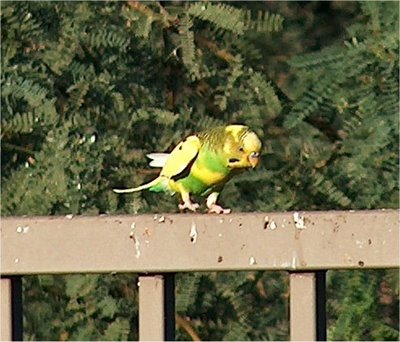
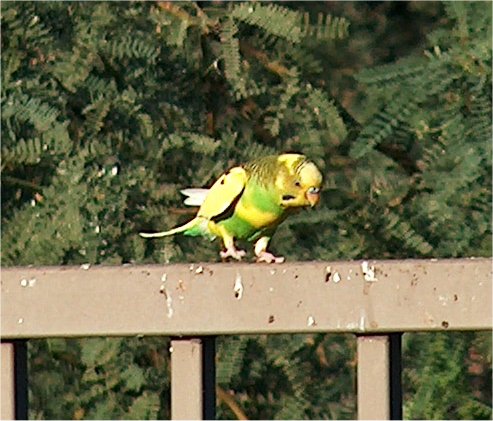
The dreaded "Sonoran Parakeet". Obviously not a wild bird, but it's the second such "out of state" visitor.
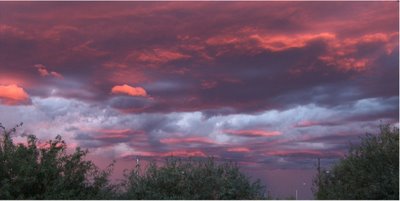
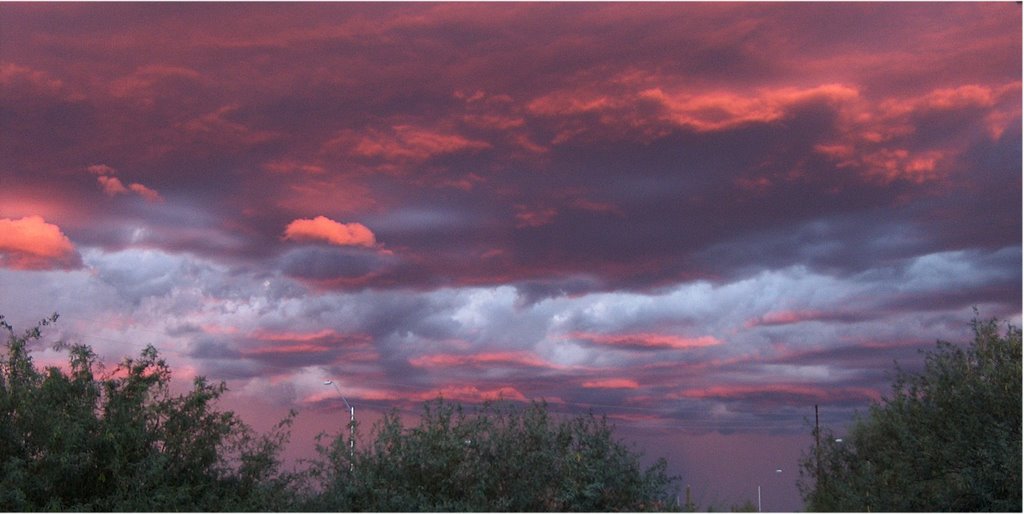
This was the stunning view at sunset from our backyard.
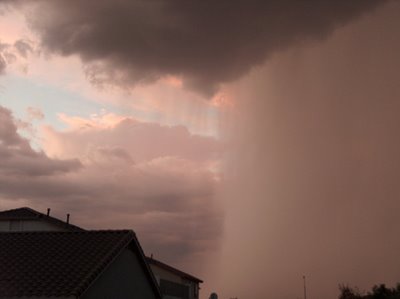
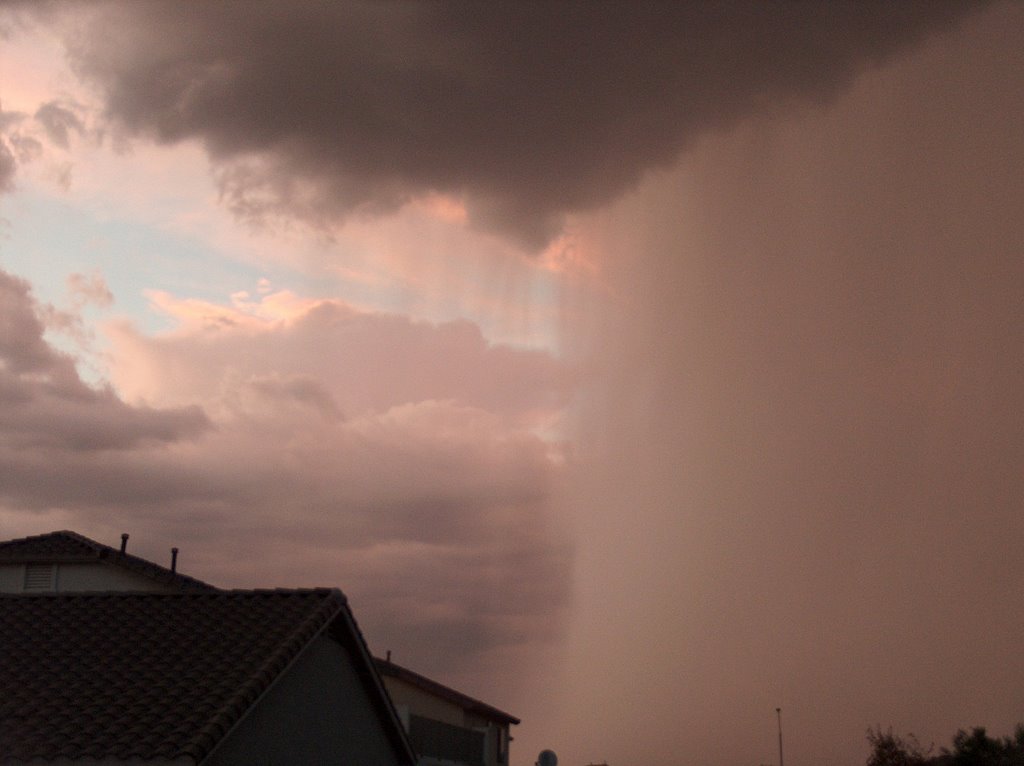
Witness the awesome Arizona monsoon. At irregular intervals without much predictability we'll get these massive downpours. Indeed, this one, just a couple miles north of us, never actually got to us.
Just thought I'd share a few of my recent photos from home.
This was the stunning view at sunset from our backyard.
Witness the awesome Arizona monsoon. At irregular intervals without much predictability we'll get these massive downpours. Indeed, this one, just a couple miles north of us, never actually got to us.
Monday, September 18, 2006
Troglodytes in Arizona
The cactus wren is the Arizona state bird. Well, of course it is ... cactus wren.  Cactus wrens are the largest North American wren, getting up to 9 inches long, and range from southern California, to northern Mexico, from western Texas to southern Nevada and into Utah. While sometimes they will use an empty hole in a saguaro for a nest, generally they build unusual nests of grass, straw, and whatever other materials they can find and line them with feathers. These nests are unusual because they are completely enclosed with only a side entrance to protect the babies from predators. They like to build these nests in prickly environments like a cactus for protection and support. Generally they will build multiple nests. They will use one for roosting, another for their young, and others simply as decoys. Then they will have up to three broods of up to six babies a season. They generally mate for life.
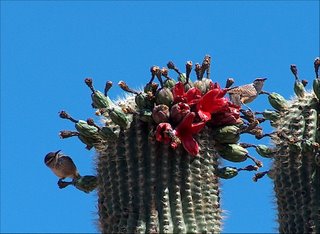 The cactus wren is well suited for the desert environment. It eats bugs like beetles, wasps, grasshoppers, and ants, some plant foods like fruits and seeds, and sometimes small lizards or frogs. Most of their water needs are met in the food they eat.
Cactus wrens are camouflaged for their environment, but still highly visible. It’s very difficult to tell a male from a female, as their colorations are nearly identical. One of their distinctions from other birds is the white and black stripes over their eyes. They are very curious birds – in fact, quite brave. Other birds take flight at the first sign of danger, but they will stay around if there is food to be had. They will explore anything new in their territory. Leave a window open on your car, and their likely to hop inside to take a look.
 These birds are quite territorial and will defend their nests with violence. They have been known to attack predators, using the defenses of their nesting environments (cactus) to impale the invaders. They may also attack nests of other birds in the area and seem to enjoy harassing dogs or cats in their territory.
They’re very noisy birds with a large “vocabulary”. They have a distinctive call – their best known sound is heard in soundtracks for movies set in desert locations – but also seem to have a variety of noises they use to communicate with one another.
(Oh, about the title. Cactus wrens are of the Troglodytidae family. In the field of birds, “troglodyte” refers to any number of small wrens.)
Cactus wrens are interesting and unusual. They are complex and designed for their environment. And they cry, with their existence, for a Designer, seeming to thumb their noses at the bizarre notion that this “just happened by chance”.
(Note: I took all the pictures in this post.)
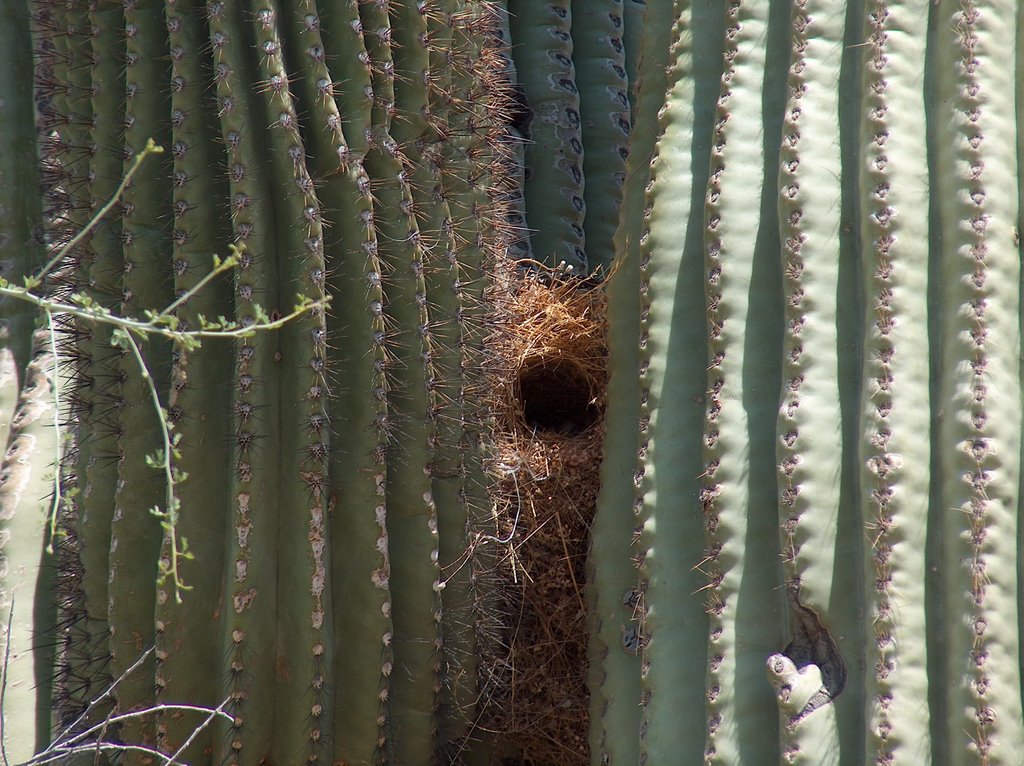 Cactus wrens are the largest North American wren, getting up to 9 inches long, and range from southern California, to northern Mexico, from western Texas to southern Nevada and into Utah. While sometimes they will use an empty hole in a saguaro for a nest, generally they build unusual nests of grass, straw, and whatever other materials they can find and line them with feathers. These nests are unusual because they are completely enclosed with only a side entrance to protect the babies from predators. They like to build these nests in prickly environments like a cactus for protection and support. Generally they will build multiple nests. They will use one for roosting, another for their young, and others simply as decoys. Then they will have up to three broods of up to six babies a season. They generally mate for life.
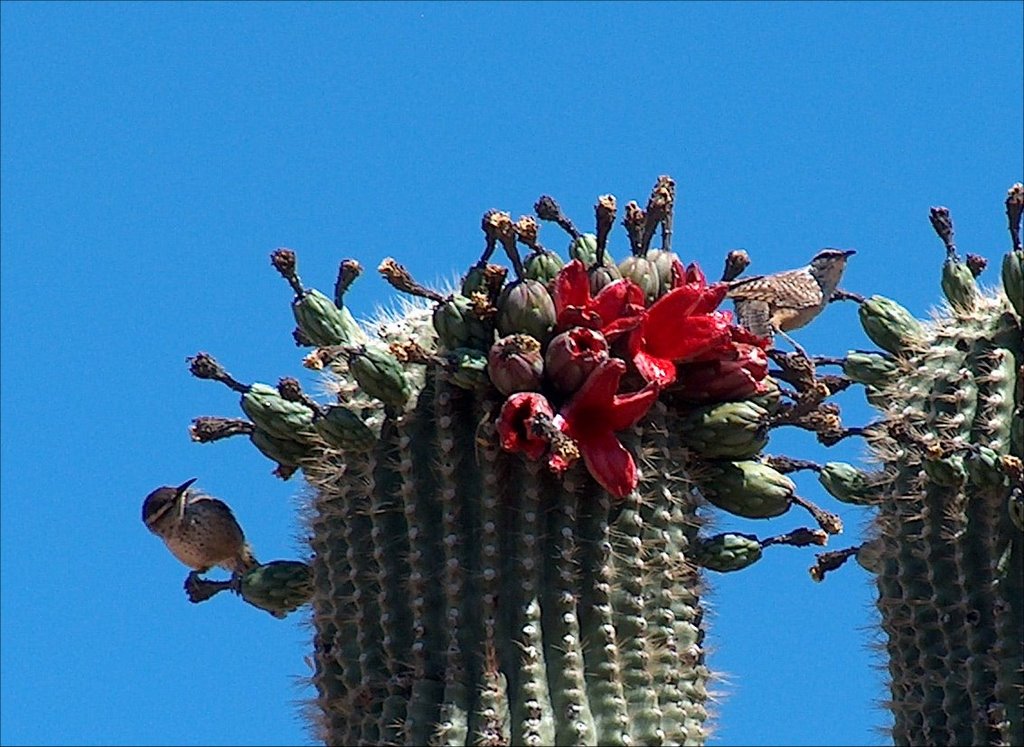 The cactus wren is well suited for the desert environment. It eats bugs like beetles, wasps, grasshoppers, and ants, some plant foods like fruits and seeds, and sometimes small lizards or frogs. Most of their water needs are met in the food they eat.
Cactus wrens are camouflaged for their environment, but still highly visible. It’s very difficult to tell a male from a female, as their colorations are nearly identical. One of their distinctions from other birds is the white and black stripes over their eyes. They are very curious birds – in fact, quite brave. Other birds take flight at the first sign of danger, but they will stay around if there is food to be had. They will explore anything new in their territory. Leave a window open on your car, and their likely to hop inside to take a look.
 These birds are quite territorial and will defend their nests with violence. They have been known to attack predators, using the defenses of their nesting environments (cactus) to impale the invaders. They may also attack nests of other birds in the area and seem to enjoy harassing dogs or cats in their territory.
They’re very noisy birds with a large “vocabulary”. They have a distinctive call – their best known sound is heard in soundtracks for movies set in desert locations – but also seem to have a variety of noises they use to communicate with one another.
(Oh, about the title. Cactus wrens are of the Troglodytidae family. In the field of birds, “troglodyte” refers to any number of small wrens.)
Cactus wrens are interesting and unusual. They are complex and designed for their environment. And they cry, with their existence, for a Designer, seeming to thumb their noses at the bizarre notion that this “just happened by chance”.
(Note: I took all the pictures in this post.)
Friday, August 25, 2006
Feathers of a Bird
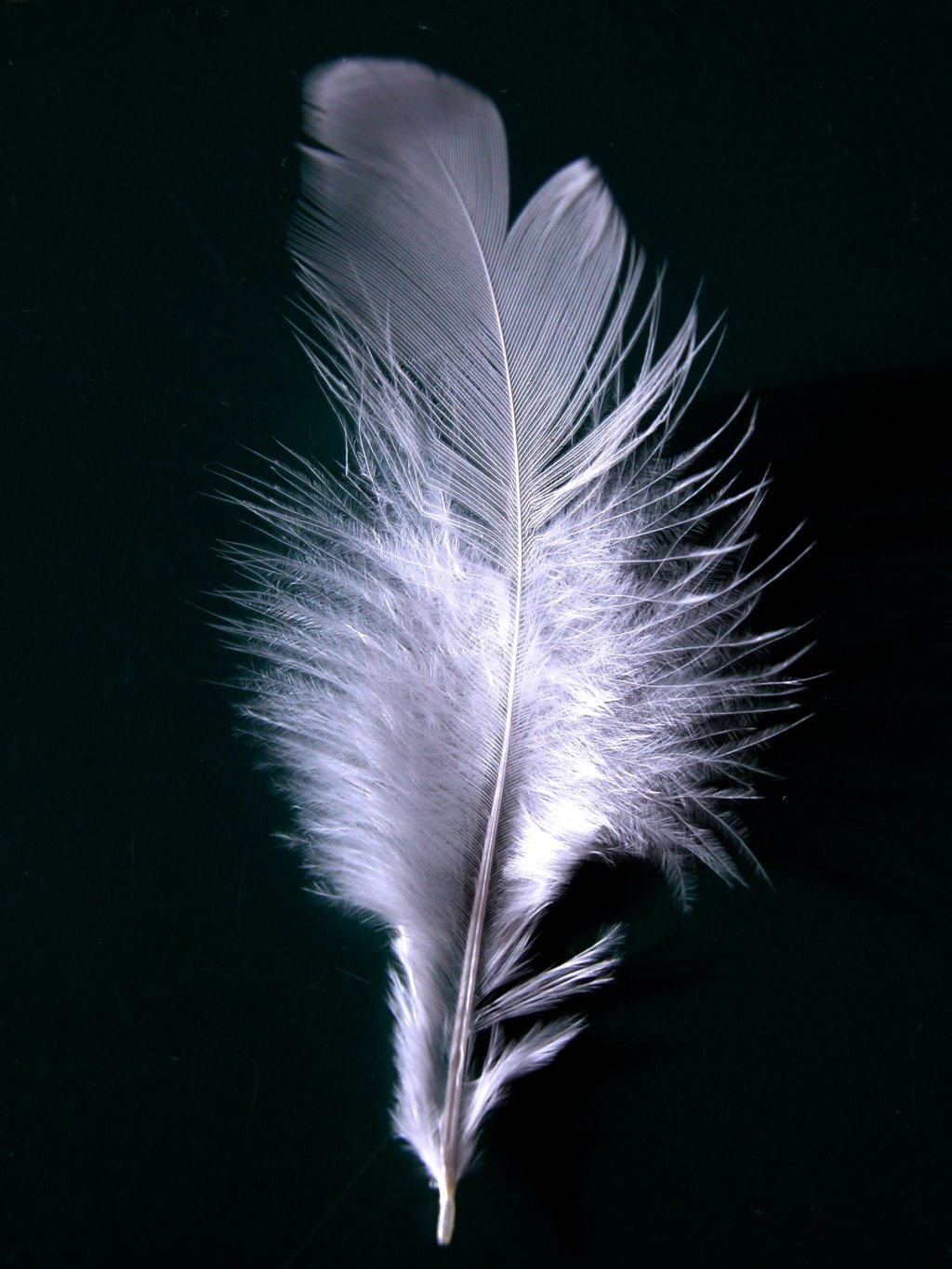
One might ask, “What possible connection can there be between feathers and God?” Well, if you take a moment to look with me at the lowly feather, you might find it to be a powerful argument for Intelligent Design.
On the surface, feathers seem somewhat plain. They do provide a lift surface for birds to use in flying, and they make a fine insulator against the elements, but what is so special about a feather? Well, if you will step a little closer, you will find them practically miraculous in their design.
Feathers are constructed of a shaft and vanes. The first thing we notice is that the shaft itself, while quite sturdy, is also quite hollow. This creates a lighter structure for the flyer. Nice touch. Attached to the shaft is a series of vanes. The vanes are strands of material not much larger than a thread. So, here we have a shaft with a bunch of threads attached. Yeah. That’ll work. Not! What we need is a surface rather than a “duster”, so how does the feather arrive at that? Well, each of these vanes is lined with microscopic barbs. These barbs run into the barbs on the adjacent vane and interlock, much like Velcro. They actually work better than Velcro because while Velcro won’t move, these barbs can slide, hooking onto other barbs, allowing the feather the movement while retaining a surface effect, both of which are requirements for a bird in flight.
As remarkable as all that is, it only gets better. If you’ve ever found a feather, you may notice that you can separate the vanes. If you have, you may also notice that they don’t go back together once you’ve separated them. This is because the barbs on the vanes require lubrication to keep functioning. A feather separated from a bird dries out and the vanes stop working as they should. This is why you will see birds preening themselves so much of the time. They naturally secrete a preening oil that they use to lubricate their feathers, keeping themselves waterproof and insulated while retaining the movement of the feathers. Without this oil, the feathers would quickly become useless for both flight and insulation.
Interestingly, different birds have different designs of feathers. The ostrich, for instance, doesn’t have the barbs on the feather vanes, giving them those fluffy feathers. They don’t need a flight surface. Owls have their own peculiar design. The leading edge feathers are serrated. The trailing edge feathers are tattered because the outer edges of their feather lack the barbs to hold them together. And the legs are covered with soft feathers. The result is a “stealth” effect. While most birds are “noisy” in flight from the air turbulence around the wings, this feather structure on the owl makes them silent flyers, a real advantage to a nighttime hunter. The Honey Buzzard feeds off nests of bees and wasps, and they have a type of feather around their heads called “bristles”. These feathers have almost no barbs and form a more solid surface to protect the bird from the stings of the insects. The penguin’s feathers are downy at the bottom and stiff at the top. The downy portion provides an air layer and the stiff portion provides waterproofing, so the penguin ends up with an excellent insulator layer and a waterproof layer to provide it some protection in its hostile environment. Birds tend to have a variety of feather types in various places on their bodies. Some feathers provide for flight, while other feathers provide protection, and still others provide simply appearance.
The feather is a perfect design. It is light but flexible. It overlaps with other feathers and creates a flight surface that enables birds to fly. They provide a layering with air between the spaces to provide an excellent insulation against the elements and a waterproofing. Yes, the feather is a perfect design, except for this one little fact: They would be useless without the preening oil. And here we arrive at our connection with God.
The idea is “irreducible complexity”. With all its marvelous design, the feather would be completely useless without the preening oil produced by the bird. On the other hand, the bird would have no use for preening oil if it didn’t have feathers to preen. And without the feather, birds wouldn't fly, the penguin wouldn't survive its habitat, and we'd never hear about "water off a duck's back". Thus, it would appear that Evolution doesn’t provide an answer for why it is that birds have feathers at all. The fossil record shows either fully-feathered creatures or not, without any intermediate stage. The theories advanced about how feathers could have evolved fall apart at every turn. So the most logically consistent argument for feathers is that they were designed, not evolved. Or, to put it another way, you can almost knock Evolution over with a feather.
Wednesday, August 23, 2006
The Cardinal Design
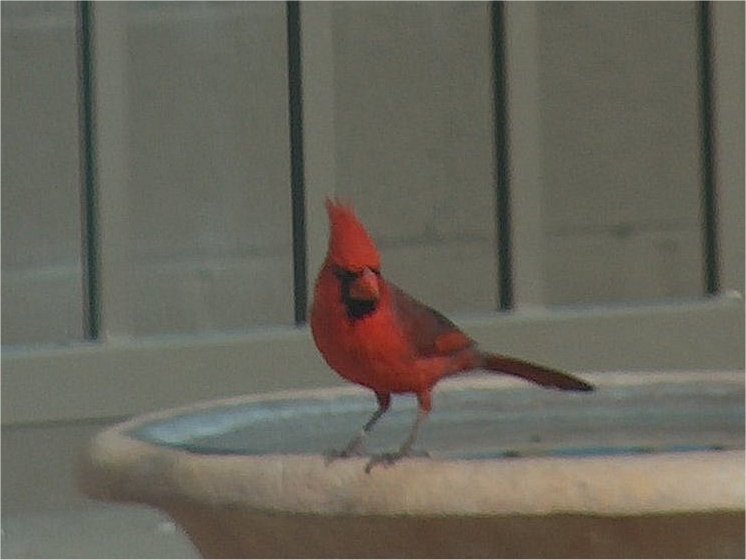
The male Northern Cardinal is unmistakable. He is almost entirely red, including his beak, with black markings around his eyes and beak. His head is tufted. He is gorgeous. He grows to 8 to 9”. His mate isn't as noticeable. She is somewhat smaller in size, mostly grey with a touch of reddish coloring here and there. She could easily be mistaken for a Pyrrhuloxia ... if you knew what one of them was. But everyone knows the male cardinal. Hey, there are two sports teams named after this bird. The cardinal gets his name from the Roman Catholic Cardinal who is also garbed in red.
They range mostly from Florida to Maine and from Texas to South Dakota, with their largest concentrations in the South, but they also live in Arizona. Cardinals tend not to migrate, but prefer to stay where they are. They like to eat mostly seeds and fruit, but will also indulge in an occasional bug. (Actually, perhaps a third of their diet is insects.) They are primarily ground feeders. They like thickets and bushes and aren't averse to living in parks and residential areas. In fact, population density of the Cardinal has increased over the last 200 years because they benefit from urban habitats, parks, and bird feeders.
Cardinals are known for their song. In the 1800's they were actually sought after as a cage bird because of their song. The male will sing out, often from a high treetop, and the female will counter sing, making a duet. Cardinal songs have their local variations and accents. Interestingly, mated pairs often share song phrases. Females will often sing right from the nest. Some think they use the song to communicate, telling the male to pick up groceries, etc.
Male cardinals are fierce when it comes to defending their breeding territory. They have been known to spend hours attacking their own reflections in glass surfaces. Interestingly, brighter males hold the territory with the densest vegetation, feed at higher rates, and have better success at reproduction than their duller counterparts.
Cardinals mate for life. Cardinal females build a cup-shaped nest of small twigs and grass in some shrubbery. They lay 3 to 5 eggs, and may have two to four broods a breeding season. Males and females both tend the young. The male will sometimes tend to one brood while the female goes off to begin the next one. They are a favorite of cowbirds. Cowbirds are “parasitic”. They will lay their eggs in another bird's nest and leave them to be raised by the other parents, sometimes at the expense of the other parents' original hatchlings. Despite the cowbird's use of the cardinal's nests, cardinals still are increasing in numbers.
Cardinals may live up to 15 years in the wild. The oldest known cardinal lived 15 years, nine months.
Cardinals are known to suffer from lice, mites, and other skin parasites. If the problem is bad, they will molt, leaving an oddly bald head. Cardinals (along with other birds) use a technique called “anting” to rid themselves of these problems. They will allow ants, alive or dead, to climb or be rubbed through their feathers. The ants' formic acid helps kill off the mites, and when they are done, the cardinal's feathers appear wet.
Isn’t that a marvelous design?
Monday, August 21, 2006
The Roadrunner
I'm a city boy. The only roadrunner I ever knew was the cartoon version. He was sweet and innocent. And anyone who watched the show knew what he ate, because the evil coyote often used birdseed as a lure to catch the roadrunner.
Reality is a different thing.
I met the real roadrunner this weekend. We have what is called a "view fence" in our backyard. It's a low wall with a fence of bars above it to allow us to view the desert behind our house. Very nice. Anyway, the other day I noticed a bird sitting on the lowest rung of the fence on the edge of the yard. She was half in, half out of the yard, so I couldn't really tell what she was, but I grabbed the camera that I keep handy to get her picture. Just as I looked back, this bird leaped from her perch at an approaching sparrow! She narrowly missed her prize, so she climbed up on the rock waterfall we have and waited again in front of the bird feeder we keep loaded. This wasn't an innocent roadrunner. She was a hunter!
Another sparrow came in range, and she leaped again, but missed again. Frustrated, she crept along the low wall across the yard and then jumped up onto the fence between yards. She didn't know it, but this was a prime spot for hunting birds. The neighbors kept their feeder right on the other side. She was within a foot of any approaching bird. But she wasn't patient enough. She waited a few more minutes, then jumped into the wash behind the house to find something else to scoop up.
As it turns out, roadrunners are not the same animal we've been given to believe on the cartoons. Go figure! They are ruthless hunters. They almost never eat seed, preferring meat at all times. They are indeed very fast, achieving ground speeds up to 17 miles per hour. They are faster than rattle snakes and are one of the few animals that preys on them. They use their short wings like a matador's cape to distract the snake, then dart around behind and grab it by the tail. Then they whip it around until it is beaten to death. They will eat the snake whole, tail first. If the snake is too big to swallow completely, they will run around with the uneaten portion dangling from their mouths until they can complete the task of swallowing it.
Roadrunners ... they're not the cute little guy you see on the cartoons. They're quick, able hunters capable of snatching a hummingbird out of the air. They are happy to raid a nest of baby birds and dine the easy way, or to scoop up a lizard on the run. Don't believe all you see in the Saturday cartoons.
Reality is a different thing.
I met the real roadrunner this weekend. We have what is called a "view fence" in our backyard. It's a low wall with a fence of bars above it to allow us to view the desert behind our house. Very nice. Anyway, the other day I noticed a bird sitting on the lowest rung of the fence on the edge of the yard.
 She was half in, half out of the yard, so I couldn't really tell what she was, but I grabbed the camera that I keep handy to get her picture. Just as I looked back, this bird leaped from her perch at an approaching sparrow! She narrowly missed her prize, so she climbed up on the rock waterfall we have and waited again in front of the bird feeder we keep loaded. This wasn't an innocent roadrunner. She was a hunter!
Another sparrow came in range, and she leaped again, but missed again. Frustrated, she crept along the low wall across the yard and then jumped up onto the fence between yards. She didn't know it, but this was a prime spot for hunting birds.
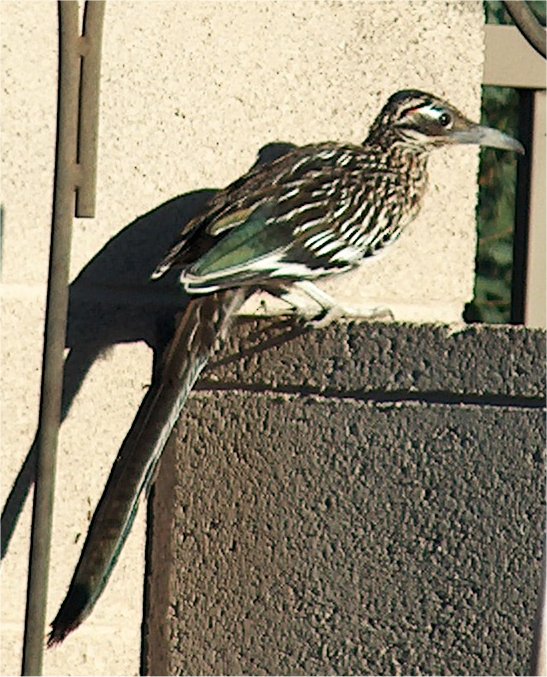 The neighbors kept their feeder right on the other side. She was within a foot of any approaching bird. But she wasn't patient enough. She waited a few more minutes, then jumped into the wash behind the house to find something else to scoop up.
As it turns out, roadrunners are not the same animal we've been given to believe on the cartoons. Go figure! They are ruthless hunters. They almost never eat seed, preferring meat at all times. They are indeed very fast, achieving ground speeds up to 17 miles per hour. They are faster than rattle snakes and are one of the few animals that preys on them. They use their short wings like a matador's cape to distract the snake, then dart around behind and grab it by the tail. Then they whip it around until it is beaten to death. They will eat the snake whole, tail first. If the snake is too big to swallow completely, they will run around with the uneaten portion dangling from their mouths until they can complete the task of swallowing it.
Roadrunners ... they're not the cute little guy you see on the cartoons. They're quick, able hunters capable of snatching a hummingbird out of the air. They are happy to raid a nest of baby birds and dine the easy way, or to scoop up a lizard on the run. Don't believe all you see in the Saturday cartoons.
Tuesday, August 15, 2006
The Black Vulture
Okay, one more for fun ...
It was a beautiful morning for flying and Kevin was right there with his friends. The warmth of the day provided good thermals to ride, and the cool breeze off the ocean just made it perfect. It was a vulture's paradise.
Kevin was tuned to his surroundings. He kept an eye out for his cousins, the turkey vultures. They had better olifactory senses and could locate food quicker, so he would often use them as food finders. With his cohorts, he could quickly down a fairly large carcass with impunity. He had even been known, on occasion, to kill a young or defenseless prey when he was hungry enough. Today it wouldn't be necessary. The flock was feeling fine.
Kevin had to work a little harder at staying aloft than the turkey vulture due to his smaller wingspan. And those cousins could easily intimidate a single black vulture, but Kevin never hunted alone, and a turkey vulture was no match for a flock of black vultures. Kevin didn't mind the additional effort. He had a family to feed. His offspring were now flying on their own, but he and his mate would still feed them for up to eight months. In retrospect, some might have found it odd that Kevin and his mate hadn't made a nest, but it was the black vulture way. The pair, mated for life, would likely return to the same spot next year for another brood.
Humans tend to think of Kevin as ugly, but to Kevin he was just right. His featherless, dark head was perfect for sticking in carrion when feeding. His sharp, hooked beak could rend meat from bone without effort. His powerful claws and opposable hind toes were quite useful for holding the food down while he ate. And despite the human distaste for him, Kevin proved a magnificent flyer. His black body and wings were offset by the silvery underside and the white wingtips. With the right wind, Kevin could remain airborn for hours. And then there was his unique approach to keeping cool, called urohidrosis. Kevin would urinate on his legs to provide for evaporative cooling. Not too pleasant to humans, but very effective for Kevin. In addition, Kevin possessed an unusually keen memory for a bird. There are reports that black vultures have been known to befriend people who are kind to them, and to recognize and avoid people who are not, even at great distance. Yes, some found him ugly, but he was just right.
Patience. It is the hallmark of the vulture. Kevin was in no hurry. Find what to eat and wait. Why not? It was marvelous soaring way up there with friends. Flap, flap ... soar. Nothing like it in the world. With no voice box, Kevin wouldn't converse with his fellow flyers, but they still hung together like lifelong pals. Life could hardly be better. While other creatures felt the press of Man, Kevin and his kin were finding the roadkill, landfills, and slaughterhouses fine places to feast. Life was good for Kevin.
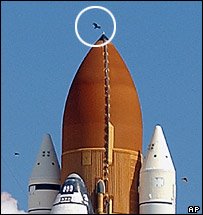
Of course, none of this ran through Kevin's mind as he soared high above the shoreline. Kevin was a creature of instinct. And nothing in Kevin's instincts prepared him for the massive, man-made rocket that shot skyward, colliding with him before he could avoid it. Poor Kevin. He would ever after be known as a bird strike on the space shuttle Discovery.
It was a beautiful morning for flying and Kevin was right there with his friends. The warmth of the day provided good thermals to ride, and the cool breeze off the ocean just made it perfect. It was a vulture's paradise.
Kevin was tuned to his surroundings. He kept an eye out for his cousins, the turkey vultures. They had better olifactory senses and could locate food quicker, so he would often use them as food finders. With his cohorts, he could quickly down a fairly large carcass with impunity. He had even been known, on occasion, to kill a young or defenseless prey when he was hungry enough. Today it wouldn't be necessary. The flock was feeling fine.
Kevin had to work a little harder at staying aloft than the turkey vulture due to his smaller wingspan. And those cousins could easily intimidate a single black vulture, but Kevin never hunted alone, and a turkey vulture was no match for a flock of black vultures. Kevin didn't mind the additional effort. He had a family to feed. His offspring were now flying on their own, but he and his mate would still feed them for up to eight months. In retrospect, some might have found it odd that Kevin and his mate hadn't made a nest, but it was the black vulture way. The pair, mated for life, would likely return to the same spot next year for another brood.
Humans tend to think of Kevin as ugly, but to Kevin he was just right. His featherless, dark head was perfect for sticking in carrion when feeding. His sharp, hooked beak could rend meat from bone without effort. His powerful claws and opposable hind toes were quite useful for holding the food down while he ate. And despite the human distaste for him, Kevin proved a magnificent flyer. His black body and wings were offset by the silvery underside and the white wingtips. With the right wind, Kevin could remain airborn for hours. And then there was his unique approach to keeping cool, called urohidrosis. Kevin would urinate on his legs to provide for evaporative cooling. Not too pleasant to humans, but very effective for Kevin. In addition, Kevin possessed an unusually keen memory for a bird. There are reports that black vultures have been known to befriend people who are kind to them, and to recognize and avoid people who are not, even at great distance. Yes, some found him ugly, but he was just right.
Patience. It is the hallmark of the vulture. Kevin was in no hurry. Find what to eat and wait. Why not? It was marvelous soaring way up there with friends. Flap, flap ... soar. Nothing like it in the world. With no voice box, Kevin wouldn't converse with his fellow flyers, but they still hung together like lifelong pals. Life could hardly be better. While other creatures felt the press of Man, Kevin and his kin were finding the roadkill, landfills, and slaughterhouses fine places to feast. Life was good for Kevin.
Of course, none of this ran through Kevin's mind as he soared high above the shoreline. Kevin was a creature of instinct. And nothing in Kevin's instincts prepared him for the massive, man-made rocket that shot skyward, colliding with him before he could avoid it. Poor Kevin. He would ever after be known as a bird strike on the space shuttle Discovery.
Monday, August 14, 2006
Ken Leaves Home
Okay, just for fun, a short story or two ...
The morning sun had not yet creased the sky, but Ken was awake ... and scared. This was the day. He knew it. There was no question, no turning back, no options. His parents were telling him to leave and he had no choice.
Restless with fears and concerns, Ken got up quietly, trying not to disturb his brother. It wasn't fair. His brother wasn't leaving today. They weren't kicking him out. Why was that? Truth be told, Ken had always been treated slightly better than his brother, so he wasn't at all clear why he was being evicted first. Ken sighed.
Well, no matter. He would have to face his fears. There was no room left for questions of fairness. It was his day to go and he would have to go. Ken sat and looked out at the dark horizon. Very soon the sun would rise, and very soon thereafter his time would come. What would it be like out there? Could he survive? Could he make it on his own? Where would he live? What would he do?
The questions continued in his head. He knew his parents wouldn't be helping him. Once he left the nest, it was over. They wouldn't help him with food or shelter or any of the other necessities. Oh, they might check in with him from time to time, but he knew how it would be. Sink or swim, those were his options, so to speak. And he didn't really think about how that seemed so cold. It was the way it had always been in his family. Once you're out, you're out. No going back. That was the history of his family for generations immemorial.
Ken thought about family. He would have to start his own. How would he go about doing that? He had never actually talked to a female other than his mother. How would he go about finding the right mate? Where would they live? He supposed that he'd start a family just as his parents had and that some day he would have children who he would, when the time was right, force to leave their home. That was the way it was. And just because he was concerned about it didn't mean it shouldn't be. Still, he was concerned.
The sun peeked over the distant mountains. Ken hadn't noticed the gathering glow, lost in his thoughts. The day was dawning. It wouldn't be long now. Dad would come to his room and he would be asked to leave. It would be any time now. He wouldn't be cruel about it, but he would be insistent. With minimal education and minimal instruction, he would be sent out on his own, forced to make his own way.
Ken took stock of himself. He should really be okay. He had amazingly good eyesight, which would lend themselves to good hunting skills. He instinctively knew where to look for food sources, so that would help. And if hunting was a matter of sitting and waiting, he had been practicing sitting and waiting all his life. He was energetic and capable. And he had been practicing, truth be told. He had no formal training, but he had watched his parents enough, and he really thought he knew what to do once he got out there. And from what he could see there was plenty of places for him to live. He'd likely get out of range of his parents, but beyond that it looked like an open world.
His father suddenly appeared on the scene, almost as if by magic. He stood behind Ken. He wasn't pushy, but there was no question. The sun was up enough now for the landscape to be clearly illuminated. It was time. And Ken suddenly realized that he was ready. There were no real fears. He was already well equipped. His only fear was that first step. Could he make it? Well, there was only one way to tell. Ken's dad departed again, flying to a nearby tree to watch. Ken flapped his wings several times and lifted off the edge of the nest, then descended down the cliff face in a controlled fall, landing somewhat awkwardly but safely on a tree. The fledgling hawk was heading out on his own.
The morning sun had not yet creased the sky, but Ken was awake ... and scared. This was the day. He knew it. There was no question, no turning back, no options. His parents were telling him to leave and he had no choice.
Restless with fears and concerns, Ken got up quietly, trying not to disturb his brother. It wasn't fair. His brother wasn't leaving today. They weren't kicking him out. Why was that? Truth be told, Ken had always been treated slightly better than his brother, so he wasn't at all clear why he was being evicted first. Ken sighed.
Well, no matter. He would have to face his fears. There was no room left for questions of fairness. It was his day to go and he would have to go. Ken sat and looked out at the dark horizon. Very soon the sun would rise, and very soon thereafter his time would come. What would it be like out there? Could he survive? Could he make it on his own? Where would he live? What would he do?
The questions continued in his head. He knew his parents wouldn't be helping him. Once he left the nest, it was over. They wouldn't help him with food or shelter or any of the other necessities. Oh, they might check in with him from time to time, but he knew how it would be. Sink or swim, those were his options, so to speak. And he didn't really think about how that seemed so cold. It was the way it had always been in his family. Once you're out, you're out. No going back. That was the history of his family for generations immemorial.
Ken thought about family. He would have to start his own. How would he go about doing that? He had never actually talked to a female other than his mother. How would he go about finding the right mate? Where would they live? He supposed that he'd start a family just as his parents had and that some day he would have children who he would, when the time was right, force to leave their home. That was the way it was. And just because he was concerned about it didn't mean it shouldn't be. Still, he was concerned.
The sun peeked over the distant mountains. Ken hadn't noticed the gathering glow, lost in his thoughts. The day was dawning. It wouldn't be long now. Dad would come to his room and he would be asked to leave. It would be any time now. He wouldn't be cruel about it, but he would be insistent. With minimal education and minimal instruction, he would be sent out on his own, forced to make his own way.
Ken took stock of himself. He should really be okay. He had amazingly good eyesight, which would lend themselves to good hunting skills. He instinctively knew where to look for food sources, so that would help. And if hunting was a matter of sitting and waiting, he had been practicing sitting and waiting all his life. He was energetic and capable. And he had been practicing, truth be told. He had no formal training, but he had watched his parents enough, and he really thought he knew what to do once he got out there. And from what he could see there was plenty of places for him to live. He'd likely get out of range of his parents, but beyond that it looked like an open world.
His father suddenly appeared on the scene, almost as if by magic. He stood behind Ken. He wasn't pushy, but there was no question. The sun was up enough now for the landscape to be clearly illuminated. It was time. And Ken suddenly realized that he was ready. There were no real fears. He was already well equipped. His only fear was that first step. Could he make it? Well, there was only one way to tell. Ken's dad departed again, flying to a nearby tree to watch. Ken flapped his wings several times and lifted off the edge of the nest, then descended down the cliff face in a controlled fall, landing somewhat awkwardly but safely on a tree. The fledgling hawk was heading out on his own.
Sunday, June 25, 2006
Consider the birds - The Babies

I’ve seen it more than once, but this incident with the grackles was the picture-perfect account.
It was late spring. The mating had taken place, and the parents were rearing their children. I had been buzzed more than once for walking too close to a mockingbird’s nest (which, of course, I never did see). But the little ones were now starting to fly. They would accompany their parents on foraging exercises to learn how to take care of themselves outside the nest.
One day a female great-tailed grackle flew in and landed under a nearby tree. Immediately behind her was "Junior". Junior was nearly her size, fully feathered … and loud. He (I’m assuming "he" for the sake of pronoun differentiation) hopped about, squawking at his mother, mouth agape, waiting, no, demanding to be fed. She looked around the sparse ground, then leapt upward and was airborne. Junior watched her go, and stopped his noisemaking. There was, in fact, a thing or two to eat, so he picked at the plants and ground. But a moment later, mom returned, a prized soda cracker in her beak. Junior was at it again, squawking and hopping, mouth wide open. Mom started breaking off pieces of the cracker and putting them in his mouth. He willingly accepted, gulped it down, and demanded more. At one point, mom broke off a larger than usual piece, and it didn’t slide nicely into Junior’s mouth. He spit it out and squawked some more, demanding that she feed him bite-sized pieces, not these things that require some work (like chewing). Mom dutifully picked up the too-big piece, broke it down, and continued to feed Junior until the cracker was gone … and mom had none.
I watched this spectacle with amusement, but in the back of my mind there was a discomfort. When they flew off, I wondered what it was. I know. I had seen this before. Where? Oh, yes. I had seen this same thing played out in nearly every visit to the store or to the restaurant. But it wasn’t birds. It was people. Little people – we call them kids – were playing out the same scenario for their adult guardians. "I want the toy truck." "You can’t have the toy truck." "Give me the toy truck." "I don’t have money for the toy truck." And somehow the kid left with the toy truck. "I want ice cream." "You need to eat your dinner." "I don’t want to eat my dinner." "No dessert if you don’t eat your dinner." And somehow, the waitress is taking away a half-eaten dinner and returning with a bowl of ice cream (which may or may not actually get eaten). Or how about that commercial that some of you may have seen? A mother is opening a bank account. Her 12-year-old daughter, dressed in a soccer uniform, is with her. The banker is telling her the benefits of the ATM card they offer. The mother is pleased, but the daughter is unimpressed. Then the man says, "You can use it at restaurants ..." and the daughter lights up. "Team dinners!" "... And at stores ..." "New uniforms!" "... And at thousands of locations around the country." "Road trip!" Now, the daughter has nothing to do with the mother’s choice to bank there or not, but if she’s not pleased, obviously the bank is the wrong one. And she’s only pleased if she’s spending her mother into bankruptcy.
Watching that grackle hassle his mother into skipping her own lunch, I wondered if there was such a thing as giving too much to one’s kids. It seems to me that, if we want them to be self-sufficient, there needs to be a limitation – perhaps a severe one – that will urge the child to learn how to acquire for themselves instead of expecting to be provided for. I wonder how many parents suffer from the needless tyranny of the child.
Saturday, June 24, 2006
Consider the birds - The Budgie
So, I’m sitting there one day, watching the variety of birds come and go. There were pigeons and doves, sparrows and finches, cowbirds, thrashers, a veritable cornucopia of birdlife. One would think that with such an assortment I wouldn’t have been surprised when a parakeet flew up to the waterfall and took a dip. But, being the Arizona desert, this wasn’t what I expected.
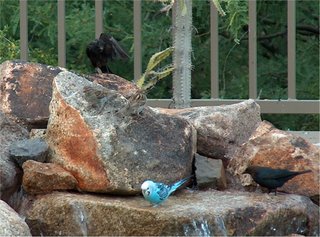 The bird was a beautiful blue color and viciously independent. He would chase off larger birds to get to some prized seed on the ground. No one stood their ground against him. He bathed in the water with impunity, then flew up to a hanging feeder, scattering several doves, to eat to his heart’s content. Then it was off to roost in the shade of a nearby tree. I could hear him making his distinct warbles and squawks and fweeps even when I could no longer see him. This budgie was free and happy.
I wondered for awhile. A desert budgie? The dreaded Sonoran Parakeet? Of course, there really was no question. This was an escapee from a cage. They primarily come from Australia and can be found in other tropical or sub-tropical regions, but none are indigenous to the southwest United States desert. They are flock animals, needing either other budgies or perhaps a human around most of the time. They eat mainly fruits and seed. The desert is not the place for lone budgies.
The budgie was around for some time. He came and went, free as a bird. Oh, wait, he was a bird. He enjoyed freedom that very few parakeets enjoy in America. He was fearless when it came to other birds, but was gone in a flash if a human appeared. He knew what a cage was like, and that wasn’t going to be his home again. Of course, it was alone, and parakeets are flock birds, so this was a trial. And budgies are not typically desert birds. So it was sad but not surprising when he quit showing up. How long could a tropical bird survive in the desert? I haven’t seen the little guy since.
It taught me two important lessons. First, most creatures love freedom. I’m sure there is the aberrant few, like my psychotic cat, who refuse to go outside. Freedom terrifies them. But in general all creatures from budgies to people love to be free. Second, absolute freedom is not necessarily freedom. We tend to think that freedom is "no limits", but it isn’t necessarily true that "no limits" is real freedom. For example, this budgie had no limits. He could go where he pleased, eat what he pleased, sleep where he pleased, without limits. However, without the limits of a flock or a person to help him, he was doomed. By the same token, a child without limits is doomed. We all need direction, limits, "lines". "Lines are our friends." By limiting our freedom, we are provided the opportunity to greater focus. With greater focus we are allowed the freedom of going farther in one direction than anyone could with no limits. Freedom is good, but limitlessness isn’t. The budgie found out both were true.
 The bird was a beautiful blue color and viciously independent. He would chase off larger birds to get to some prized seed on the ground. No one stood their ground against him. He bathed in the water with impunity, then flew up to a hanging feeder, scattering several doves, to eat to his heart’s content. Then it was off to roost in the shade of a nearby tree. I could hear him making his distinct warbles and squawks and fweeps even when I could no longer see him. This budgie was free and happy.
I wondered for awhile. A desert budgie? The dreaded Sonoran Parakeet? Of course, there really was no question. This was an escapee from a cage. They primarily come from Australia and can be found in other tropical or sub-tropical regions, but none are indigenous to the southwest United States desert. They are flock animals, needing either other budgies or perhaps a human around most of the time. They eat mainly fruits and seed. The desert is not the place for lone budgies.
The budgie was around for some time. He came and went, free as a bird. Oh, wait, he was a bird. He enjoyed freedom that very few parakeets enjoy in America. He was fearless when it came to other birds, but was gone in a flash if a human appeared. He knew what a cage was like, and that wasn’t going to be his home again. Of course, it was alone, and parakeets are flock birds, so this was a trial. And budgies are not typically desert birds. So it was sad but not surprising when he quit showing up. How long could a tropical bird survive in the desert? I haven’t seen the little guy since.
It taught me two important lessons. First, most creatures love freedom. I’m sure there is the aberrant few, like my psychotic cat, who refuse to go outside. Freedom terrifies them. But in general all creatures from budgies to people love to be free. Second, absolute freedom is not necessarily freedom. We tend to think that freedom is "no limits", but it isn’t necessarily true that "no limits" is real freedom. For example, this budgie had no limits. He could go where he pleased, eat what he pleased, sleep where he pleased, without limits. However, without the limits of a flock or a person to help him, he was doomed. By the same token, a child without limits is doomed. We all need direction, limits, "lines". "Lines are our friends." By limiting our freedom, we are provided the opportunity to greater focus. With greater focus we are allowed the freedom of going farther in one direction than anyone could with no limits. Freedom is good, but limitlessness isn’t. The budgie found out both were true.
Subscribe to:
Posts (Atom)