Like Button

Showing posts with label Photography. Show all posts

Thursday, August 08, 2024

Arizona Animals

Thought I'd introduce you to some of the creatures of the Arizona desert.

The Whipscorpion is a gruesome sight. Six legs to walk with and two pincer arms to grab with and pointy jaws to eat with. And the kicker ... we found this in the shower. Turns out, as ugly as it might seem, they're kind of nice to have around. For humans, they might bite you hard enough to draw blood, but they're not venemous. They do like to eat scorpions, though, and the enemy of my enemy is my friend.

You think of squirrels and you think of wooded areas, trees, grass, the idyllic place ... but not the desert. Indeed, most of the squirrels here in the desert are very small. So we were pleased to see this guy hanging around. He's a Rock Squirrel, indigenous to the Arizona desert, bushy tail and all. This one hung around in the wash behind our house for a few years and then vanished. Don't know if he was someone's lunch or just ...? He liked to climb that fence you see behind him, grabbing two adjacent bars and arm-walking himself up until he got to a bird feeder. So I greased the bars and it was amusing for quite awhile. No squirrels were harmed in the process.

Of course, you think "desert" and you logically think "rabbits." This is the typical Cottontail Rabbit. This one is very young, in fact. Maybe 5" long. The odd part is the picture was taken outside the local Lowes hardware store. He and his family were living in among the pallets. I was more concerned about cars than coyotes for this guy. We get jackrabbits, too, but they're not as plentiful here as farther out in the desert.

Bobcats are not uncommon around here. Mostly harmless ... to humans. And they have, obviously, made themselves at home in our urban sprawl. This one was sitting on the wall of our yard keeping an eye on the birdfeeder as if he thought we put it there to attract birds to give him something to eat.

Obviously, you think "desert" and you definitely think vultures -- Turkey Vulture to be precise. They're found in more places than the desert, actually, but certainly in the desert. Vultures are ugly up close, most say. Those bald heads and beady eyes and, after all, they do eat dead things. But, in flight, they are magnificent. At a distance, the easiest way to tell the difference between a vulture and a hawk is that the vulture almost never flaps his wings. He just ... hangs there, drifting on air currents, cruising along. Quite majestic, actually. They get up around sunrise and find themselves a place to sun themselves to get ready for the day. You know, warm up a little, dry off the feathers, maybe get rid of a few parasites. I took this picture from my back porch and didn't realize until I looked at it later that the bird was staring right at me. "Hey! I'm not dead yet! Wait your turn!"

Last one for today. This is one of the smaller hawks. He's called a Cooper's Hawk (or Sharp-Shinned Hawk -- I can never be sure). They're very swift flyers. I read about one birder watching a Cooper's Hawk chasing a quail. He was gaining quickly, so the quail folded his wings and simply fell into the thicket for cover ... except the hawk was faster. He rolled upside down in flight, flew beneath the quail, and caught the quail in his talons, and flew off with lunch. Very impressive. These hawks prefer birds while others, like the Red Tail Hawk, like larger prey like rabbits and such. As such, this Cooper's Hawk, too, is pretty sure we put birdfeeders out as bait to attract things he likes to eat.


Try if you like, but you can't convince me that this stuff is "random" and "chance," the product of some mindless evolution. They are too complex, skillful, uniquely adapted, and carefully designed to be accidental. Oh, no, that's not reasonable at all, looking at creation.

Sunday, June 30, 2024

Saguaro

I was thinking for awhile that it might be interesting to take pictures of saguaros and turn them into a coffee table book. Of course, that won't happen (and, no, it wouldn't have been that interesting), but, still here are some facts about saguaros you may not know.


Did you know that, when given a suitable supply season, saguaros can absorb enough water to live through 10 years of drought? I bet the meter on this one is reading "full." The very fact that a cactus can live for 10 years without water in a place that just might go 10 years without water screams "design."


One of the most popular uses for saguaros is as a birdhouse, especially for gila woodpeckers. They will make a hole in a saguaro, wait a period of time for the cactus to "scab over" -- seal itself up inside -- and then turn it into the next cool, protected nest. Interestingly, they don't typically return next season, although others might use them. These hollowed-out, solidified cavities form what is called a "boot," which survives the cactus along with the skeleton and are quite popular among collectors. (They're actually under federal protection.)


Everyone knows that saguaros typically have two arms sticking out ... except that such saguaros are actually quite rare. I've only found one or two traveling the state. Saguaros don't grow arms until they're about 50 years old, and then they often grow quite a few all at once.


Saguaros in bloom are actually quite remarkable. First there are these "tufts" of white flowers that eventually turn into red fruits that the wildlife (like the two cactus wrens here) just can't get enough of.


There are some unusual saguaros, too. Some appear to be all arms and very little saguaro. Some appear to be asking, "Why?" (Get it? "Y?" Sorry ... bad joke.)


One of the most unsual is what I call the "brain" saguaro. Science hasn't figured out what causes it, but the crested saguaro grows this odd shape, sometimes along with arms and sometimes not.


Saguaros are found only in the Sonora Desert, which is found only in southern Arizona and California and northern Mexico. Arizona even has a Saguaro National Park which appears to be a forest of these amazing cacti in all manner of shapes and sizes. A full-grown saguaro is over 200 years old, but no one knows how old the oldest of these cacti is. What we do know is that they are the impressive workmanship of a benevolent and creative God.

Sunday, May 26, 2024

What? A "Photography" Label? Huh.

I had forgotten that I had an entire category labeled "Photography." I mean, if I have the label, I might as well use it, right?

This is a roadrunner that was on our pool deck. He was hunting. We have bird feeders across the pool there and he was looking for a nice, juicy little sparrow. (Note: He caught one.) As a sidenote, roadrunners do not say, "Meep, meep!" Nor are they mild-mannered birds, but, rather, quite aggressive. A couple of lies in my youth I got from those "Coyote and Roadrunner" documentary cartoons.


This would be a popular food choice for the roadrunner if he could catch it. It's a verdin. They're smaller than a sparrow and enjoy drinking out of hummingbird feeders.


It's only fair, I suppose, that this bobcat would be just as willing to catch himself a fine, juicy roadrunner. (I know; it's not the best picture. The cat was sitting on the wall outside our window and I had to get the picture through the window without disturbing him. "Smile and say cheese" doesn't work with wild animals for some reason.)


This shot illustrates why I cannot quite fathom how it is that northern cardinals are native to the desert where we are. I mean, they're not well camouflaged. They are prey birds. You'd figure any halfway-attentive hawk could pick this guy off in a moment. But this particular one has lived here for more than 10 years. (Amazing, given their normal average lifespan is more like 3 years.)


I hope you've enjoyed the show. I may do more going forward. Let me know if that's a good idea.

Saturday, May 30, 2015

Flying Things

Every so often I like to put up some pictures I've taken over the years because every so often someone seems to enjoy them.
The first is a B-17 ... flying over the house ... very low. It came from a nearby small airport and is part of the Arizona Commemorative Air Force (previously called the Confederate Air Force). They offer rides. I couldn't cough up the $800 they were asking.
Next up is a butterfly who was part of an amazing "third Spring" we enjoyed last October.
When the saguaros bloom here, they become a feast. I didn't even see the cactus wrens in the picture until I got it off the camera.
This one was taken at Avery Island in Louisiana. They have an area dedicated to wild great egrets.
Two mockingbirds were posing for me, but I was surprised when it turned out that one took flight for the picture. I thought it looked like the kind of thing a bird book would have. 
The bird is a white-winged dove. You wouldn't know it given the pink coloration. It took some digging, but I finally found out that they sometimes tag birds with dye that lasts a year or so, does no harm, and allows them to track the bird for awhile. Certainly bizarre to me.

There. Relatively short, not too controversial, maybe even a little enjoyable. You know, for a change.

Thursday, June 25, 2009

You asked for it

So someone asked for more nature pictures. Okay ... more bird pictures, but I thought I could expand it. Let's see how this goes.


Interestingly (at least to me), this picture was taken on Margs Trail which, by sheer coincidence, is (almost) my wife's name. I found the contrast pleasing. (My wife wondered if I photoshopped it even though she was there when I took it. I did nothing to edit this photo.)


I wonder if someone can give me the name of this lizard. No, no, not "Ted" or "Bob". I mean, what kind of lizard? A Chuckwalla perhaps?


The green lizard, I'm pretty sure, is a collared lizard. Sure, but what kind of collared lizard? (Note: This was a pretty large lizard. The body without the tail was something close to a foot long.) I'm thinking Eastern Collared Lizard?


Getting a butterfly to sit still long enough for a picture is tough. Getting them to smile is really hard. (Made you look.)


I need some help identifying this yellow bird. It was singing madly up in the Sedona area. I can't figure out what it is.


This sweet little hummingbird looks way too thin. Maybe she needs to buff up a little?

Thursday, June 18, 2009

Through a New Lens

Okay, so the old camera started falling apart. (No, seriously ... the battery cover fell off.) So now it's time for a new camera. I'm not rich guy, nor am I highly adept at photography, so I didn't go for the more capable but more expensive SLR models. Still, the one I got has a 20X optical zoom with image stabilization that will make it even easier to get some of the shots I have tried for. So far, then, so good. Here are some of the pictures I've taken as I have started learning this new Canon.

Look closely. I know ... it looks like rocks. But look closely. It's a brand new Killdeer. Right next to this one is an unhatched sibling. This little baby was one of three born in the middle of a parking lot near where I work. I got to see his parents do the "I'm dying, chase me" dance that they do and then I got to see this little guy finally hatched.


This one is a long shot of a fairly common visitor to our yard. We've watched this cardinal grow up since he was a just a young kid. Now he is "married" (cardinals are monogamous for life, you know) and has had several groups of offspring come through. I just think it's odd to see such a brilliantly colored bird in the desert of Arizona, but, hey, I'm not complaining.


My wife invited a friend from work to come with your kids to enjoy the pool. Sure, it was a bit cold (we didn't even reach 100°), but the kids didn't mind. So I tried the camera out for action shots and caught Adrian in midair after I told him how to do a real cannon ball. Not a bad shot, if you ask me.


At the same time, I noticed that the clouds were quite lovely. (We really do get some spectacular cloud formations here, complete with remarkable colors.) I just thought I'd get a "picture of the day", so to speak. Sure, it was a chilly 95°, but it was a pretty day.


This shot was taken clear across the yard. My wife had filled the feeder and the birds came in to gorge themselves. So, let's see ... the darkest ones are brown-headed cowbirds. The light one above them is a female of the same variety. The one in flight is a male house finch and the one next to him perched there is a female. Just a test of a long-distance action shot. Not too bad, I think.


UPDATE: I apologize. The explanation for each picture doesn't line up with each picture. Please chalk it up to blogger.com's difficulty of use and, obviously, to my ignorance of how to make it work.

Thursday, November 06, 2008

Photography Break

Just thought I'd take a break today from too much politics or theology or controversy and put up some of the pictures I've taken over the past few years.


Parrots in Orange, California


A Black Phoebe


A Praying Mantis with failed camoflage


The B2 Bomber

Wednesday, November 15, 2006

Coop'ed Up


Meet my friend, Coop. Okay, that's not his name. Coop is my local Cooper's Hawk.

Coop is a regular around here. He appears to be a juvenile, as the adults have redder eyes, but his are turning. We see him weekly at irregular intervals. And when Coop is in town, the birding goes quiet.

We thought for some time that he might be a Sharp-shinned Hawk. But the Sharpie is typically jay sized, and this bad boy, well, he's bigger than that.

Cooper's Hawks are magnificent birds. They eat medium-sized birds and mammals. That means that the pretty little sparrows and finches around are safe (yeah, right) ... but watch out pigeons! The domestic pigeon, it seems, is one of their favorite treats. A single Cooper's Hawk can wipe out an entire colony of pigeons if left alone. In other parts of the country it is known as the "chicken hawk." You can guess why. Cooper's Hawks capture and kill their prey using their feet. They won't bite their prey like a falcon does, but simply hold it away from their bodies until it stops wriggling. Sometimes the mere impact kills their prey. Some have been known to drown their catch!

These are swift fliers. They catch their prey by surprise, making sudden dashes at high speed. They will chase their target into the trees. Estimates are that nearly a quarter of all Cooper's Hawks have healed from broken bones suffered in these hunting forays. And they are tricky. They will hide behind things or sneak around things to give them the element of surprise. One of the interesting accounts of the Cooper's Hawk hunting skills includes a hawk hunting a quail. The quail was flying as fast as it could, but when it got over a thicket that could give it some cover, it folded its wings to drop into the protective cover. Not to be outdone, the Cooper's Hawk dove under the falling bird, rolled onto its back, and caught the quail as it fell into his claws. Indeed, some have reported that these birds might attack for the mere sport of it.

Cooper's Hawks and Sharp-shinned Hawks are in the acipiter family. There is such competition between them that they cannot tolerate each other. The larger hawks, known as buteos, don't seem to have such a conflict, and Coopers have been known to nest within the hunting range of a buteo without any problems.

Cooper's Hawks are vicious defenders of their nests. When there are young in the nest, they will become quite aggressive, attacking larger, more dangerous birds to ward them off. They use their impressive speed and agility to harass their opponent until they give up and leave. In a local community near us there is a nest that is occupied annually by a pair of these hawks. The nest, unfortunately for the residents, is located in the vicinity of the community mail box. Therefore, at a certain time of the year, for a few weeks, you take your life in your hands when you go to retrieve your mail. Many people have suffered bird strikes from these aggressive parents, willing to take on even humans to protect their young.

Cooper's Hawks are living demonstrations that nature is red of tooth and claw. That doesn't stop me from admiring them ... and their Maker.

Friday, November 10, 2006

Exploding on the Scene

Okay, this is just for fun.

I was standing on my front porch the other day, surveying the driveway, and trying to figure out a mystery. Here and there, scattered at random, were a particular type of seed. My first thought was that these were pebbles, but they were all identical in size, smooth surfaced, and all the same color. No, these were seeds. So, the mystery: Why are they scattered around my driveway?

I was mentally running through hypotheses. Kids had come through and tossed them. No, that didn't make any sense. Maybe a bird had dropped them. No, too many for that. A drive by fruiting? That wasn't even reasonably funny, let alone practical.

Suddenly there was a POP! A couple of these mystery seeds came dancing across the driveway. Well, now I knew their direction. But exploding seeds? The mystery was afoot. I hunted around the yard and the neighbor's yard. Various possibilities presented themselves, but I finally found the explosive culprit.
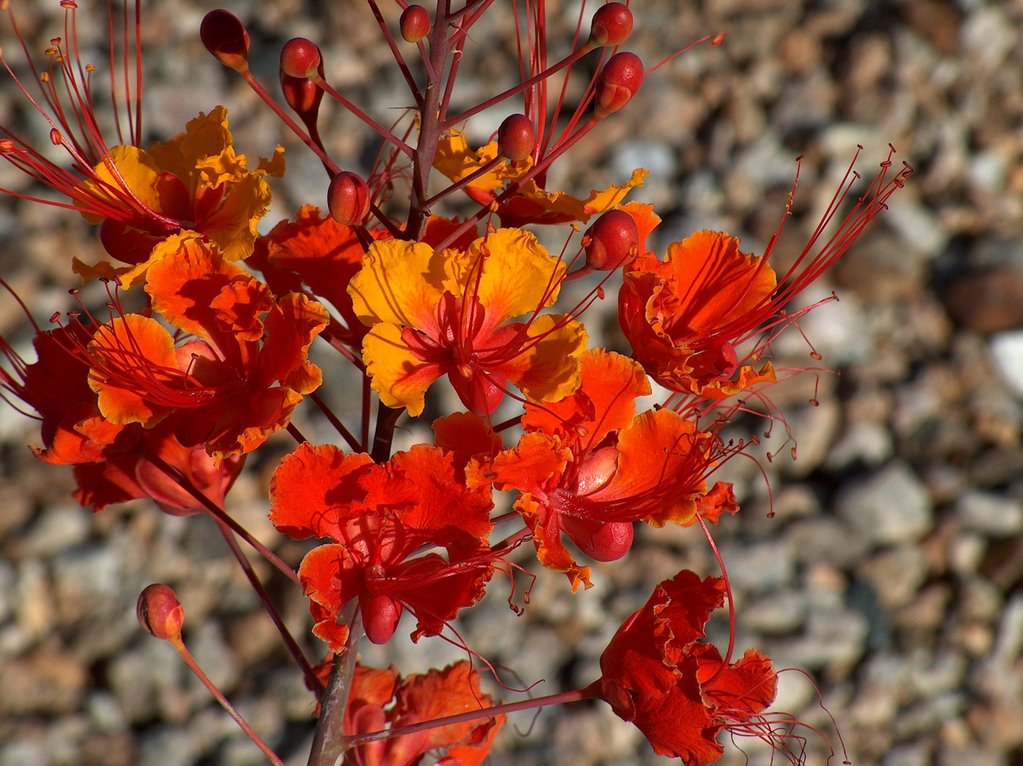
The plant is native to South and Central America, but it is very popular here. We call it the Mexican Bird of Paradise, but those who know better tell me it's the Red Bird of Paradise or the Caesalpinia pulcherrima. Yeah, you probably already knew that. Or not.

The desert here is full of the standard fare -- cactus, brush, desert trees and the like -- but we also have some beautiful blooms, and this Bird of Paradise is one of them. When they're done, they form seed pods, like so many of the plants here in the desert. These pods contain several seeds. They ripen, then dry out, and then, as I have just discovered, explode, scattering their seed ... quite literally.

I thought it was fascinating, a marvelous design. They are very happy here in the desert and grow prolifically. They bloom multiple times and add their beauty to the desert landscape more than once a year. And now I know ... the rest of the story.

Thursday, November 09, 2006

A Brief Picture Gallery

And now for something completely different ...

Just thought I'd share a few of my recent photos from home.

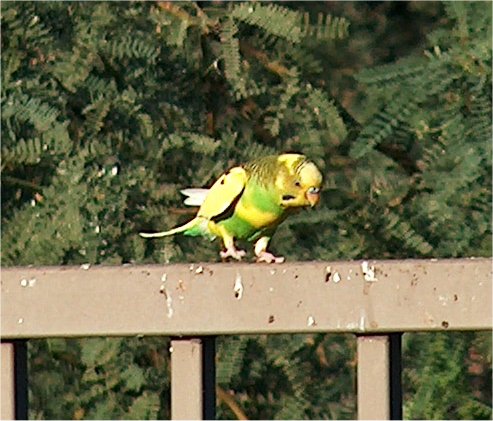
The dreaded "Sonoran Parakeet". Obviously not a wild bird, but it's the second such "out of state" visitor.

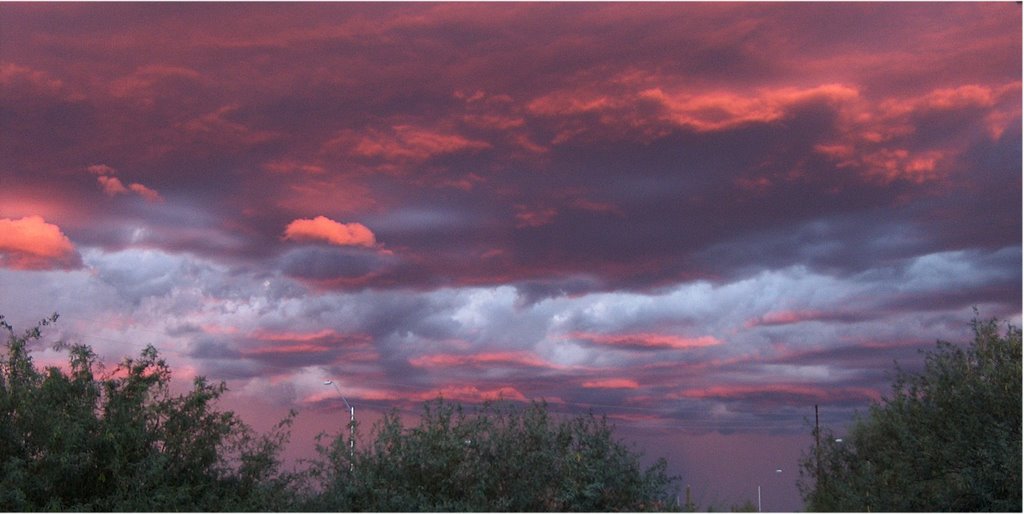
This was the stunning view at sunset from our backyard.

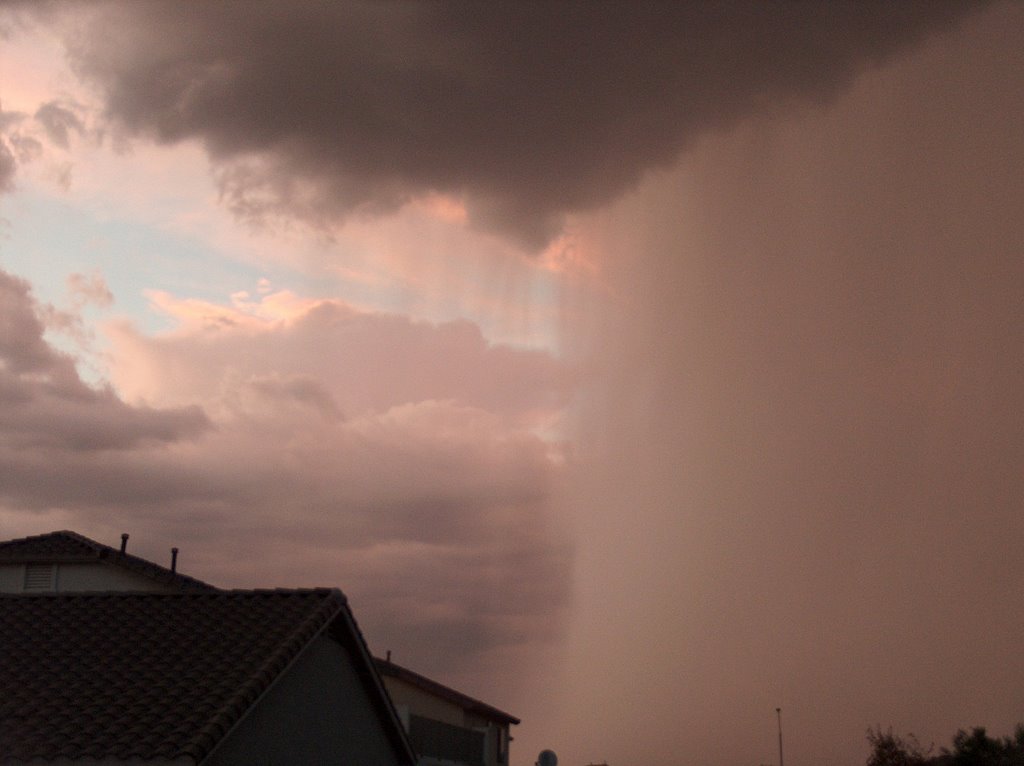
Witness the awesome Arizona monsoon. At irregular intervals without much predictability we'll get these massive downpours. Indeed, this one, just a couple miles north of us, never actually got to us.